
French Student Protests Spread Nationwide, Over 1000 Injured
—
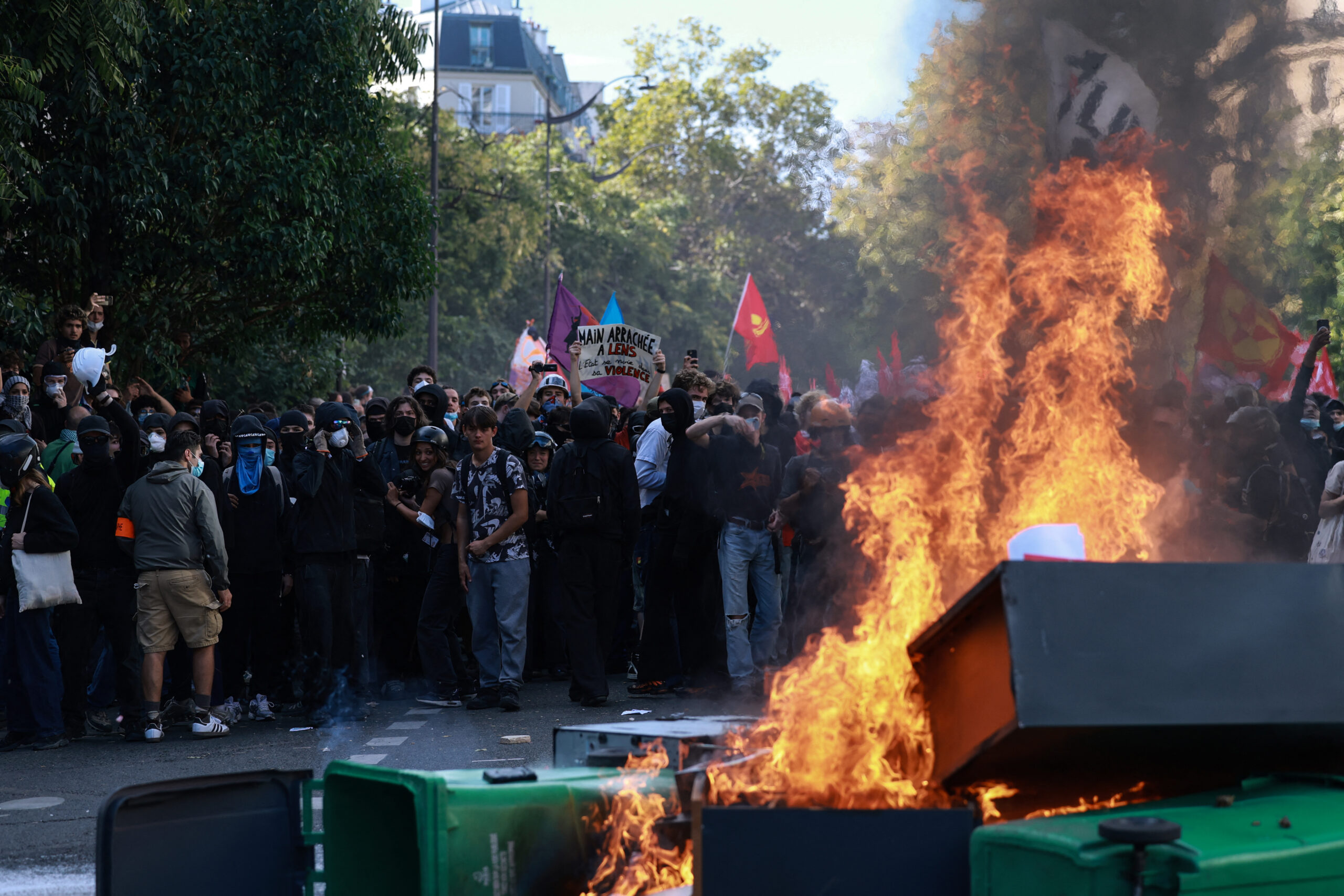
In France, student protests on Tuesday (October 6) have spread nationwide, with hundreds of high schools suspending classes and the teachers’ union joining the demonstrations. The protests have been marred by frequent violent incidents, with over 1000 people injured.
According to Le Figaro, on Tuesday, the French High School Students Union (USL), student councils, along with national education unions, the French General Confederation of Labour (CGT), and some left-wing political parties jointly called for protests and demonstrations nationwide.
In Paris, the march started around 2:30 pm from Place de la République, moving along Boulevard Voltaire in the 11th district of Paris, and culminated at Place de la Nation.
Some protesters carried banners with messages such as “Macron, shut up!,” “Culture = Future,” “Down with the police state,” and “ACAB” (a common anti-establishment and anti-police slogan in French social protests and graffiti).
Others chanted slogans like “We are all anti-fascists” and “Youth hates the National Front” repeatedly. Several leaders of left-wing political parties participated in the march and walked at the front.
As the protest continued at Place de la Nation, more intense clashes broke out. Protesters set fire to trash cans and threw fireworks and other objects at law enforcement personnel who responded with tear gas.
Around 300 “hostile individuals” confronted law enforcement at Place de la Nation, leading to confrontations.
By 5:00 pm, 12 individuals had been detained by the police, relating mainly to throwing objects at law enforcement and threatening them.
Currently, Place de la République in Paris is the largest protest site. Protesters could be seen standing on trucks, shouting slogans like “Give us funding for our high schools, give teachers money” amidst electronic music.
Earlier in the day, turmoil erupted in Strasbourg, with trams damaged; clashes also occurred in Rennes, Châteauroux, where police became targets of violence, and tensions flared in Toulouse.
As reported by Le Figaro, the scope of student protests is expanding continually, with approximately 256,000 people nationwide and around 56,000 in Paris participating. Organizers estimate the total number of participants to be as high as 450,000.
The Ministry of the Interior noted that student protest activities often involve violent clashes, leading to law enforcement’s use of tear gas in multiple instances. Nearly 500 individuals were arrested on Tuesday alone, adding to over 6500 arrests since September 28, with a majority being minors.
Data from the French Ministry of Education on Tuesday revealed that out of approximately 3700 high schools nationally, nearly 900 had either partially or entirely suspended classes.
On Tuesday at the National Assembly, French Prime Minister Sébastien Lecornu stated that the number of injured individuals has surpassed 1000 since the start of the protests, including 215 students. Additionally, 85 educational staff members, including 34 principals and vice principals, were injured, along with 715 police officers and gendarmes.
Interior Minister Laurent Nuñez remarked that in the vast majority of cases, law enforcement’s response has been appropriate, highlighting that some protest activities have escalated into riots, necessitating police intervention.
The student protests that began in mid-September in a disadvantaged suburb of Paris quickly spread to Marseille, Strasbourg, Rennes, and Lille.
Students are protesting against heavy course loads, teacher shortages, overcrowded classrooms, old school buildings, and inadequate adaptation to rising temperatures, demanding smaller class sizes, renovation of school buildings, abolishment of Parcoursup (the French university admission platform), and improved course scheduling.
The core protest slogan raised by students is “Our address should not determine our future.”
According to an opinion poll by Odoxa research institute, 62% of French people support the student actions.
Prime Minister Sébastien Lecornu acknowledged the validity of the issues raised by students at the National Assembly on Tuesday and condemned the violent acts surrounding the student protests.
Lecornu disclosed that he had written to ministers requesting each department to analyze the students’ five main demands and propose solutions by the end of October.
He announced that for the remainder of the week, certain high schools would suspend some classes to allow for “internal democratic time” discussions, and the Ministry of Education would launch an online platform for students to express their views, pledging to expedite the recruitment of teachers.
President Emmanuel Macron was briefed on the situation Tuesday evening at the Élysée Palace.
Nuñez urged law enforcement to remain highly flexible in handling situations, minimizing direct contact with protesters whenever possible.