
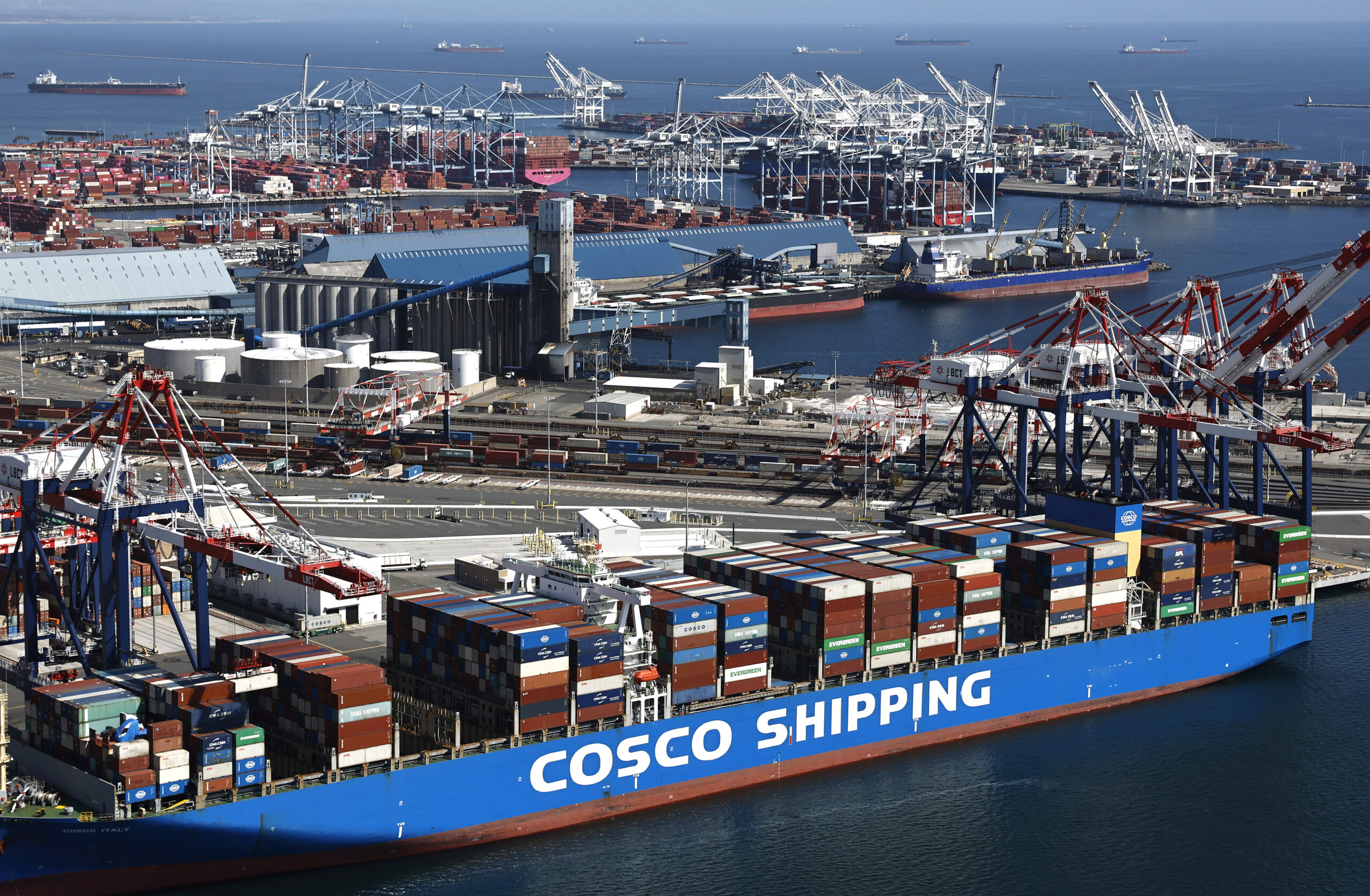
The United States had previously warned that the Chinese Communist Party’s “National Transportation Logistics Public Information Platform” (LOGINK) was a trade “secret weapon” that controlled the global flow of goods. However, recent reports indicate that the platform has been shut down and is embroiled in legal troubles, facing multiple lawsuits related to debt and leasing agreements.
According to a report by Reuters on October 5th, interviews with over 20 shipping industry professionals and officials, as well as examination of relevant legal documents, revealed that LOGINK’s international expansion has encountered major setbacks. The reasons behind the sudden financial and legal difficulties facing the platform remain unclear. However, the period during which it ceased operations coincides with the time when the U.S. issued warnings to allies and related organizations.
Public information indicates that LOGINK, formally known as the “National Transportation Logistics Public Information Platform,” originated approximately 20 years ago as a project of the Zhejiang provincial government in China. It aimed to integrate logistics data from ports, trucks, freight enterprises, and customs. With support from the central government and inclusion in the State Council’s “Mid- to Long-Term Development Plan for the Logistics Industry (2014-2020),” LOGINK was entrusted to the Chinese Ministry of Transportation, with overseas expansion becoming a focal point. In 2010, it established a cargo data sharing mechanism with Japan and South Korea, linking the logistics information platforms of the three countries; a few years later, LOGINK signed a contract with a logistics platform in Hong Kong, claiming at the time that it could access tracking data for over 90% of global vessels.
Analysts believe that for Beijing, LOGINK was a tool to enhance its global maritime influence. Shipping accounts for approximately 80% of global trade, with China and the U.S. continuing to compete for the infrastructure and key technologies supporting this industry. U.S. officials and security experts express concerns that Beijing might use the platform to obtain non-public information such as goods, transaction volume, and prices, to assist Chinese foreign trade companies in undercutting prices, taking business away from Western companies, and potentially tracking the distribution of U.S. military supplies via commercial shipping networks.
In April 2022, LOGINK joined a data sharing program led by the International Port Community Systems Association (IPCSA). A report by the U.S. Congress that year indicated that participation in this program would double the number of international ports collaborating with LOGINK. Several Republican lawmakers urged then-President Biden to take action and issue warnings, expressing fears that if LOGINK’s expansion was left unchecked, the Chinese Communist Party could control a vital artery of global trade. Subsequently, the U.S. Congress passed laws prohibiting the Department of Defense from signing transportation contracts with entities associated with LOGINK, and advised allies and partners against using the platform. Following this, LOGINK began to withdraw from international cooperation. Insiders stated that after LOGINK ceased paying IPCSA membership fees in 2024, its membership was terminated.
Recent reports indicate that the official website and operations of LOGINK are in distress, with the official website now closed (archived webpage last updated in June 2024), and the Wenzhou operations center facing multiple lawsuits related to contracts, labor disputes, and leasing agreements, leaving the premises deserted and quiet. A Reuters reporter who visited Wenzhou in September 2026 found no signs of activity at the site, with the office lights off, the reception area empty, computer cables unplugged, and desks covered in dust.
According to information from the Chinese corporate data platform “Qichacha,” the business entity behind the Wenzhou operations center has been involved in at least 39 court cases since January 2024, with a total exceeding 9 million Chinese yuan, including some related to labor disputes, and others suspected of involving unpaid utility fees.
Records show that in October 2025, a local subsidiary of China Mobile filed a lawsuit over a service contract dispute, with the court later ruling that LOGINK should pay the amount, but it is unclear whether the payment has been made. In May 2026, the state-owned developer of the park where the operations center is located also raised leasing disputes, indicating that the company may face eviction issues.
Aside from LOGINK, in recent years, the Chinese Communist Party has expanded internationally through initiatives such as the “Belt and Road,” infrastructure loans, commercial acquisitions by state-owned enterprises, and equity investments.
The operation rights of the Panama Canal ports are a prime example. The Panama Canal is a critical node for global shipping, with sovereignty over the canal belonging to Panama. However, aspects such as port operations, logistics coordination, and data statistics have seen deep involvement from capital controlled by the Chinese government.
The Wall Street Journal revealed in November 2022 that through Chinese enterprises and companies headquartered in Hong Kong, the Chinese Communist Party has gained lease rights or equity in 95 foreign port terminals worldwide, spanning locations including Belgium, Spain, Sri Lanka, Saudi Arabia, Germany, Peru, and even Israel.