
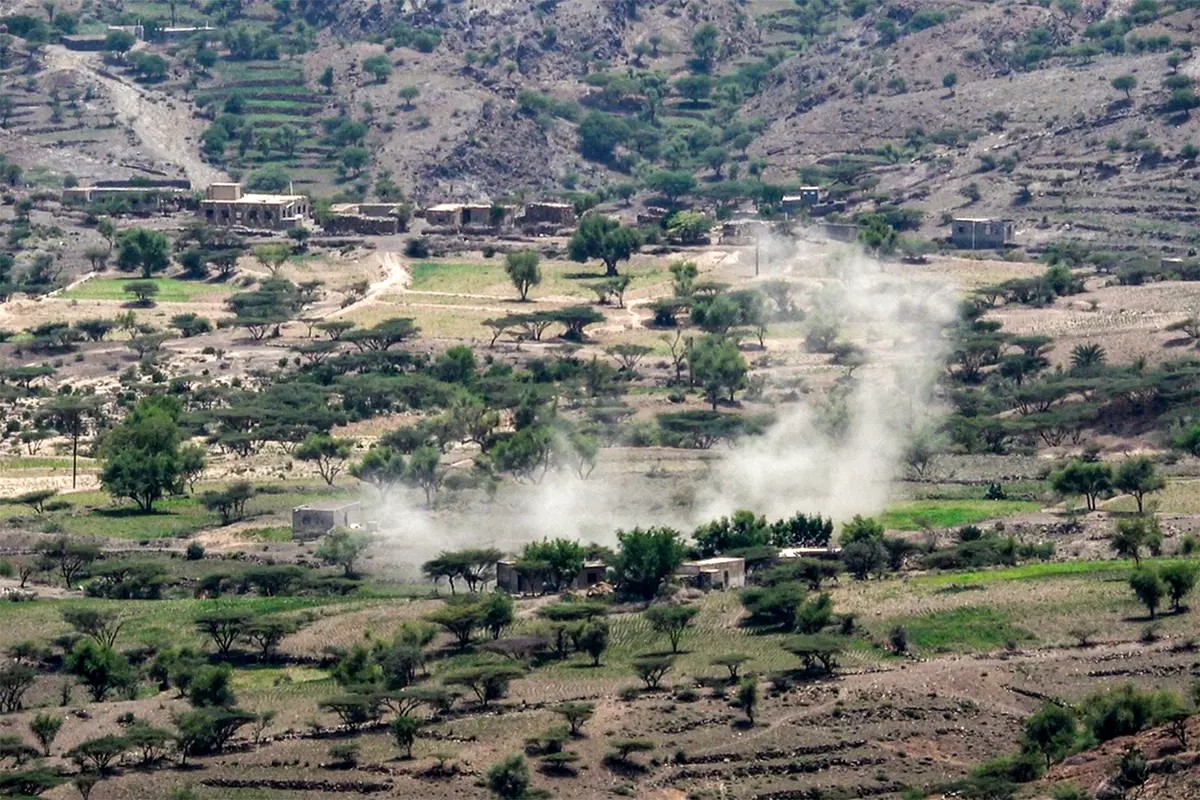
Yemeni government announced that the Yemeni government forces, with the support of Saudi Arabia, have launched a lightning offensive and recaptured areas from the Houthi armed forces along the coast of the Red Sea up to the city of Mocha. At the same time, Turkey, Pakistan, and Saudi Arabia have agreed to activate deterrent measures under a mutual defense treaty and swiftly deploy troops to Saudi Arabia.
According to four Yemeni government sources speaking to Reuters, with strong air support from Saudi Arabia, the Yemeni government forces arrived on the outskirts of Mocha on Monday night (October 5), and Houthi armed personnel are retreating towards higher ground. The Yemeni Defense Ministry stated that the city has been taken back by the government forces.
If this development is confirmed, it would weaken the Houthi armed control over the important oil route in the Red Sea. Houthi forces, backed by Iran, seized Mocha on September 10 and strengthened their effective control over the Bab el-Mandeb Strait in the following days, causing disruptions in the global energy markets for three to four weeks.
Mocha is located about 75 kilometers north of the Bab el-Mandeb Strait on the Red Sea coast of Yemen, serving as a major port for the northern approach to the strait. The Bab el-Mandeb Strait is a narrow waterway connecting the Red Sea to the Gulf of Aden and a crucial passage to the Suez Canal, making it one of the most important maritime chokepoints globally.
The Yemeni government forces are currently launching counteroffensives against the Houthi armed forces on multiple fronts. Yemeni President Rashad al-Alimi vowed on Sunday to fight until the country is liberated from the control of terrorist militias.
Saudi Arabia announced on Monday that they have carried out attacks on hundreds of Houthi targets to provide air cover for the ground forces in the Bab el-Mandeb Strait and Yemen.
The Saudi-led coalition against the Houthi armed forces also reported a naval military operation along the Red Sea coast of Yemen’s Hodeidah province on Monday night. The government forces had already recaptured key positions, including a makeshift airport in the Dhubab area, where the Houthi occupation last month had a significant impact on the energy markets.
After capturing Mocha, Houthi forces frequently launched attacks on southern Saudi cities, oil facilities, and military bases in response to Iran’s confrontation with the United States. Reportedly, these attacks also involved the Islamic holy sites of Mecca and Medina.
The recent developments between the Yemeni government forces and Saudi Arabia are yet to be independently verified. Meanwhile, the Houthi armed forces have made advances in other areas.
According to five Yemeni government military sources speaking to Reuters, the Houthi armed forces made significant progress near Taiz, the third-largest city in Yemen, capturing some mountainous terrain and besieging thousands of government forces stationed there. Taiz province has a population of half a million, with thousands of government soldiers stationed there.
Shortly after the Yemeni government forces launched counterattacks, Turkey, Pakistan, and Saudi Arabia issued a joint statement agreeing to activate deterrent measures under a mutual defense treaty and swiftly deploy troops to Saudi Arabia in response to attacks by the Houthi armed forces in Yemen.
The statement said, “All parties strongly condemn the attempted attacks on Mecca and Medina and the continuing attacks on cities, civilians, and economic facilities within Saudi Kingdom; all parties reiterate their firm opposition to any attacks or threats against the security and territorial integrity of the country.”
The defense and foreign ministers of the three countries held an emergency meeting in Riyadh on October 5 after issuing the above statement. It marks the first activation of the “Mecca Joint Defense Agreement” signed on August 7. According to the treaty, an attack on any of the three countries will be considered an attack on all.
Saudi Arabia’s Defense Minister Khalid bin Salman posted on social media, “The committee agreed to activate collective deterrent measures within the alliance framework to address these attacks and all those responsible.”
In a separate joint statement released by the Pakistani Foreign Ministry, the three countries will provide Saudi Arabia with agreed military forces and capabilities, ensuring their rapid deployment.
According to the 2026 Global Firepower Index, the three member countries of this alliance together have nearly 1.4 million active-duty personnel, approximately 3,400 military aircraft, 6,000 tanks, and over 340 navy vessels.