
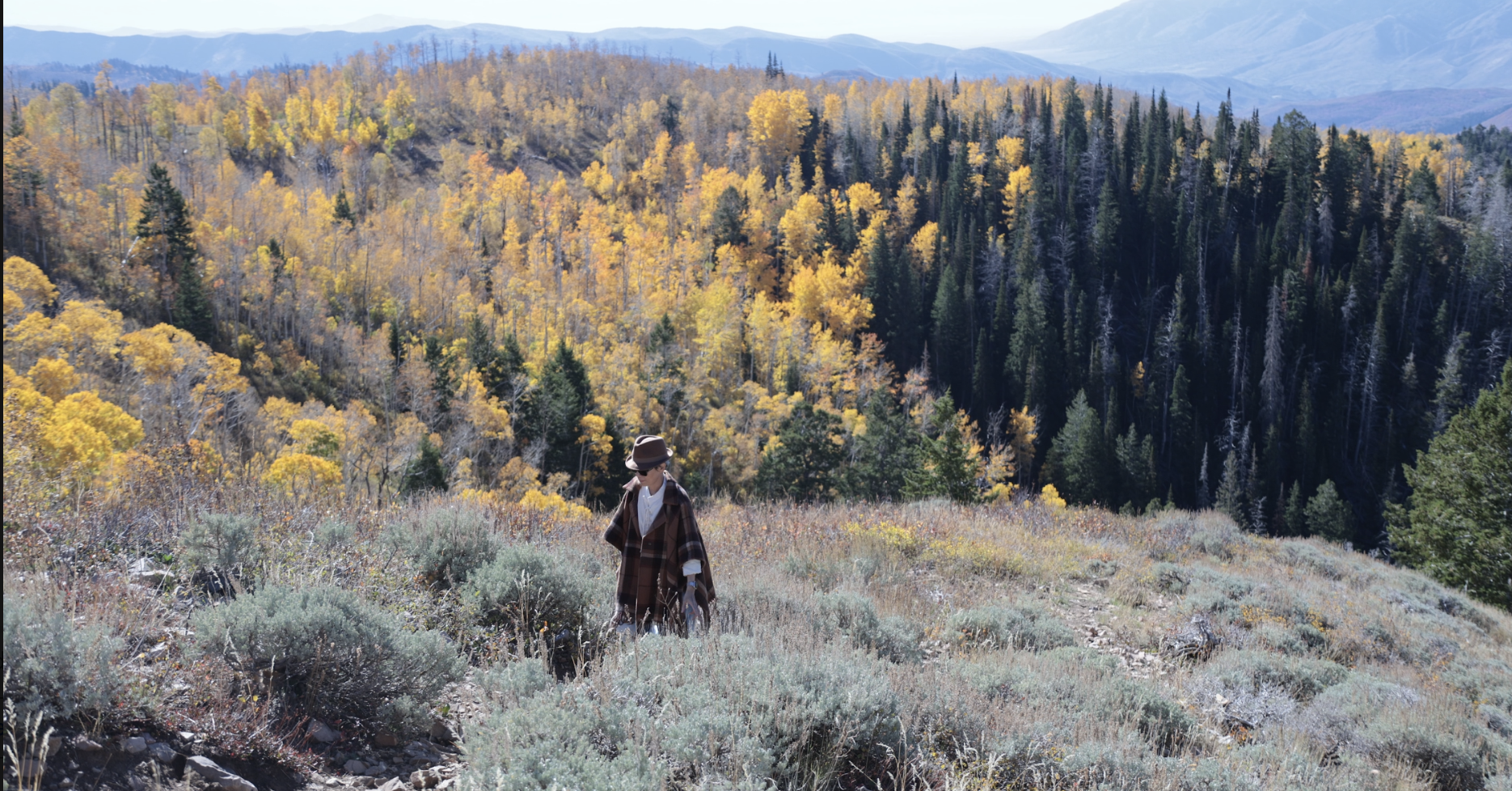
In the state of Utah in October, autumn descends from the mountain peaks all the way down to the valley.
Driving our Wagoneer, we ascend the Nebo Loop scenic byway, reaching an elevation of over nine thousand feet. The aspen trees cover the mountainside, turning a dazzling golden hue in the autumn breeze, interspersed with fiery red maples. It is the most brilliant yet fleeting season of the year. Our family, accompanied by a little dog named Miracle, ventures southward into this vast wilderness.
As we descend in altitude, the golden autumn leaves gradually give way to dark red Jurassic sandstone. Entering Cathedral Valley and its dome-shaped reefs, the car windows reveal towering vertical cliffs hundreds of feet high. Millennia of weathering and water erosion have sculpted the earth into solemn peaks.
In the morning past nine, we drive into Cathedral Valley. In the open wilderness, two towering reddish-brown rocks suddenly rise up, like two stone monuments, known as the Temple of the Sun and the Temple of the Moon. The morning sunlight perfectly illuminates the rock walls, a spectacle that is difficult to put into words.
Upon our arrival, only one car is parked there, and it soon drives off. We find ourselves alone in the vast expanse, taking a stroll nearby to experience the ancient solitude and profundity that transcends billions of years.
Near the Temple of the Sun and the Moon, there is a spot made of crystallized selenite called Glass Mountain. Despite sounding grand, it turns out to be a small hill. When the sunlight hits, the crystals on the slope shimmer like glass and marble.
My husband urged me to climb up for a photo, and our daughter eagerly wanted to join. However, our son spoke up: “Don’t climb. Even if there are no signs prohibiting it, we shouldn’t. Many things disappear from the Earth due to human actions. Some things may seem unimportant, but it’s not good for the environment and for future generations.”
So, we stood at the base of the slope, gazing at the glistening crystals, none of us venturing further up.
In this area, there are several unmarked spots on the map, with even more challenging paths to navigate. Some resemble the surface of the moon, some like Mars, making it hard to believe one is still on Earth. Those days, it felt like we truly took a trip away from our planet.
On a canyon trail near Hanksville, towering cliffs on both sides, sculpted by years of wind erosion and water cutting, display layers of red and white patterns resembling bacon. Our son particularly admires the ambiance of this place.
Nature’s magnificent creations are entrancing, yet hold unexpected dangers.
On our way back, my husband, suffering from diabetes, suddenly experienced low blood sugar, rapidly draining his energy. Unfortunately, due to our oversight, we had no sweet snacks with us. In the remote canyon with no signs of civilization, a family of three approached. The child seemed quite young. Upon hearing about the situation, the father immediately stopped, pulled out a mango pastry from his backpack, and without hesitation handed it over, defusing the crisis.
Little did we know, the real scare awaited us on the return journey.
As we headed back, our daughter walked upfront, holding her blue umbrella, while I followed with Miracle trailing behind. The little one seemed exhausted, slowing down gradually. Concerned about a possible thorn in her foot, I knelt down to check. When I lifted my head back up, the blue umbrella was no longer in sight.
Initially unperturbed, thinking she would walk back to the parking lot on her own, it wasn’t until my husband, son, and I returned with our dog to the parking lot, searching frantically, but she was nowhere to be found. In the desolate wilderness with no cellphone signal, the sudden panic and helplessness were indescribable.
It was around 2 p.m., the sun scorching hot, the desert temperature at least above 80 degrees Fahrenheit (about 27 degrees Celsius). Our daughter was overdressed for the occasion. My immediate worry was, had she gotten lost? Was she suffering from heatstroke?
My son and I swiftly retraced our steps. Each encounter with people was met with the same question: “Have you seen a girl with a blue umbrella?” Every response in the negative sank my heart a bit deeper. While walking, I called out her name, the sound echoing off the rock formations, yet no response.
Midway, we encountered a group of young climbers descending the mountain. I posed the question, receiving a similar response. The first words they uttered were, “Do you need water?” Perhaps noticing my flushed face and swollen neck. After learning our daughter’s name, they joined in shouting her name. Several individuals spread out on the trail, searching.
A group of strangers, in the wilderness, shouting the name of someone they had never seen before.
In the end, our son found our daughter nearby. She had taken a wrong path, circling back to the same incorrect spot, hiding under a rock, looking panicked. Upon seeing her brother, she burst into tears.
At that moment, my entire body went numb, even my nose and lips.
If the red rock canyons symbolize nature’s sternness, then hidden within the depths of Capitol Reef lies the Fruita orchard, narrating the resilience of the human spirit.
Amidst desolate badlands and eroded riverbeds in the vicinity, suddenly, there appears a vibrant oasis.
In the late 19th century, Mormon pioneers arrived at this barren land, implementing irrigation and planting apple and peach trees. Over a hundred years later, the orchard still stands. Stepping on the soft soil, plucking apples from the trees, biting into them, crisp and sweet, our daughter compared the moment to Sun Wukong stealing peaches of longevity, feeling a bit intoxicated.
There was no attendant at the orchard’s payment station; it operated on an honor system. Our son insisted we leave extra change.
On the return journey, we opted not to take a shortcut but decided to drive the Nebo Loop once again, curious to witness how the mountains had transformed in these few days.
However, after three to four days, the colors of the forest had completely changed. The once-yellowing aspen trees now displayed vast swaths of fiery red and deep brown, hues so rich they seemed unblendable.
It being the weekend, there were more cars and autumn admirers on the road compared to our initial journey. Having spent several days in the desolate desert with no signal and no one around, returning to the bustling traffic evoked a sensation of returning from another planet to humanity, feeling strangely comforting.
In the back seat, both our daughter and Miracle were exhausted. The Wagoneer continued its journey homeward, through hills adorned in red and gold, signaling the end of our memorable trip.