
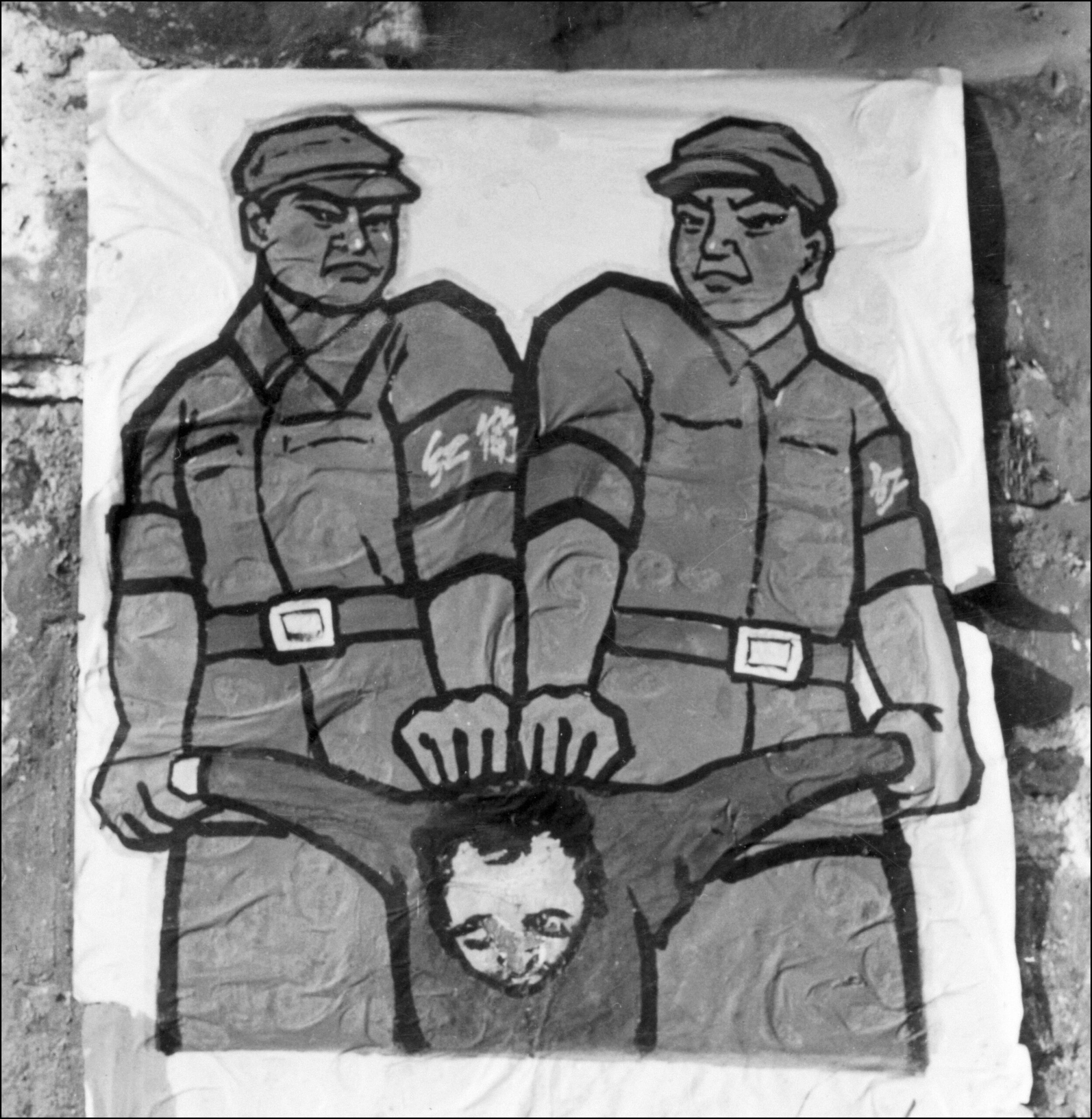
October 6 is a significant commemorative day, but in China, there won’t be any grand events. This day marks the 50th anniversary of the official end of the Cultural Revolution. The Economist believes that the Chinese Communist Party’s silence on this ten-year calamity cannot make this period of history disappear; instead, it has become a potential force leading to its self-destruction.
On October 6, 1976, then Chinese Communist Party Chairman Hua Guofeng, along with Ye Jianying, Wang Dongxing, and others took action to isolate and review Jiang Qing, Zhang Chunqiao, Yao Wenyuan, and Wang Hongwen (known as the “Gang of Four”), marking the practical end of the turmoil of the Cultural Revolution. However, the Communist Party is extremely unwilling to reflect on past mistakes.
Last month, a columnist from The Economist visited a museum in the mountains outside Shantou, which used to be the only place in China to showcase the terrifying history of the Cultural Revolution.
In 1966, shortly after Mao Zedong launched this political movement in Beijing, extreme violence spread like a virus across the country, reaching Shantou, nearly 2,000 kilometers away.
A deputy mayor in that area had been persecuted during those insane years. Upon learning that many victims of the Cultural Revolution were buried in the mountains, he transformed the area into a museum and officially opened it in 2005.
Using private donations, the deputy mayor installed plaques inside the museum with the names of thousands of victims engraved on them. He displayed records of the tumultuous events at that time, as well as photos of people angrily denouncing the so-called “enemies of the people.”
The museum also presented the official conclusion on the Cultural Revolution: “It was an internal disturbance initiated by leaders, exploited by counterrevolutionary cliques, causing serious disasters to the Party, the country, and all ethnic groups.”
The Economist journalist, walking along the mountain road on a rainy day, reached the former location of the museum. The Communist government had closed it in 2016 under the guise of “renovation.”
For some time afterwards, visitors could still find traces of commemorative facilities, including some hastily covered plaques. Now, all these traces have completely disappeared.
The cylindrical tower-like building that once housed historical relics is now empty and locked. The inscriptions on stone tablets have been smoothed over with cement or covered in yellow paint. The graveyard from that era no longer bears any markings; it has been replaced by a site promoting China’s “12 core socialist values.” These values were slogans adopted by the Communist government when Xi Jinping gradually came to power.
In the past, plainclothes police would monitor and even harass people who came here, including foreign journalists coming for interviews and relatives bravely coming to mourn their loved ones. These families used to gather here every summer.
Today, this memorial site has been completely erased, and journalists can move around freely without any obstacles.
A nearby elderly man resting told the journalist, “People of our generation know exactly what happened. We experienced it firsthand. There were violent clashes between different factions in Shantou back then.”
“Young people don’t know, and the leaders don’t want them to know,” he said.
Covering up history is not new in China. For example, the Communist Party has been making efforts to erase memories of the 1989 Tiananmen Square protests.
However, The Economist believes that China’s silence on the Cultural Revolution is becoming increasingly “deafening.”
In the late 1970s, Deng Xiaoping allowed people to reflect on the trauma they had endured, giving rise to the so-called “scar literature.” However, shortly after, Deng Xiaoping tried to put an end to all that. In 1981, the Communist Party passed a historical resolution attempting to set aside that period of history.
Nevertheless, during Deng Xiaoping’s era and beyond, people continued to revisit their experiences, discussing this national tragedy. These discussions appeared in some outspoken publications, books, films, and commemorative sites like the one in Shantou.
Although these efforts faced resistance, there were still cracks that allowed these voices to barely exist.
However, over the past 15 years, the Communist Party has gradually closed off most of these spaces. Relevant publications have been shut down, some books that were once published by official Chinese publishers have been banned or restricted, and some film directors have been under constant surveillance.
In July of this year, a researcher using a pseudonym wrote on the overseas website “China Unofficial Archives,” stating that by 2026, the Communist Party’s control over information related to the Cultural Revolution had reached “unprecedented levels.”
In universities, some historians still mention that decade in their classes, but no one dares to question the official brief and superficial historical conclusion.
The Economist points out that China’s silence transcends different political stances. In 2016, the 50th anniversary of the Cultural Revolution’s beginning, people of various political beliefs in Chinese society began discussions on this period of history on the internet and in publications.
Liberals hope to have a more thorough reflection on the Cultural Revolution to prevent such madness from happening again, while leftists advocate for a reevaluation of Mao Zedong, believing that he had an impact on the rigid Communist system.
But as this year’s 50th anniversary of the end of the Cultural Revolution approaches, criticism or praise has become unacceptable.
In 2021, the Communist Party passed a new historical resolution that effectively replaced the 1981 resolution. The new resolution reduced the analysis of the Cultural Revolution to a short passage.
If Deng Xiaoping tried to shelve this debate, Xi Jinping seems to have gone further in trying to completely seal it off.
For Xi Jinping, The Economist believes that this silence is a victory; he seems to have suppressed the “historical nihilism” he warned of at the beginning of his rule, which refers to excessive criticism of Mao Zedong’s reign that could undermine the legitimacy of the current Communist regime.
However, there is an irony here. The impact of historical events that happened 50 years ago tends to gradually diminish if these events are fully and openly discussed. This is the case with the fading influence of the Vietnam War in the United States.
On the contrary, if a country refuses to have such discussions, anger over past atrocities may flare up again. Spain is a prime example. The history of Francisco Franco’s authoritarian rule has become a political controversy in Spain years later.
In China, the generation that once served as Red Guards is aging. The Economist believes that if the Cultural Revolution receives a detailed historical scrutiny, it may gradually turn into a strange and terrifying but distant history for the next generation growing up.
However, because this history is shrouded in silence, it retains a latent power. One day in the future, discussions about the Cultural Revolution may resurface, providing new arguments for critics of the Communist regime.
The Economist emphasizes that this criticism may no longer be directed solely at the mistakes of Mao Zedong’s era but may extend further to the entire political system. This is why the Cultural Revolution continues to trouble not only the diminishing number of surviving victims but also the Communist Party itself.