
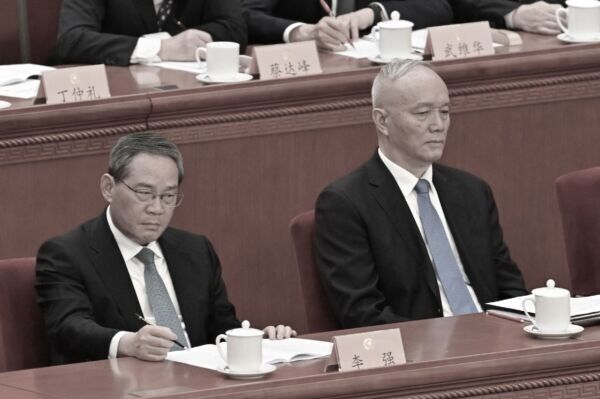
In recent times, there have been incidents in various parts of the world where individuals are believed to have faced cross-border crackdowns by the Chinese Communist Party (CCP) due to “insulting Xi” (insulting Xi Jinping). Some analysis suggests that the top CCP leadership, led by Cai Qi, has secretly initiated a cross-border anti-“Xi insult” operation. The CCP authorities rely on force to maintain Xi’s image, indicating that the regime is facing an unprecedented crisis.
Taiwan recently disclosed a case involving cross-border repression by the CCP. Taiwanese comedian Huang Yihao was scheduled to perform a satire mocking Xi Jinping at a comedy club in Taipei in May this year but had to cancel the show due to threats of oil and feces being thrown at him.
An investigation by Taiwanese prosecutors revealed that the 33-year-old Taiwanese man, Liu Shengjie, acting under the instructions of unidentified CCP individuals, instigated the 35-year-old Taiwanese man, Guo Weihao, to carry out the paint-splashing intimidation. This incident essentially reflects the CCP’s “cross-border repression,” damaging freedom of speech in Taiwan.
Previously, Huang Yihao had mocked in his comedy: “Ruling the country is like flipping a pancake, with underlings like the wolf warriors and pink soldiers. Backing up while stepping on the gas, the number one fool Xi Jinping.” (Click to watch the comedy sketch
video
)
In South Korea’s Gyeonggi Province, a Chinese restaurant named “Xi Jinping” was invaded by four Chinese individuals on September 24th who sprayed paint and possibly pesticide substance on the ingredients. These individuals flew back to Shanghai and Yantai in China from Incheon International Airport the same day. South Korean courts have issued arrest warrants against the four individuals.
Furthermore, during Xi Jinping’s visit to the United States from September 23rd to 25th, he faced large-scale protests. Props such as Winnie the Pooh, a nude “Xi King” playing card, and even street violence against Xi Jinping dolls were visible at the protests. The protest rallies were disrupted by pro-CCP individuals, suspected to have direct involvement of CCP agents, leading to violent acts like assaults and pepper spray against the protesters.
Independent commentator Du Zheng, in an article published on Taiwan’s media outlet “Upmedia” on October 5th, listed these incidents, suggesting that the harassment of the Korean restaurant, with the ingredients sprayed with pesticide-like substance, carries the nature of terrorism. The harassment of this restaurant is likely because the CCP authorities deemed the restaurant name as “insulting Xi,” and these individuals came on a mission.
Du Zheng pointed out that these events occurred within the past few months and may be related to a secretive ongoing international anti-“Xi insult” operation.
Du Zheng revealed that a CCP national security personnel, while studying in Hong Kong last year, admitted to monitoring students and teachers who criticize or insult national leaders.
Du Zheng believes that this trend of targeting anti-“Xi insult” externally, both domestically and globally, began with Xi Jinping’s allies taking key positions after the 20th CCP Congress, including Wang Xiaohong of the Fujian faction as the Minister of Public Security and Chen Yixin of the Zhejiang faction as the Minister of State Security. The espionage activities of the state security, public security, and newly established Central Social Affairs Department are all under the control of the CCP Politburo Standing Committee member Cai Qi. The internal and external “anti-Xi insult” activities are being secretly arranged by Cai Qi. The recent wave of domestic and international actions against “Xi insult” may be related to ensuring Xi Jinping’s smooth re-election at the upcoming 21st CCP Congress next year.
The article also mentioned that Xi Jinping has the most nicknames in history, all with negative connotations, such as Xi Zedong, Xi Hitler, Xi Pontiff, Master of Acceleration, Yuan Er, Mao Er, Zero Clearing Sect, Elementary School Student, King of Trade and Liberal Attire, Xi Baozi, Rotten Tail Emperor, Two Hundred Catties, Winnie, Pig Head, and many more. The emergence of these nicknames reflects public opinion for obvious reasons. Xi Jinping clearly understands that his actions are not winning favor with the people.
In recent years, criticizing Xi has become a trend in official circles, with many officials being accused of “false accusations against central authorities.” The CCP even revised its party discipline, prohibiting “vilifying the image of the party and country, or slandering and defaming the party and national leaders.”
Du Zheng stated that in recent years, Xi Jinping has not only angered officials but also various segments of the population; he has not only provoked domestic displeasure but also made enemies globally, especially among those who have fled abroad and particularly enjoy “insulting Xi.” Hence, the CCP authorities have initiated cross-border crackdowns.
It has long been revealed by insiders that criticizing Xi is more sensitive than criticizing the CCP itself.
In January 2024, dissident Chen Siming, who is now in exile in Canada, told “Epoch Times,” “In recent years, criticizing the CCP or government officials within the country was not a big deal, but criticizing Xi Jinping would trigger an immediate and strong reaction from the authorities. They would come for me right away.”
In 2024, an anonymous source disclosed to “Epoch Times” that there is a special group in Beijing dedicated to protecting Xi Jinping’s image, though it is unclear if it is at the central or local level.
Chinese-American scholar Li Hengqing told “Epoch Times” that safeguarding Xi Jinping’s image has indeed become one of the core tasks of senior CCP officials. Since Xi Jinping came to power, he emphasized “two maintenances,” which focus on safeguarding Xi Jinping. “If your image is good, do you still need to be maintained? You don’t need to.”
Former Beijing lawyer Lai Jianping stated that all modern totalitarian rulers need to embellish themselves, establish their legitimacy, and suppress anyone who tarnishes their image. Therefore, they require a group of court eunuch-like personnel specifically for this task. This illustrates that the CCP regime is facing an unprecedented crisis.