
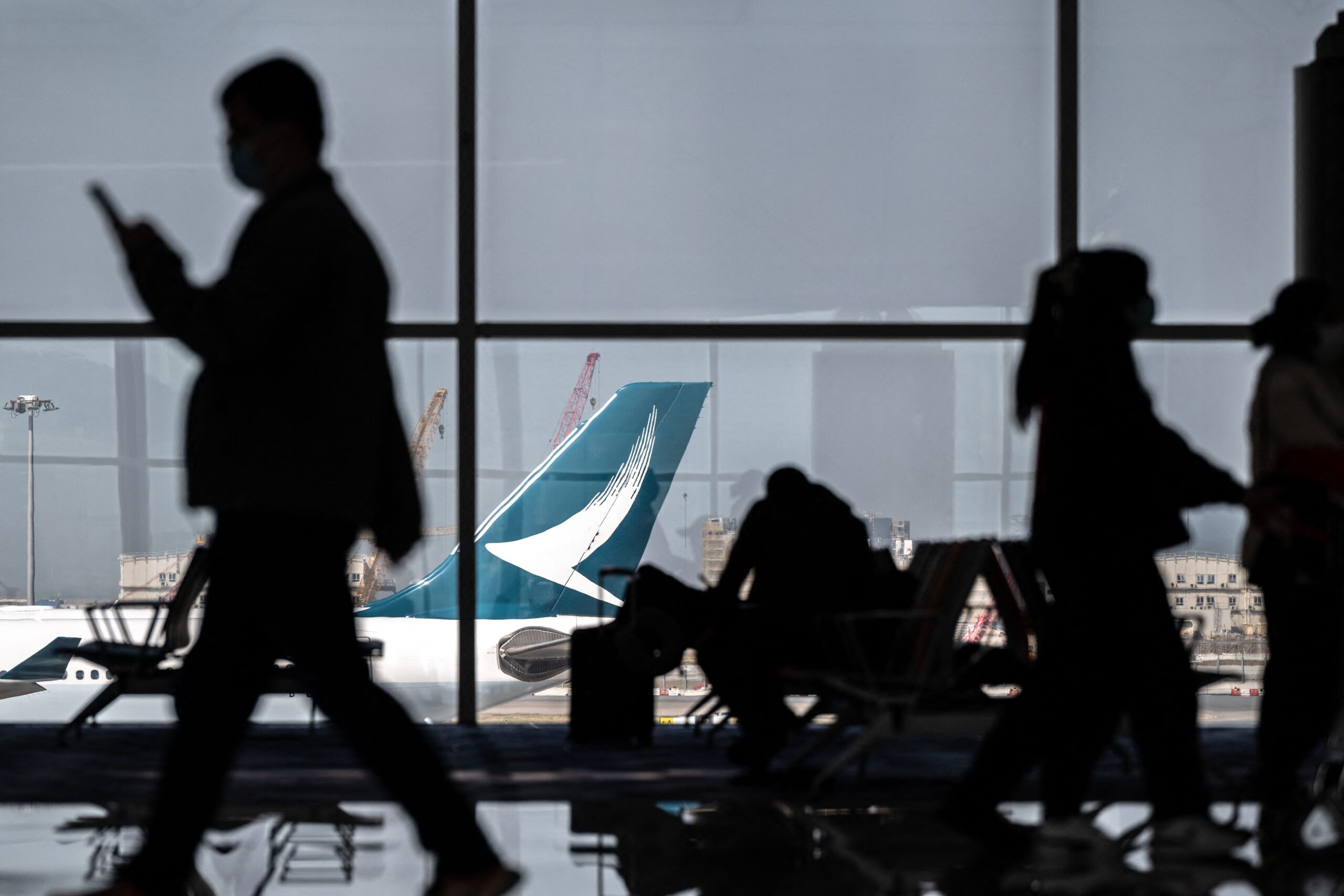
The new entry and exit regulations announced by the Chinese State Council have not yet taken effect, but some passengers have revealed that Hong Kong Airport recently implemented a secondary screening for passengers arriving from mainland China and transferring to the United States. After completing transfer procedures and reaching the boarding gate, passengers are required to queue for document checks and questioning.
One passenger who traveled from Shanghai to Los Angeles via Hong Kong recently released a video stating that after his family of four completed the transfer procedures, they saw passengers bound for Los Angeles lining up for inspection outside the boarding gate. Personnel enclosed the waiting area with metal barriers, and passengers had to undergo questioning before being allowed to enter.
The passenger mentioned that the personnel checked their passports and boarding passes, and asked where they arrived from in Hong Kong. He noted that such questions related to the length of stay are typically asked by U.S. immigration officials upon entry, but this time the questioning occurred before boarding at Hong Kong Airport.
In addition to inquiring if baggage had been out of sight or if electronic devices had been repaired, the personnel also asked passengers where they arrived from in mainland China and how long they had stayed there.
A Hong Kong resident, Ms. Leung, told reporters that when she flew to Los Angeles from Hong Kong in late July, she did not encounter such checks. She expressed confusion, saying, “When I flew to Los Angeles at the end of July, I didn’t experience this at the boarding gate. It seems to be a new measure targeting mainland Chinese, I don’t understand why they need to inspect mainland Chinese in this way.”
The passenger also mentioned that he had not encountered such procedures when traveling from Hong Kong to the U.S. in the past, with other passengers at the scene also questioning the sudden increase in checks. The experiences of the passenger and Ms. Leung, who were on different airlines, flights, and departure dates, only illustrate the differences in procedures they encountered.
When the passenger asked the inspection personnel on the spot whether such special questioning was now required from Hong Kong to the U.S., the personnel responded, “Yes, ask him.”
The passenger turned to find the person the personnel referred to and was told, “You ask him, I can’t say who he is.”
He replied, “Then I understand immediately.” He then asked his daughter if she knew who “he” was, to which she responded, “I know.”
Immigration consultant Zhang Le, based in Australia, told reporters that the Hong Kong inspection personnel did not explain the new inspection procedures as airline requirements, nor did they attribute the responsibility to the U.S. Zhang believes that when the staff stated, “You ask him,” “I can’t say who he is,” the “him” refers to Chinese leader Xi Jinping, indicating that the on-site personnel knew where the relevant instructions or notifications came from but were unwilling to openly name names.
In the authoritarian environment of the Chinese Communist Party, when avoiding naming names, people often use “he” to refer to Chinese leader Xi Jinping. The dialogue where the inspection personnel did not directly state who “he” was, but rather implied it politically, was significant. The uniform setting of barriers on-site and the systematic checking and questioning by staff clearly indicate that this was not a random decision.
Political commentator Liao Chenkai, based in Japan, told reporters that while the new Chinese entry and exit regulations have not officially taken effect, control over personnel’s cross-border movements has already reached Hong Kong.
Liao believes that Hong Kong is being transformed by Beijing into a part of the mainland’s exit control system, gradually eroding its previous institutional advantages as an international free port, international transfer center, and gateway connecting with the outside world, as the Chinese national security system systematically takes over.
He expressed that China is transferring its system of surveillance, review, and restriction of personnel movements to Hong Kong. The city’s former judicial independence, free movement of people, and its status as an international financial center are gradually being dismantled. Quoting Ni Kuang, he stated that to destroy a city, one must eliminate all its advantages. Hong Kong grew from a small fishing village into an international metropolis based on the rule of law, freedom, and integration with the international community, but China is currently dismantling these advantages one by one, reverting Hong Kong back to its original state. Hong Kong is no longer the Hong Kong of the past but is turning into the forefront gateway for Chinese control of personnel, information, and capital flows.