
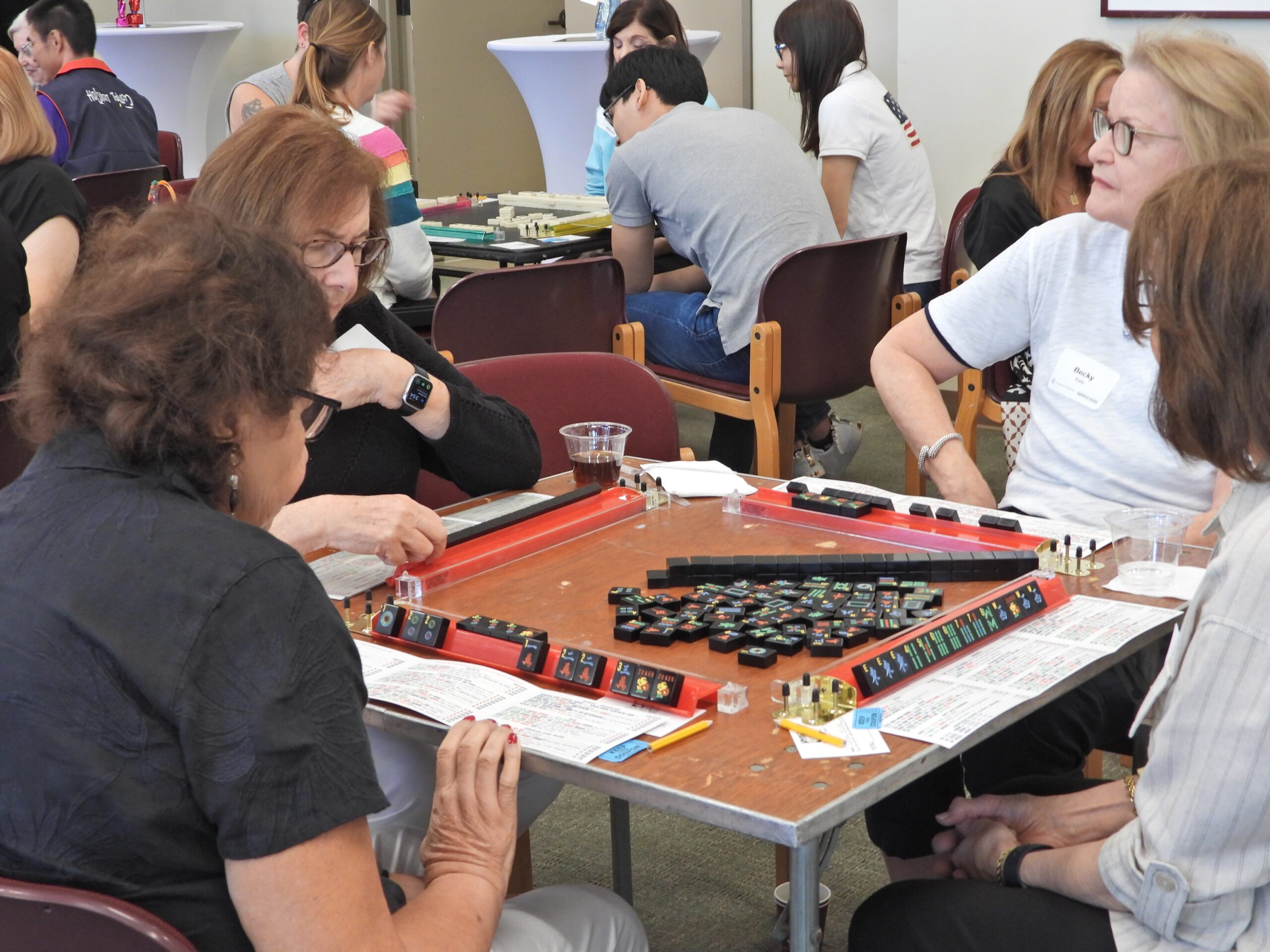
Mahjong, a Chinese game with hundreds of years of history, has always been beloved by the elderly and Asian cultures and has now attracted fans from different backgrounds.
As a sport, Mahjong is becoming increasingly popular in Canada. According to an email sent by the online platform Eventbrite to Canadian media CTV on August 6, the number of Mahjong-related events in Canada in 2025 increased by 5% compared to the previous year, with a growth of over 70% in the number of participants.
Mahjong is a four-player tile-based game originating from China, popular in Chinese society and East Asia, blending strategy, probability, memory, and psychological tactics.
Even celebrities are now captivated by playing Mahjong. Former supermodel Cindy Crawford has become a Mahjong enthusiast, and the Duchess of Sussex Meghan Markle recently celebrated her 45th birthday with a Mahjong-themed cake. She also shared her experience of playing Mahjong with a group of friends, known as the “Mahjong Squad,” on her Netflix show.
Sandy Gunn, co-founder of Lucky Tile based in Vancouver, mentioned that since April 2025, she has seen growing interest in the game through the events and courses organized by the company.
Gunn noted that within a short period, there has been an increase in participation across different generations, with about half being of Asian descent and the rest from other ethnicities. She mentioned that around 1,000 people have attended their courses, with the frequency of courses increasing from once a month to about five times a month, often selling out within a week of registration opening.
“I think people enjoy playing games and want to gather together.” The 55-year-old leadership coach told CTV that her clients would bring their partners, children, parents, or grandparents along.
Though Mahjong’s history is somewhat controversial, a report by Stanford University in 2013 stated that in the 1920s, American immigrants and visitors learned Mahjong from China and brought it back to the United States.
There are approximately 40 different types of Mahjong, each with distinct rules and scoring methods. Gunn mentioned that they teach Hong Kong-style Mahjong, but regardless of the type, it can attract those looking to temporarily escape the digital world and provide an opportunity for face-to-face interaction with others, especially post-COVID-19.
Mahjong’s English name “Mahjong” roughly translates from the Chinese “麻雀” (máquè), meaning sparrow, as the sound of Mahjong tiles resembles the chirping of sparrows.
Gene Mah, chairman of the Edmonton Mahjong Association, noted that they started offering Mahjong game services about four years ago due to the demand from young people in their twenties and thirties.
“Since then, the Mahjong movement has rapidly revived nationwide… from Vancouver all the way to Montreal,” the 65-year-old IT manager told CTV.
Mah mentioned that around 50 players join his Mahjong group for the bi-weekly “Mahjong Night” held on Fridays. They play Hong Kong-style Mahjong, with one-fourth of the players being non-Asian.
Cyrus Fu, the president of the Mahjong Club at the University of British Columbia (UBC), mentioned that he started learning to play Mahjong on an iPad when he was seven years old, sparking his interest in the game.
“I used to visit China often as a child,” the 19-year-old pharmacy student told CTV, “and my grandmother would play Mahjong with her friends in her apartment, and I would sit beside her and watch.”
Fu mentioned that he also enjoys using his native languages Cantonese and Mandarin to communicate with others to understand his culture better.
Gunn expressed her desire to learn to play the instrument (the sound of Mahjong tiles clicking together akin to music) earlier, as she grew up watching her mother play.
“I can say with certainty that I fell in love with it immediately.” She said that the tactile experience of Mahjong is another reason she is so engrossed in it.
She added, “I enjoy being with everyone, having engaging conversations, deep talks, or just being silent, all of which can happen over a few hours around a table.”