
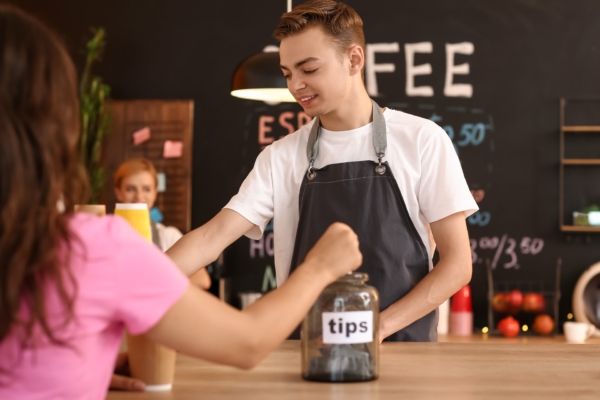
In recent years, many coffee shops and takeout establishments in the United States have adopted electronic payment systems that automatically prompt customers to choose between tipping options of 15%, 20%, or 25% when making a payment, which has caused pressure on many consumers. Experts suggest that in cases where customers only stand at the counter to order or pick up their coffee without receiving table service, tipping is usually not mandatory, and choosing “No Tip” should not be considered impolite.
Etiquette expert Charlotte Hilton Andersen pointed out that traditionally, tips were mainly intended for restaurant servers, delivery drivers, and those in service-related fields like beauty services who provide extra assistance. Whether to tip during counter transactions depends on personal discretion. However, in small coffee shops or when facing staff who regularly serve you, or if the staff provided extra service (such as accommodating special requests or complicated orders), tipping can be a way to show support and appreciation.
Using her own experience buying shaved ice in the United States as an example, Andersen recounted being presented with tipping options of 18%, 20%, or 25% during checkout. She found herself torn between questioning the need to tip generously for just a cup of shaved ice and considering the hard work of the staff who might not earn high wages, making it difficult for her to press the “No Tip” option directly.
Ultimately, Andersen decided to leave a $1 tip, but she admitted to questioning throughout whether she was being generous or stingy.
She noted that tipping used to be straightforward, but with the prevalence of electronic payments post-pandemic, situations where tipping is requested have become ubiquitous, extending from coffee shops to food trucks and gas stations, often with a default 20% tip option. This phenomenon has even been referred to as “tipflation”.
However, Andersen emphasized that she never skimps on tipping at restaurants with table service, acknowledging the hard work of servers who may refill your glass six times before you even ask or provide delivery services. Moreover, she highlighted the fact that many servers are paid the “tipped minimum wage,” which in many states can be as low as $2.13 per hour, making tips an essential part of their income.
According to Andersen’s research, half of the respondents base their tipping decisions on the service received, performance of the server, and their own financial situation on any given day, while the other half stated that they never tip in informal settings, such as regular coffee shops or counter service locations. None of the respondents from either group opted to tip every time.
A survey conducted by Talker Research in 2024 found that on average, Americans overpaid $453 in tips annually due to guilt-inducing factors but by 2025, the amount decreased to $283, with nearly 80% of respondents suggesting that businesses should pay their employees fair wages without relying on customer tips.
Andersen stressed that the decision to tip should be based on the actual service received and the context, outlining five criteria to consider:
Firstly, in local boutique coffee shops where baristas demonstrate professional skills in crafting intricate beverages, adjusting coffee ratios, pulling espresso shots, and ensuring precise milk foam temperatures, tipping should be considered for such specialized services. However, in chain fast-food establishments where staff simply grab pre-made sandwiches from the counter, the level of service dedication may not warrant the same tip.
If someone prepares a sophisticated, complex, or customized drink for you, tipping is appropriate as a way to acknowledge their effort. On the other hand, if you only purchase a bottle of water and a pack of chips from a convenience store and are unexpectedly prompted to tip during checkout, you are under no obligation to do so.
Andersen suggested that during busy peak hours, when you witness staff members working hard to manage a large volume of customers, providing a small tip of one or two dollars is a considerate way to show appreciation for their efforts.
If a server remembers your preferences, handles your order with care, and offers additional services, then a more generous tip may be warranted. Conversely, if the service is lackluster, with the server displaying negative attitudes or distractedly using their phone during checkout, it is acceptable to tip less or not at all without feeling guilty.
Finally, Andersen emphasized that the essence of tipping lies in allowing customers to decide freely whether to provide additional gratuities. Consumers should not feel pressured by the screen to make choices that do not align with their own preferences.
This article referenced reporting from Reader’s Digest.