
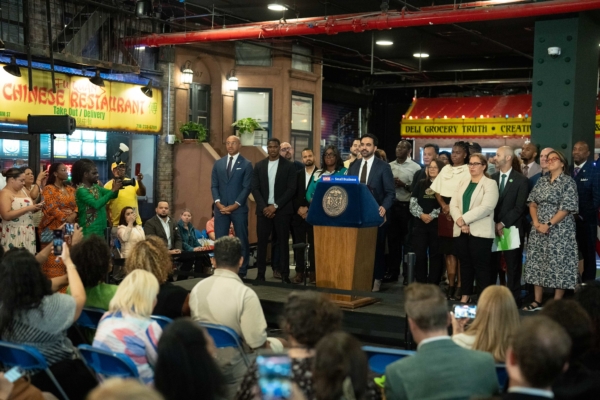
New York City Mayor Mamdani announced the “OPEN for Small Business” initiative on July 20, introducing over 50 measures to simplify regulations and administrative procedures. These measures include canceling redundant permits, reducing fees, streamlining the application process for the restaurant and childcare industries, and establishing a one-stop business service. Many of these initiatives are closely related to businesses run by the Chinese community, such as restaurants, grocery stores, food trucks, and childcare centers, aiming to reduce administrative costs and processing time.
The city government stated that this reform includes actions that can be implemented by the municipal government through executive orders and departmental guidance, as well as actions that require legislative completion. The former can be promoted directly by the mayor, while the latter must go through the State Legislature and State Government for regulatory revisions.
The restaurant industry is one of the key focuses of this reform. The city government will cooperate with the state of New York to eliminate the requirement for restaurants selling ice cream and other frozen desserts to apply for an additional permit in addition to the general food service permit. This regulation originated from dairy management regulations decades ago and is no longer in line with current food management practices. However, due to involving state-level regulations, cooperation from the state government is required for formal implementation.
Furthermore, the Food Protection Course that all food service providers must complete will be relocated from the Health Academy in Upper West Side Manhattan to 125 Worth St in Lower Manhattan, making it more convenient for operators from Queens and Brooklyn and reducing travel time.
The city government also plans to reduce the maximum fines for three common food safety violations, from $600 to $500. It will also integrate two separate allergen notification regulations currently under the jurisdiction of the municipal and state governments into a single notice, reducing the risk of businesses being penalized for redundant regulations.
For community grocery stores, the city government proposed eliminating the requirement for shops to apply for a street vending license when selling fruits, flowers, and bottled drinks at the storefront. Under the current system, even if a business has obtained a permit to sell the same products inside the store, they still need additional permits if the items are displayed outside the entrance. If implemented, this reform could reduce administrative burdens for many community small stores.
Food trucks and street food vendors will also benefit from the reform. The city government announced that within the next year, the registration fee for food trucks and certain cooking equipment with the Department of Environmental Protection (DEP) will be reduced from $110 to $0. Food truck operators will no longer need to carry a physical food supply agreement with them as the government can now access this information directly through the system. In addition, the fee for temporary food vendor permits will be reduced from $70 to $20.
Many childcare centers operated by the Chinese community are also included in the reform. The city government will integrate relevant regulations from the Department of Health (DOHMH), Department of Buildings (DOB), and Fire Department (FDNY) to create a single application guide, simplifying the startup process by eliminating the need to separately review requirements from different departments.
In addition to regulatory easing, the city government is expanding the functions of the “NYC Business Express Services Team” (NYC BEST). In the future, newly established small businesses will receive full assistance from dedicated service personnel to handle licenses, permits, inspections, regulatory compliance, and other matters, reducing the need to interact with various government departments and decreasing the demand for hiring agency services.
An executive order also mandates that all enforcement agencies of the city government actively provide the “Business Owner Bill of Rights” to businesses during inspections or interactions, informing owners of their rights, inspection procedures, and complaint channels. According to a 2025 survey, only 9% of over 500 small businesses interviewed indicated receiving this document. The city government will require all agencies to ensure comprehensive distribution and enhance service training for inspection personnel.
Furthermore, the city government has tasked the Small Business Services Office (SBS) with submitting further recommendations this fall on how to lower commercial insurance, commercial rents, utility costs, and address storefront vacancies. However, these measures are currently in the research stage and specific plans have not yet been disclosed.