
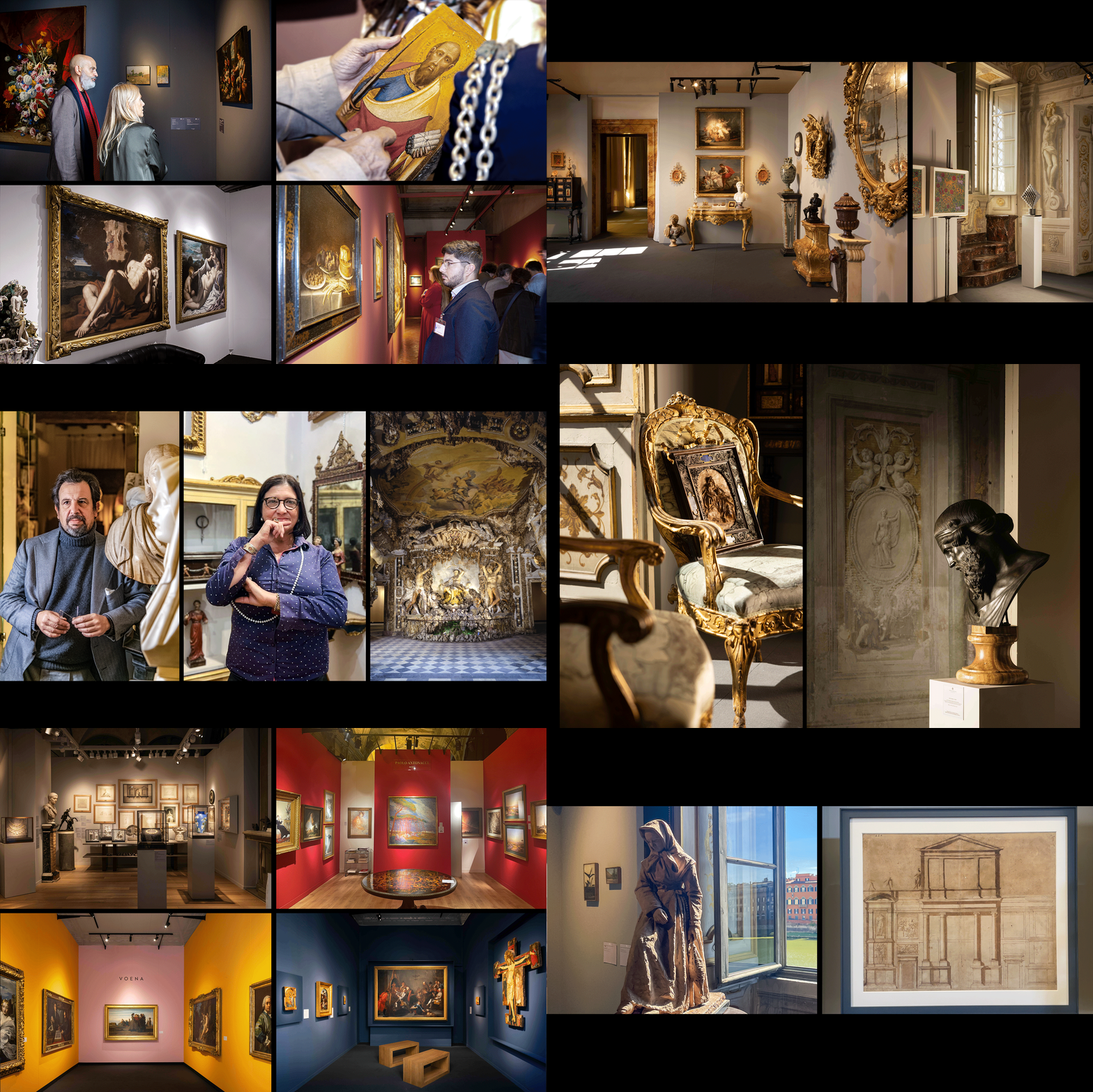
In an interview with The Epoch Times in Florence, Italy, Tomaso Piva, a charismatic Milan gallery owner specializing in Baroque and Neoclassical Venetian art, expressed the sentiment that people are searching for rare treasures that evoke wonder.
Piva pointed to a piece of tabletop décor from the mid-18th century and emphasized its exceptional rarity and outstanding condition. The piece, known as “Italian Garden,” is a miniature garden crafted from Venetian blown glass set on a mirrored base and adorned with lacquered wood edges. To the casual observer, it may resemble a decorative ornament placed on a high surface, featuring small flowers and fruit trees delicately arranged in gilded vases.
However, this masterpiece is far more than just a simple décor item. “Italian Garden” is a museum-grade masterpiece produced by Giuseppe Briati, the renowned Venetian glassmaker from the 18th century. Works of such caliber are seldom seen in the private market.
This precious artifact was just one of the thousands exhibited at the Biennale Internazionale dell’Antiquariato di Firenze, an international antique biennial held in Florence this year. The event showcased ancient masterpieces, including paintings, sculptures, textiles, and furniture from over eighty galleries. Held in a Baroque-style palace by the Arno River, the ten-day event featured public exhibitions and private soirées.
The International Antiques Biennale aims to continue the tradition of Florence as a bastion of humanistic culture. The event celebrates humanistic culture as a revival that involves ethics, aesthetics, and spiritual values.
The Italian Renaissance, which began in late 14th-century Florence, was fueled by a revival of classical culture, reigniting interest in ancient Greek and Roman art, literature, and values. This philosophy, focusing on human potential, emotions, natural beauty, and civic virtues, ushered in centuries of unprecedented prosperity and change in Western civilization.
In an era dominated by digital information and rapid technological advancements, the International Antiques Biennale offers a refreshing counter-narrative by celebrating exquisite craftsmanship, meticulous restoration, and the enduring beauty of traditional handcrafted skills and timeless aesthetics.
Contrary to the digital world’s prevalence, the younger generation’s interest in analog existence and authenticity-as-luxury is on the rise, leading to a vibrant antique market. This year’s exposition covers a wide range of works from various periods, extending to the late 20th century, reflecting a growing trend in the contemporary art world where boundaries between fine art and decorative or functional design are becoming increasingly blurred.
Under the leadership of the new director, this year’s Biennale also seems committed to fostering forward-looking dialogue. Classic works are viewed not just as havens of nostalgia or marketable sentiment but as pathways to understanding and confronting the current cultural moment.
Bruno Botticelli, the Secretary-General of the International Antiques Biennale, shared his vision for the digital age’s movement in antique collecting during an interview with The Epoch Times. He emphasized the importance of using digital technology and artificial intelligence as tools for presenting artworks on social media while also showcasing physical works like Michelangelo’s sketches at the exhibition.
Michelangelo’s “Drawing No. 45 A” held a central place at the event, representing a significant aspect of the master’s surviving works. The drawing, commissioned by Pope Leo X in 1516, portrays a sketch of the marble facade of the San Lorenzo Cathedral using silverpoint, pencil, and ink layers.
The restoration team at the Opificio delle Pietre Dure, founded in 1588, is currently studying the drawing to grasp Michelangelo’s technique and understand how the passage of centuries and conservation measures may have affected the artwork. Emanuela Daffra, the institution’s director, described this process as a delicate balance between hands, eyes, history, and science.
Paulo Antonacci, a participant at the Biennale, highlighted the importance of the event as a prestigious platform where exceptional dealers gather. With around 85% of the exhibitors being Italians specializing in Italian art, the Biennale serves as a showcase for the country’s vibrant artistic heritage.
As the event continues to evolve and incorporate new forms of artistic expression, the Secretary-General emphasized that the definition of a masterpiece, particularly in the fields of design and decorative arts, is continually evolving. He noted shifts in consumer preferences towards unique historical artifacts, despite overall taste leaning towards modern styles.
Giuliana Grilloti, an art historian, pointed out how art serves as a form of visual education, reflecting the emotions and values of past societies. In a world that often lacks mystery, she stressed the enduring influence of heritage and the power of art to convey personal sentiments and connections with the past.
Reflecting on the ongoing Antique Biennale and its integration of new art forms, the Secretary-General suggested that a trend towards appreciating aesthetics and ritual might entice the younger generation to participate in the vintage market. He noted a growing interest, particularly in Japan, for a slower lifestyle and a desire for meaningful experiences beyond immediate gratification.
In conclusion, as the International Antiques Biennale continues to adapt and grow, it is evident that the definition of a masterpiece and the appreciation for historical artifacts are subjects of continual change, guided by evolving aesthetic standards and cultural values. Amidst the digital age, the preservation of art and the rekindling of interest in ancient relics are integral to shaping our understanding of the past and the values we hold dear.