
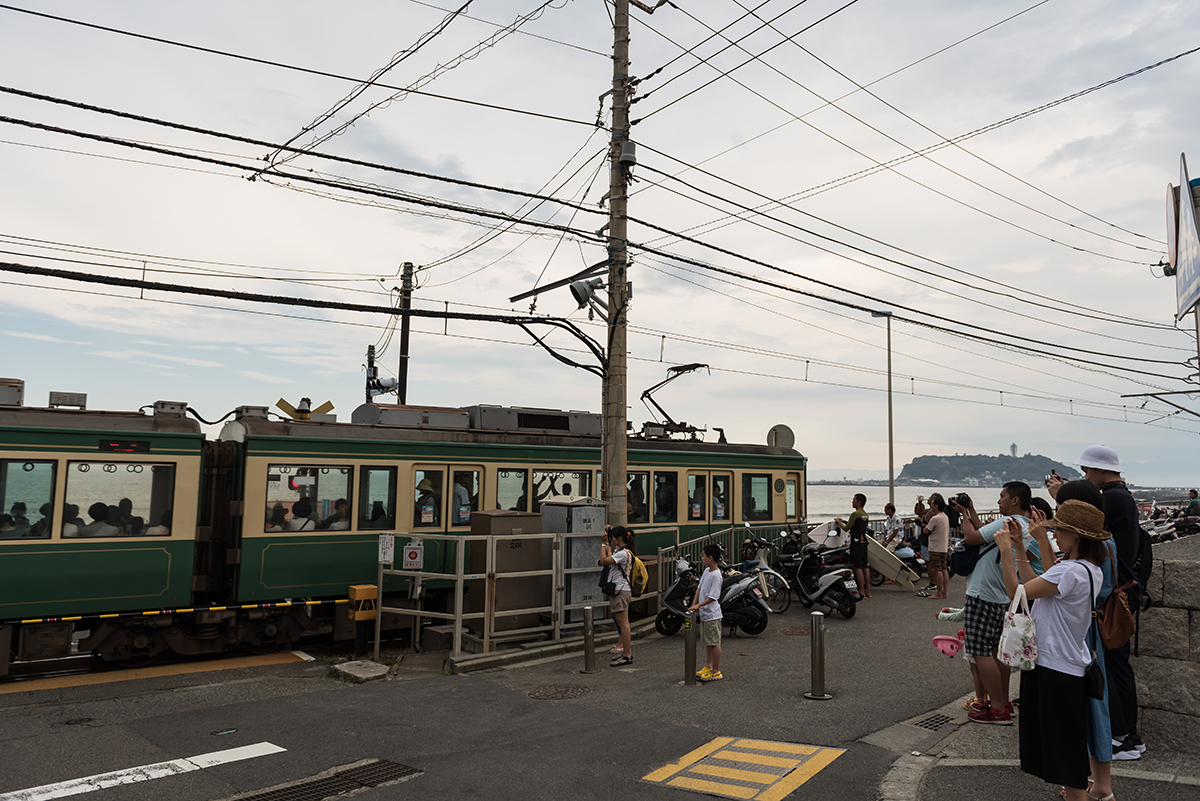
During this year’s “Golden Week” holiday, starting from October 1st, the number of Chinese tourists traveling to Japan has been steadily decreasing. However, in China, tourist attractions modeled after Japanese anime scenes are gaining popularity. Recently, a place called “Little Kamakura” in Yancheng, Jiangsu Province, has attracted attention from visitors due to its recreation of scenes from the popular anime “Slam Dunk”.
The “Golden Week” holiday in China has begun, but this year there has been a noticeable decrease in Chinese tourists traveling to Japan. A shop owner in Kyoto mentioned to Yomiuri Television, “The number of Chinese tourists has significantly decreased, and group tourists are completely absent.”
Hajimoto Akimoto, the manager of a hotel in Dotonbori, Osaka, said, “In the past, starting from October 1st, there were Chinese tourists everywhere, but now we are seeing visitors from various countries. Compared to last year, there are fewer Chinese tourists and more tourists from Europe and America.”
According to the August accommodation statistics released by the Japan National Tourism Organization on September 30th, the total number of stays in Japan was 62.68 million, a 6.7% decrease from the previous year; the number of stays by foreign visitors was 12.64 million, showing a 10.3% decrease. Among them, the number of stays by mainland Chinese tourists decreased by 49.9%, almost halved.
The decrease in Chinese tourists traveling to Japan is related to the cooling of relations between China and Japan. Following remarks by Japanese Prime Minister Takai Sanae about “issues in Taiwan,” the Chinese authorities have advised people to avoid traveling to Japan, leading to restrictions on related group tours to Japan.
In contrast to the decline in Chinese tourist numbers visiting Japan, there is a growing interest in tourist destinations within China that are modeled after Japanese scenes.
A site in Dafeng District, Yancheng City, Jiangsu Province, known as “Little Kamakura,” has recently gained attention on Chinese social media platforms. The area imitates the scenery in front of Kamakura High School in Kanagawa Prefecture, Japan, with a station signboard that reads “Kamakura Coast Station” in Japanese, and a simulated train parked on the track that has been transformed into a café.
According to the establishment, “Little Kamakura” was completed in August 2026, with the design blueprint based on the scenes from Kamakura High School in “Slam Dunk.”
A visitor who came to the site mentioned to Japanese media that they drove about an hour to get there because they really wanted to visit Kamakura in Japan, saying, “Otherwise, I wouldn’t have come here specifically.”
In the year of worsening relations between China and Japan in 2026, Japan has raised visa application fees for foreign tourists since July, nearly five times the original amount. Some flights on the China-Japan route have also been reduced.
Regarding whether Chinese tourists can return to Japan in large numbers, long-term observer of the Chinese community in Japan, Kei Nakashima, expressed pessimism. She analyzed, “Many civil servants, teachers, and engineers from the mainland have had their passports confiscated, coupled with concerns among Chinese people about the new immigration regulations that took effect on September 15. It is expected that this year’s ‘Golden Week’ holiday will primarily focus on domestic travel within China. Although those who can travel abroad also wish to take advantage of the 7-day holiday for long-distance trips (such as Europe or the Middle East), they also face the risk of sudden travel restrictions at the airport.”