
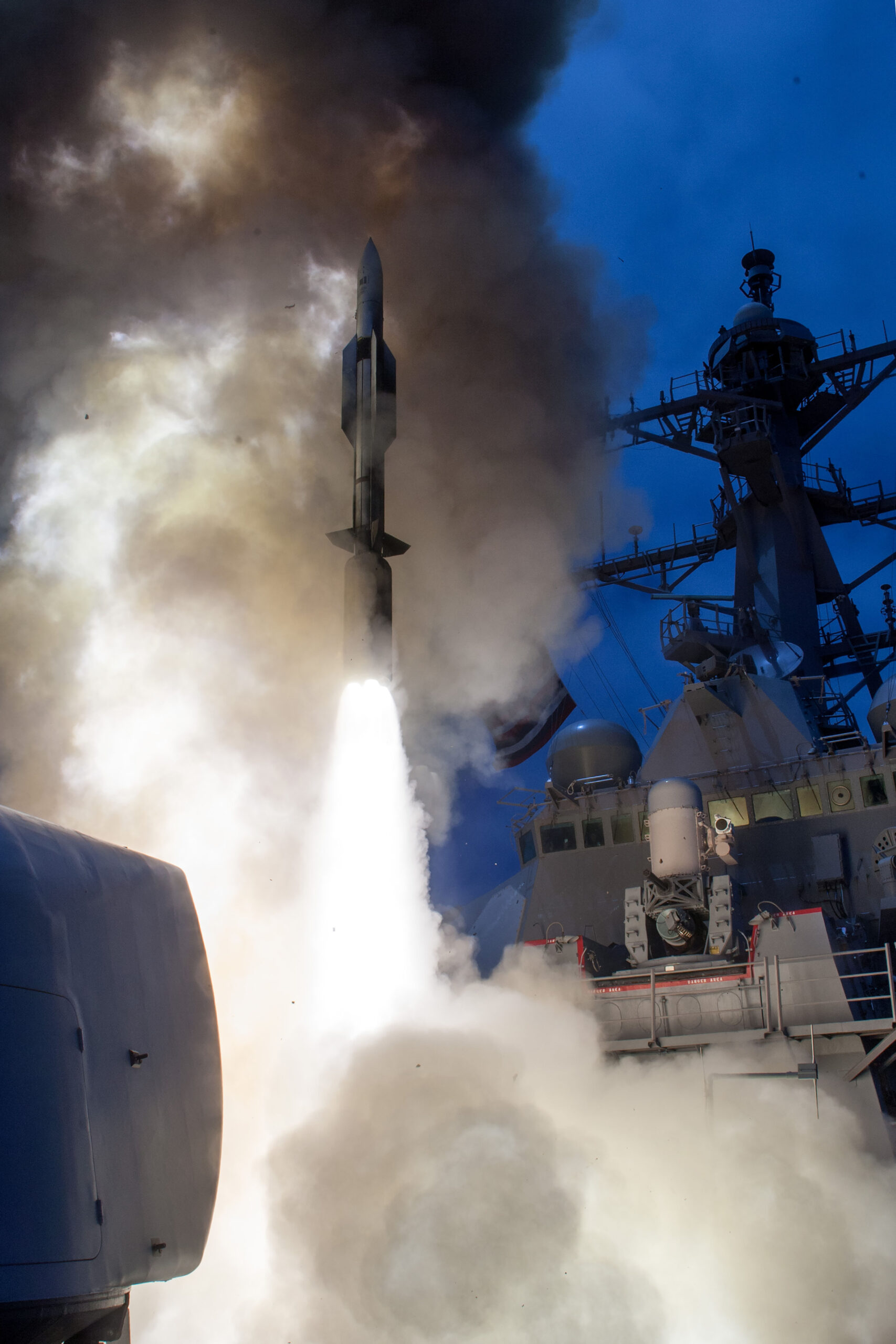
The U.S. Navy announced on Thursday, October 1st that Acting Navy Secretary, Hung Cao, has approved a 5-year contract for the “Standard-6” (SM-6) missile to be awarded to Raytheon, a subsidiary of RTX, with an additional option for a 2-year contract extension, with a total contract value of up to $24.4 billion. This decision aims to expand the production capacity of the “Standard-6” missile, enhance the supply capability of critical ammunition for the U.S. military, and strengthen the defense industrial base.
The “Standard-6” is a significant model in the U.S. Navy’s “Standard” missile series, capable of carrying out various missions such as air defense, anti-ship, and ballistic missile defense, and can be launched from both warships and land-based launchers.
Raytheon stated that the “Standard-6” is currently the only mature missile system with multi-mission capabilities that has been validated in real combat scenarios.
This contract is structured as a multi-year procurement, providing a more stable and predictable order flow to encourage defense industry companies to expand their production capacity while reducing procurement costs through long-term negotiations. The U.S. Navy emphasized that the investment will enhance manufacturing efficiency, expand the workforce, and strengthen the supply chain.
Daryl Caudle, the Navy’s Chief of Naval Operations, stated that the fleet needs to acquire weapons in sufficient quantity and speed. The “Standard-6” missile contract will provide stable demand for defense industry companies to expand production capacity and increase ammunition reserves for the fleet.
In February of this year, Raytheon reached multiple framework agreements with the Department of War involving weapons such as the “Tomahawk” cruise missile, AMRAAM air-to-air missile, “Standard-3” (SM-3), and “Standard-6” missiles. Raytheon indicated that these arrangements will increase the annual production of “Standard-6” missiles to over 500.
Previously, Raytheon has continuously expanded its production facilities. In March of this year, the company announced the completion of a $115 million expansion project for the Redstone missile integration facility in Alabama, expecting to increase the facility’s integration and delivery capability by over 50%.
The contract amount announced is the maximum value, and the Navy has not disclosed the specific procurement quantities and delivery times. Based on the contract ceiling, the $24.4 billion includes the 5-year base contract and up to 2 years of extension, with actual expenditure depending on subsequent procurement arrangements.
This contract is part of the U.S.’s efforts this year to accelerate production of critical ammunition and replenish weapon stockpiles. The Pentagon has recently advanced significant missile acquisitions, including reaching a multi-year contract for the AIM-120 “Advanced Medium-Range Air-to-Air Missile” (AMRAAM) with Raytheon for up to $20.7 billion at the end of September and a $58.6 billion contract for the “Patriot” interceptor missile with Lockheed Martin in July.
The U.S. Navy has extensively used the “Standard-6” missile in operations in the Red Sea. In January 2025, then U.S. Navy Surface Force Commander Brendan McLane revealed that from October 2023 to January 2025, the U.S. Navy launched a total of 80 “Standard-6” missiles in response to missile and drone attacks by Houthi militants.
However, the full implementation of these multi-year weapon contracts still requires funding support from Congress. Executives from U.S. defense companies have warned that the pace and scale of further significant investments in component procurement and production facility expansion may be constrained until the relevant funding is approved.
(This article referenced reporting from Reuters)