
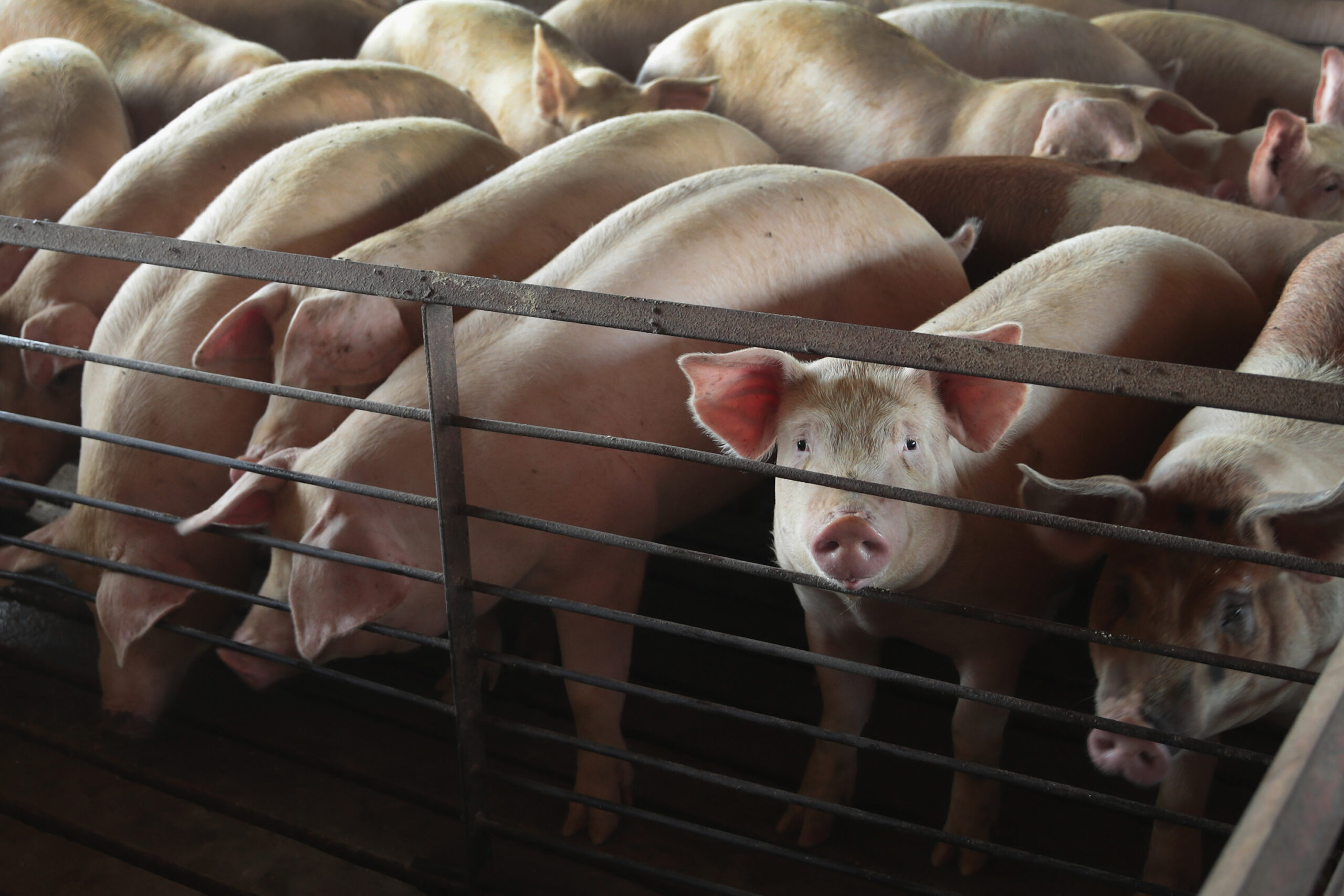
Recently, suspected cases of African swine fever have been reported in Guangxi, Hunan, Jiangxi, and other regions of China. In some pig farms, there has been a concentration of pig deaths, leading to the forced disposal of the pigs. Many farmers have revealed that despite vaccination, many pig herds have still fallen ill this year. Due to the impact of the epidemic, even at low prices, it has been difficult to find buyers for the sick pigs, causing individual farmers to accelerate their exit from the market. Additionally, some of the diseased and culled sows are being directly transported to cold storage and processing plants to be used for making sausage and other meat products.
In recent days, information on the epidemic posted online by pig farmers in various regions of China shows that the risk of African swine fever is on the rise in parts of East China, South China, and Southwest China, involving provinces such as Jiangxi, Fujian, Zhejiang, Guangdong, Guangxi, Yunnan, Guizhou, Sichuan, Hunan, and Chongqing.
The epidemic has identified entrusted farming and secondary fattening farms as important risk points in the regions of East China and South China. Farmers mention that in such pig farms, a batch of pigs are often sent to market within 3 to 5 days, and some farmers have a higher tolerance for infected pigs. Inadequate cleaning and disinfection of pig transportation vehicles may increase the chances of the virus spreading between farms.
With the decrease in temperature and increased rainfall in the fall, farmers believe that the virus may survive longer in the environment. Combined with the transportation of live pigs, personnel, and vehicles, the transmission chain becomes more complex. Once a farm is infected, it could become a new spreading point for surrounding farms, leading to the spread from a single point to surrounding areas.
Despite the disclosure of the widespread African swine fever epidemic by farmers, the official report from China’s Ministry of Agriculture and Rural Affairs has not mentioned it at all. The only major epidemic reported recently was a case of Foot-and-Mouth Disease Type O in Chongqing in September, raising questions about the authenticity of official information.
While the official reports do not align with the information from the public, many farmers in Guangxi, Hunan, and Jiangxi have shared their experiences of the African swine fever epidemic in their areas.
Liu Yongchang, a farmer from Rong County in Yulin City, Guangxi, told reporters that there have been two outbreaks of African swine fever in the area this year. He mentioned that many pig farms in the vicinity were affected after the Chinese New Year, and now the epidemic has resurfaced.
When discussing the vaccine issues encountered during his farming process, Liu Yongchang said, “We used to use a vaccine from Guangdong without any issues, but we had problems after using the vaccine from Zhongmu Livestock (a state-owned enterprise).”
He explained that after vaccination, the sows experienced miscarriages and stillbirths, while weaned pigs also fell ill. “Sows vaccinated with the virus had more miscarriages and stillbirths, and three weaned pigs got sick, and one died. Those that were not vaccinated were fine.”
Similar concerns have arisen in other provinces among farmers as well.
Ru Jianle, a farmer from Hunan, said that even on larger pig farms in the area, outbreaks occurred. “On those large farms where they all vaccinated the pigs, the epidemic still broke out.”
He described the suspicion among farmers in a more colloquial way: “Pigs vaccinated are the ones getting infected, it’s commercial secrets.”
However, these statements about the effectiveness of vaccines are based on the farmers’ experiences and judgments, lacking independent testing or investigation data for verification.
According to Ru Jianle, there has been a large-scale epidemic in the region he is in. “Almost 80% to 90% of the pig farms here were affected and had to be cleared.”
He described the rapid rate of death among infected pigs, “The pigs get dry noses and are feverish. They die in three days.” Since the pigs he raises are larger in size, dealing with their deaths also becomes a problem.
He said, “We have larger pigs over 300 pounds, and we can’t dispose of them all.”
The epidemic has directly affected farmers’ income. Ru Jianle said, “We are all losing money now. When African swine fever strikes, we sell at low prices and face huge losses. Those that are not infected are sold at low prices, while the infected ones are buried.”
In Guangxi, farmers who have not encountered issues are also feeling the pressure.
Liang Jianguo, a farmer from Guangxi, stated that although his pig farm has not suffered any losses yet, neighboring farms have been cleared. “There are rumors of African swine fever everywhere now, neighboring pig farms have been cleared out.”
He mentioned that a nearby farm recently cleared out, and dozens of pigs died the night before. “There were around 16 pigs weighing between 130 to 140 pounds and 7 pigs weighing around 100 pounds, totaling 23, sold for 3000 yuan.”
Regarding the handling of the epidemic aftermath, Liang Jianguo explained that local farmers sometimes have to dispose of pigs at low prices. “We are selling for a single yuan (per pig).”
Regarding the disposal of the dead pigs, he said that the local community generally does not allow them to be disposed of randomly. “Dead pigs are directly buried, we don’t allow them to be thrown around. As long as they haven’t breathed their last, there are people to collect them.”
He also mentioned that some pigs are sent to frozen processing plants. “They are directly taken to the cold storage plant for processing, for making sausages.”
Liang Jianguo further expressed, “Many sausages are made from sick pigs and culled sows.”
Zhang Shujuan, a farmer from Gao’an City, Yichun, Jiangxi, revealed to Da Ji Yuan that the situation of African swine fever in the area is severe this year. Many neighboring farmers have already sold their live pigs in advance due to a decrease in pig traders, and the farmers now face issues such as selling at low prices and difficulty in handling diseased pigs.
She initially had over 30 breeding pigs. Compared to regular live pigs, purebred pigs have relatively stronger resistance and higher prices, but in the spreading African swine fever situation, farmers still face unavoidable risks.
She said, “Some farmers sold their pigs off over a month ago when they could still find buyers. It’s very difficult to sell now because African swine fever is everywhere.”
As the epidemic spreads, there is a noticeable decrease in pig traders coming to collect pigs.
Zhang Shujuan believes that small-scale farmers are especially vulnerable to risks. On one hand, they have limited farming scale, and on the other hand, once problems arise with live pigs, the selling channels are also limited.
She stated that it’s very challenging for small farmers to handle the bulk sales and disposal of diseased live pigs, even if they know the pigs are sick. “The government isn’t providing subsidies now, why would they bother with all this?”
According to data monitored by Zoho Information, in August, the average national price for three-way-crossbred live pigs was 10.82 RMB per kilogram, a 21.42% decrease year-on-year. Data from the Ministry of Agriculture and Rural Affairs shows that in the fourth week of August, the national price for live pigs was 11.55 RMB per kilogram, an 18.8% decrease year-on-year.
Zoho Information monitoring data indicates that the average loss per head in self-breeding and self-raising models was 153.71 RMB. Bo Ya and Xun data also show that the average loss per head in self-breeding and self-raising was 209.49 RMB per head.
(The aforementioned farmers, Liu Yongchang, Ru Jianle, Liang Jianguo, and Zhang Shujuan, are all pseudonyms.)