
Beijing-Tianjin-Hebei will welcome a new round of heavy rainfalls, with Beijing preparing for the worst as the Beijing Meteorological Bureau issued 5 disaster warnings. Some kindergartens have announced early closures for 3 days, some companies have informed employees to work from home, and companies holding their ground have taken comprehensive prevention measures.
On August 11, the Beijing Meteorological Bureau issued multiple warnings: the city-wide orange alert for heavy rain, from the evening of the 11th to the daytime of the 13th, with heavy to severe rain expected in Beijing, with the strongest period expected from the early hours of the 12th to the nighttime; red alerts for heavy rain in 7 districts, covering Tongzhou, Economic-Technological Development Area, Mentougou, Fangshan, Daxing, Huairou, and Fengtai; orange alert for urban waterlogging risks, from 8 p.m. on the 11th to 8 p.m. on the 13th, with high risks of urban waterlogging in the central area;
Orange alert for mountain flood risks, including Fangshan, Mentougou, and Pinggu in Beijing with red risks, and other mountainous areas with orange risks, taking effect from 8 p.m. on the 11th. Orange alert for geological disaster weather risks, including Fangshan, Mentougou, western Changping, Shijingshan, Haidian, and Fengtai with orange risks.
There is also a risk warning for mountain road collapses along the mountainous areas, including some mountain roads in Fangshan, Mentougou, Changping, Yanqing, Huairou, Miyun, and Pinggu that might experience collapses.
Officials have also warned that this round of rainfall covers a wide area, with intense rainfall in a short period of time and long duration, posing significant disaster risks. Low-lying areas are prone to waterlogging, while mountainous areas may experience flash floods and floods in small to medium-sized rivers.
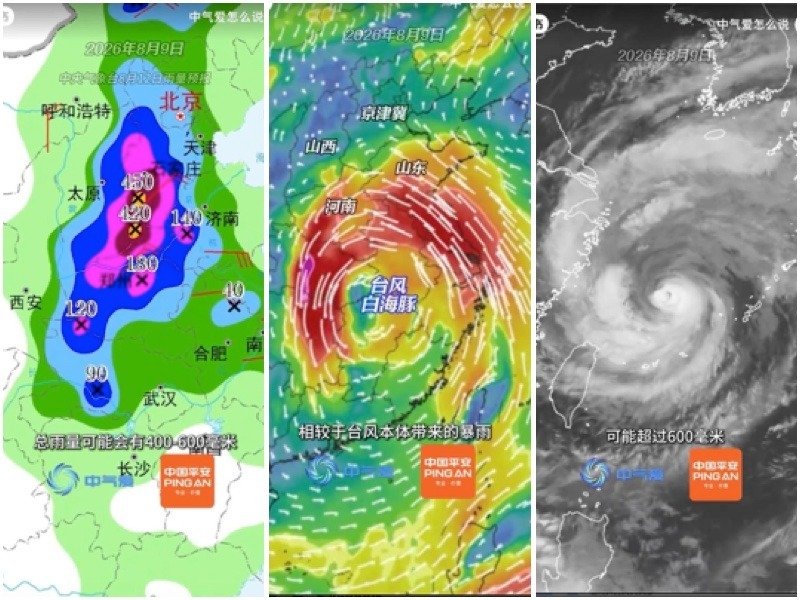
The day before, meteorological professionals in Beijing issued a video warning on the self-media “What Meteorological Love to Say” platform, stating that after Typhoon “White Dolphin” made landfall in Zhejiang, the residual circulation may bring a large amount of warm and humid air northwards. Henan, Shandong, Hebei, Beijing, Tianjin, and southern Liaoning will face heavy rain, severe rain, or even extremely heavy rain in the next few days. The video mentioned that some numerical models predicted local accumulated rainfall in Henan, Hebei, and Shandong could reach 400 to 600 millimeters.
He stated that this round of rainfall in North China is combined with 5 dangerous factors including the northward movement of the residual circulation of the typhoon, subsequent tropical systems continuously transporting moisture, high sea temperatures in the Bohai and Yellow Seas evaporating, the convergence of cold and warm air flows, as well as the uplifting terrain of the Taihang and Funiu Mountains, which may recreate the situation of the 2023 Typhoon Dusu caused severe floods in the Beijing-Tianjin-Hebei region.
A source in Beijing revealed to Dajiyuan that the Chinese Communist Party authorities had quietly informed foreign journalists in Beijing two days in advance to stock up on food, saying that stores may not open. The upcoming heavy rainfall in Beijing might be even more severe than that of 2023.
Currently, it is the summer vacation period for students, but kindergartens do not have summer breaks. A Beijing resident with children attending kindergarten stated they have already been notified that their children will have a 3-day break from Tuesday to Thursday (August 11 to 13).
Some companies in Beijing have informed employees to work from home for 3 days from Tuesday to Thursday, with only a few staff members remaining on duty.
There are even reports of people in Beijing saying on social media, “During heavy rain, rushing work at the company may pose risks. The company provided us with manually inflatable boats for our department.”
The news of early remote work arrangements has sparked discussions online, with some netizens expressing envy, while others commented, “They say the heavy rain will come in the evening, but are you starting to work from home in the early morning?”
There were also netizens questioning, “Are you part of the system?” Some responded that they were from Chaoyang Community. Those who had not received any notifications joked, “We are also from Chaoyang, why is there such a big difference?”
A white-collar worker in Beijing told Dajiyuan, “Beijing’s weather warnings are often inaccurate. Whenever they predict heavy rainfall, it may turn out to be very light, but suddenly one day a heavy rainfall occurs, catching us off guard. Last time, a warning led to the evacuation of 100,000 people in Beijing, but nothing really happened.”
Many in the group also mocked Beijing’s weather forecasts, “Have Beijing’s weather forecasts ever been accurate?” “When they don’t issue warnings, heavy rainfall occurs, but during the warnings, nothing happens.” “The Beijing Meteorological Bureau usually can only accurately forecast events after they happen.”
From July 29 to August 2, 2023, affected by the residual circulation of Typhoon “Dusu”, Beijing experienced the largest downpour in 140 years recorded by instruments, with an average rainfall of 331 millimeters across the city, and Changping’s Wangjiayuan Reservoir received 745 millimeters of rainfall. Mountain torrents erupted in Mentougou, Fangshan, and other areas, causing rivers to surge, roads and bridges to be washed away, and some villages to lose water, power, and communication. Official reports stated that 33 people died, 18 went missing, and about 1.29 million people were affected.