
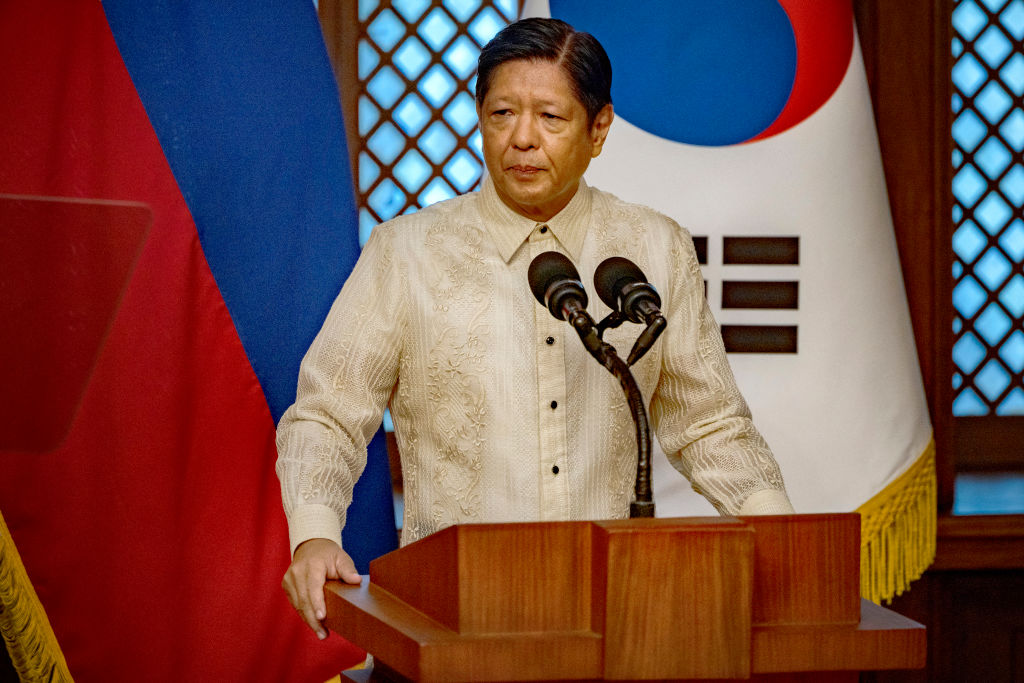
Philippine President Ferdinand R. Marcos Jr. reiterated on Monday (July 27) during the fifth State of the Nation Address (SONA) that the Philippines will never give up the 2016 South China Sea arbitration ruling which holds historical significance. The government will take all necessary peaceful and legal means to uphold the ruling and oppose any efforts to undermine its validity.
In his address, President Ferdinand R. Marcos Jr. stated, “The government will take all necessary measures, utilizing all peaceful and legal means available to the Republic, to continuously uphold this arbitration ruling and oppose any domestic or foreign attempts to undermine this achievement.”
This year marks the tenth anniversary of the South China Sea arbitration ruling. On July 12, 2016, the Permanent Court of Arbitration in The Hague rendered a decision under Annex VII to the United Nations Convention on the Law of the Sea (UNCLOS), which found that China’s claim of the “nine-dash line” lacked legal basis and affirmed the Philippines’ sovereign rights and jurisdiction in its exclusive economic zone under UNCLOS. However, the tribunal did not rule on sovereignty over South China Sea islands and reefs.
Marcos emphasized that this ruling has become an important legal reference for the interpretation and application of UNCLOS. He stressed, “This is not a claim presented unilaterally by us, nor is it a claim we will abandon.” He further stated, “The Filipino people will never surrender.”
According to the Philippine Constitution, the President must deliver the State of the Nation Address to a joint session of Congress every fourth Monday of July. The State of the Nation Address is the President’s most important annual political speech, serving as not only a summary of governance but also typically outlining the government’s policy direction for the upcoming year, making it one of the Philippines’ most significant political speeches of the year.
In his speech, Marcos also paid tribute to the Philippine armed forces, coast guard, and fishermen operating in the West Philippine Sea, expressing gratitude for their continuous efforts in safeguarding the Philippines’ maritime interests despite various risks and pressures. He stated, “We should all express our gratitude and respect to them because they are the ones who truly embody the spirit and content of the arbitration ruling.” The West Philippine Sea is the official term used by the Philippines for parts of the South China Sea within its exclusive economic zone.
While not specifically naming China in his speech, Marcos criticized foreign media outlets for portraying the Filipino people in a demeaning manner recently. He said, “Our humanity has been questioned recently. The Filipino people are a noble and great nation. We are not greedy, we are not racists, and we are not fraudsters. We respect others and value our own dignity. We are Filipinos, and we will not yield.”
It is widely believed that Marcos was referring to a video generated by artificial intelligence released by China Daily prior to the tenth anniversary of the South China Sea arbitration ruling. The video depicted Filipinos as monkeys manipulated by the United States and Japan, resulting in strong protests from the Philippine government criticizing the content for its racial bias and dehumanizing nature, leading to a summoning of the Chinese Ambassador to the Philippines.
Chinese Foreign Ministry spokesperson, Lin Jian, stated last week that the video “does not represent the official stance” and reiterated China’s position that the 2016 South China Sea arbitration ruling is “illegal, invalid, and lacks binding force.” China has yet to take down the video.
In his closing remarks, Marcos called for national unity in facing escalating security challenges. He expressed, “Our unity and collective consciousness are being tested more than ever before, a common threat is challenging the dignity and self-esteem of us as a nation.” He emphatically declared in Filipino, “We are of one nation. We are all Filipinos. In the face of insults, we will not waver; in the face of oppressors, we will not yield.”
The so-called “nine-dash line” is an area marked on Chinese maps in the South China Sea comprising nine broken lines, used to assert historical rights over most of the South China Sea and its islands, covering about ninety percent of the South China Sea, overlapping with maritime claims of countries such as the Philippines, Vietnam, Malaysia, Brunei, and Indonesia.