
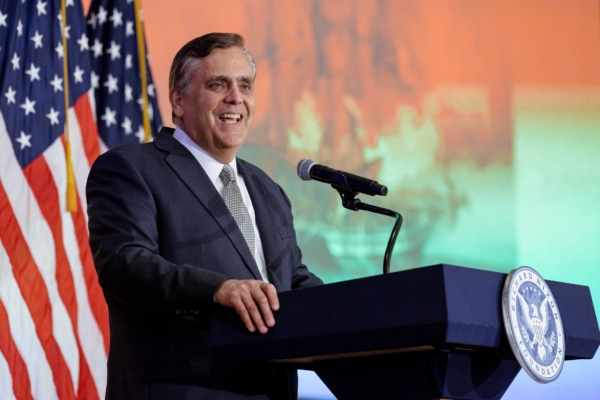
On July 21st, prominent lawyer, law professor, columnist, and media legal analyst Jonathan Turley was invited to the Nixon library to introduce his new book “Rage and the Republic,” which reviews American history and discusses how to uphold the government system established by the Constitution.
Published on Amazon in February of this year and receiving a 5-star rating, Turley’s new book “Rage and the Republic: The Unfinished Story of the American Revolution” has brought him from the Reagan Library to the Nixon Library for a lecture, with plans to visit the Ford and Carter Libraries. Turley expressed, “One of the pleasures of writing this book is having the opportunity to speak at presidential libraries.”
As a lawyer, Turley has represented various clients, including in presidential impeachment cases, congressional members, judges, attorneys general, celebrities, journalists, whistleblowers, protesters, individuals accused of espionage or terrorist activities, and employees from Area 51 (site of multiple UFO events). He is hailed by The Washington Post as a “leading figure in legal analysis,” one of the 100 most famous law professors in history, and one of the most influential figures in public policy.
Turley described the present as an “age of anger” due to many angry sentiments tearing the nation apart, such as the left-wing advocacy for open borders, system changes, and constitutional amendments. He pointed out that the “Boston Tea Party” in history exemplified public anger, and that “anger” is a fascinating force that can drive people to say or do things they wouldn’t ordinarily.
Looking towards the future, Turley believes, “We (America) can not only survive in the 21st century but thrive because we have the most flexible and adaptable system; the only potential failure would be altering this system.”
Turley explained that the first part of the book delves into how the American Revolution erupted and concluded. While most “revolutions” end unfavorably, the founders at the time sought to break free from historical constraints, viewing the revolution as both a rupture and the birth of a new nation. The Declaration of Independence reads like a document from the Enlightenment, with its core concept that people’s rights are not granted by the government but stem from God, declaring that “all men are created equal and endowed by their Creator with certain unalienable Rights.”
Thomas Paine, renowned for writing “Common Sense,” is considered the spark of the American Revolutionary War. He knew how to mobilize people for the revolution, fueling the fervent force; meanwhile, James Madison, known as the “Father of the Constitution,” used rationality to guide the revolution towards establishing a republic. The Declaration of Independence defined American identity as a nation and proceeded to formulate the Constitution to fulfill the promises made in the declaration.
Paine, born in England, was expected to follow his father’s trade as a staymaker, but he disliked it. Despite only obtaining less than 1% of the total value of the loot, Paine considered it a fortune, using the money to pursue university courses where he immersed himself in Enlightenment ideas.
Paine fell into poverty once more. Surprisingly, he became a tax officer for the British king but performed poorly, claiming to have “inspected the ship” when he hadn’t gone. Every company he founded went bankrupt, his two marriages ended tragically, and he eventually found himself destitute in London.
However, Paine’s encounter with Benjamin Franklin led to a transformative period. Recognizing Paine’s talent, Franklin paid for his journey to the colonies and arranged for work, two years before the Declaration of Independence was published. Paine discovered a revitalizing quality in the American climate, believing it to be a place where one could embrace a rebirth and pursue their “destiny.”
Turley noted that Paine’s friend, Benjamin Franklin’s daughter once wrote that Paine was not a likable person but should have passed away immediately after the publication of “Common Sense.”
Marquis de La Fayette, a French officer, volunteered to join the Continental Army and partook in the American Revolutionary War (1765–1789), where he later played critical roles in the French Revolution (1789–1799) alongside Paine. Despite not speaking French, Paine was elected as a member of the French National Assembly. Lafayette participated in drafting France’s “Declaration of the Rights of Man and of the Citizen.” Amid the chaos of the revolution, Lafayette sought a moderate path upon being appointed commander of the National Guard after the storming of the Bastille.
When the radical Jacobins, Robespierre, and Marat, rose to power, thousands perished by the guillotine, starting with nobles, then clergy, followed by the infighting within the revolutionary factions. To evade capture, Lafayette fled to Austria and was imprisoned by the military for five years.
Paine and seven acquaintances resided on the outskirts of Paris, witnessing friends being taken away one by one, even the innkeeper met the same fate, leaving Paine alone in the desolate inn until he was arrested with his just-completed book, “The Rights of Man.” This revolution devoured its own children.
Paine and three Belgian companions were held in a dank, damp dungeon where they cared for each other as best they could, even persuading the guards to open the door for ventilation. The Luxembourg prison had a rule of inscribing a number on the door each night, symbolizing the number of people to be executed the next day. Despite the door bearing the number “4,” the chalked “4” faced inward, sparing the four individuals from execution.
Paine did not entirely agree with Madison’s “auxiliary precautions,” such as bicameralism or various checks and balances mechanisms, advocating for more direct action. However, witnessing the self-destructive chaos of the French Revolution, he eventually acknowledged Madison was right.
The latter part of the book contemplates the future, discussing if the republic can endure. Benjamin Franklin once said, “It is our responsibility to maintain this republic,” which is why the subtitle of the book is “The Unfinished Story of the American Revolution.” Turley emphasized that presuming the nation can survive another 250 years just because it has existed for that long is dangerously presumptuous; each generation must safeguard and pass on what was built and preserved through countless sacrifices.
A group now claims to be the “New Jacobins.” The Democratic Socialists of America (DSA) released a manifesto calling for the abolishment of the U.S. Senate, echoing the desires of the French Jacobins; this manifesto also advocates for eliminating the Supreme Court and direct election of the president, aligning with Jacobin ideals.
Amid the celebration of the 250th anniversary of the Declaration of Independence, some Harvard professors and the deans of law schools are arguing that the American Constitution has failed. One professor listed radical reforms, openly stating that if these changes were implemented, the Democratic Party would never lose power; however, to achieve this, control over the Supreme Court is paramount. Turley lamented, “Not surprisingly, they are calling for expanding the Supreme Court.”
Looking ahead to the 21st century, can we survive amidst the rise of socialism? Turley referred to the New York City Mayor adopting the rhetoric of English and French socialists, noting that socialist governments that have attempted such measures have collapsed, leading to economic ruin. Britain had to turn to the International Monetary Fund (IMF) for assistance, while the current British Prime Minister seeks to revert to past practices.
When asked about confidence in America compared to the EU, Turley expressed doubt in the EU’s ability to persist, as he believed they have undermined successful foundations and institutions; therefore, the EU system is destined to collapse. Once this collapse occurs, tyranny may follow.
Turley emphasized that the only possible failure for America is to alter its current system. Socialist organizations in America and their allies seek a world without capitalism, with nearly all Democratic Party leaders seemingly questioning capitalism.
This year marks the 250th anniversary of the publication of the Declaration of Independence and the “Wealth of Nations” by Adam Smith; while it went unnoticed in Europe, it gained immense popularity in America. The founding fathers strongly believed that individual economic freedom was crucial to achieving true liberty.
Turley stressed the importance of a free-market economy for America, stating that dependency on government support for all citizens or industries is intolerable. To enable effective governance, American citizens must maintain independence from the government.
With the explosive advancement of AI and robotics, we are facing the largest wave of unemployment in global history, as some professions may never return, such as taxi drivers or radiologists; however, new job opportunities will emerge, with young individuals taking advantage of them. Turley acknowledged that America is a nation unafraid of innovation, but some lawmakers are attempting to subsidize declining industries, an approach that is not viable.
Turley referenced a character from “Starship,” Guinan, a bartender who had a replicator that could mimic any cocktail, yet people only requested Guinan to mix drinks. Thus, the future lies in jobs akin to those of “Guinan,” hinting at evolving employment opportunities.
So, what is America? At that time, people were strangers to one another, with no deep ties to the land, no rigid class structure, and no established social system. Paine once wrote, “We have it in our power to begin the world anew.” Franklin, gazing at a Chippendale-style chair during the Constitutional Convention, pondered the relief on the chair’s top crest, seeing it as a sunrise. Some may view it as a sunset, but Turley optimistically remarked, “For us, it is the rising of a republic.” ◇