
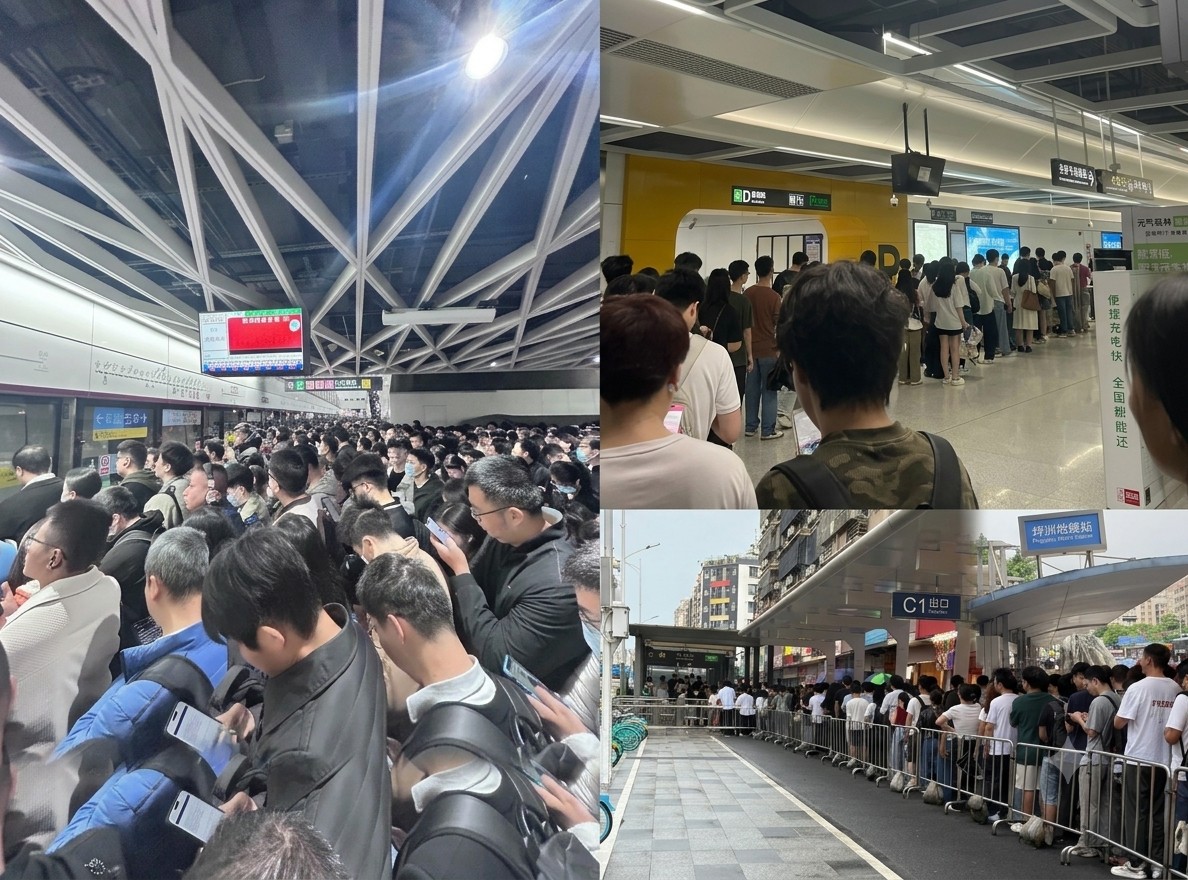
Shenzhen Metro recently upgraded its security measures, requiring all passengers and their belongings to undergo inspections. The new regulations were implemented on a Monday morning during rush hour and coincided with heavy rain, leading to long queues at multiple stations and complaints from the public about a significant drop in commuting efficiency. The question of whether the metro security checks are necessary quickly became a hot topic, with discussions linking the upgrade to the APEC summit scheduled to be held in Shenzhen in November.
On the evening of July 19, Shenzhen Metro issued an announcement stating that all passengers and bags must be inspected, disrupting the daily commuting routines of many residents. The first day of the new regulations coincided with a Monday morning rush hour and heavy rainfall, causing massive queues at busy stations.
Citizens reported a significant decrease in efficiency when entering the stations, with situations such as “riding for 10 minutes, waiting in line for half an hour” and “crowded security checks but empty train cars” becoming common. Social media platforms like Xiaohongshu (Red) were filled with numerous posts expressing dissatisfaction with the Shenzhen Metro.
On July 21, a Xiaohongshu user posted their thoughts on the upgraded security checks, saying, “If smoking restrictions were enforced with the same intensity, I wouldn’t mind,” and “If the same effort was put into addressing animal abuse, I wouldn’t have objections.” The post sparked widespread discussions in the comments section before being deleted shortly thereafter.
In the following days, “Shenzhen Metro security checks” rapidly trended online, with many netizens referring to it as the “strictest metro security checks in history,” attracting widespread attention from the public and media.
As public opinion intensified, Shenzhen Metro responded on July 21, stating that the policy was not independently formulated by the metro company but rather implemented in accordance with documents issued by the transportation authority, with the metro company responsible for enforcement.
Shenzhen Metro’s response did not clarify the specific reasons for the security check upgrade but emphasized that the policy was executed based on directives from the supervising authority, leading to a general interpretation of attributing responsibility to the overseeing authority.
Why did the metro suddenly upgrade security checks in the heat of the summer? Several overseas Chinese media outlets analyzed that Shenzhen is set to host the APEC (Asia-Pacific Economic Cooperation) summit on November 18th to 19th, and it is expected that Chinese leader Xi Jinping will attend. Consequently, the upgrade of security checks is widely linked to the APEC conference to be held in November.
Interestingly, in response to the escalating public sentiment surrounding the Shenzhen Metro security checks, official Chinese media outlets and commentator Hu Xijin entered the fray to cool down the situation. These responses also sparked discussions.
Three years ago, Hu Xijin questioned the need for security checks, stating, “We have the most security checks in the world, which is a waste of resources.” However, in this instance, Hu Xijin changed his previous stance and on July 22nd, posted on Weibo stating that many people welcome more security checks and suggested using technology to make security checks faster and more accurate.
On the same day, CCTV, the Chinese state broadcaster, commented that the Shenzhen Metro lacked differentiated design and supportive crowd control measures, lacking scientific anticipation.
Subsequently, on the 24th, the People’s Daily, a Party-controlled media outlet, published a commentary stating that “strengthening security checks is in the public interest” and proposed the use of “smart non-intrusive security checks” through big data methods.
However, amidst the ongoing public debate sparked by the metro security check upgrade, some prominent online figures compared the operation of subways in China and surrounding regions, directly questioning the necessity of security checks. Weibo influencer “Former HR Specialist,” with over 2 million followers, posted stating that excessive vigilance raised the operational costs of society as a whole, citing examples of subways in Hong Kong, Taiwan, Japan, and South Korea not having security checks. These comparisons raised doubts about the need for security checks.
On unfiltered overseas platforms, some netizens believed that the incident reflected a trust rift between the authorities and the public. Some stated that “The Chinese Communist Party no longer sees the people as ‘imaginary enemies,’ but as ‘real threats'”; while others pointed out that “This (CCP) regime has done so many bad things, they are afraid of everything.”