
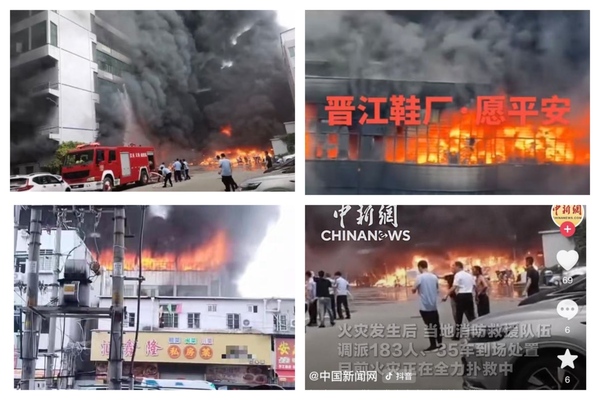
A tragic incident unfolded recently in a shoe factory in Jinjiang, Fujian Province, causing multiple worker fatalities and sparking strong public outcry. Many questioned why the factory lacked adequate escape routes for the workers, and doubted the accuracy of the death toll reported by the Chinese Communist Party (CCP) officials. This fire once again sheds light on the deadly issue of production safety in Chinese enterprises.
Scholars specializing in Chinese issues pointed out that in present-day China, the government and enterprises do not fulfill their roles properly. Safety accidents continue to occur frequently, affecting primarily vulnerable groups in society.
On July 9th, a devastating fire broke out at the Huigeng Shoe Factory in Jinjiang, Fujian Province. After the rescue operation, witnesses revealed that the fire originated on the ground floor of the factory. Workers on the upper floors were trapped as the factory windows were sealed with iron bars and the fire exits were blocked by debris, leaving them with no escape route. In desperation, some climbed to the rooftop and tried to seek refuge in a water tank. Subsequently, firefighters retrieved multiple bodies from the tank, a heart-wrenching sight.
According to official CCP reports, the factory building consisted of five floors with each floor covering 1,300 square meters. The fire was fueled by flammable shoe-making materials and resulted in the death of 28 out of 237 workers present at the scene.
However, there are speculations among the public that the actual death toll is much higher, potentially reaching hundreds of workers.
On July 11th, the Wall Street Journal published a featured report on the incident, labeling it as the latest deadly industrial accident in China, the world’s second-largest economy.
The report cited other recent fatal industrial accidents in China, including a coal mine explosion in Shanxi Province on May 22nd that claimed 82 lives, and an explosion at a fireworks company in Huasheng, Hunan Province on May 4th that resulted in 37 deaths and numerous injuries.
The Huigeng Shoe Factory fire incident in Jinjiang underscored that China’s traditional manufacturing industry, renowned as the “world’s factory,” still carries significant safety risks.
It was revealed that just two days before the fire, on the night of July 7th, a safety inspection was conducted at the Huigeng Shoe Factory in Jinjiang. However, only two fire hazards were identified: excess clutter in a corridor and a fan near the distribution box.
Following the fire, it became evident that these hazards were not rectified in time. Additionally, it was discovered that besides sealed windows and blocked safety exits and staircases, the factory lacked a firefighting sprinkler system. The narrow surrounding roads also hindered the timely arrival of firefighting vehicles.
Chinese scholar Wang He emphasized the multifaceted causes behind such fire incidents, attributing them to governmental oversight shortcomings, enterprises neglecting their safety production responsibilities, and employees failing to fulfill their safety obligations. When any of these factors falters, the nation faces frequent safety issues and vicious events.
Regarding the incident, independent scholar Lai Jianping highlighted various factors contributing to accidents, such as long-term disrepair, poor management, aging equipment, and improper operations. He also emphasized cost-cutting measures by enterprises and local governments prioritizing economic interests, which often result in compromising safety standards.
Reports indicated that besides prominent establishments, smaller shoe factories in Jinjiang, like Huigeng, commonly operate under informal rules without contracts, social security, or fire drills.
China’s Production Safety Law was initially implemented in 2002, underwent a recent revision in 2021, and serves as a foundational comprehensive law in the realm of production safety. While the law delineates corporate responsibilities and penalties, it also stipulates adherence to the CCP’s leadership in ensuring safety production.
Wang He criticized the lack of implementation and enforcement of laws by the Chinese government due to the absence of faith or belief. He stated that the lack of regular inspections and oversight leads to frequent safety incidents, necessitating substantial accountability from the government.
Following the Huigeng Shoe Factory fire, CCP General Secretary Xi Jinping called for strict accountability, with the State Council and the Emergency Management Department taking action, and the Fujian provincial government establishing an accident investigation team. Seven individuals, including the factory’s management, were taken into custody, and the enterprise’s accounts were frozen.
Lai Jianping remarked that although China has laws in place, they often remain theoretical and fail to translate effectively into action, especially concerning specific operational safety conditions in enterprises.
China is not a rule of law society, thus facing challenges in law enforcement, resulting in frequent breaches with minimal repercussions. This pattern is pervasive across various sectors, including safety production, where regulatory compliance may be lax or ignored.
Despite emphasizing the “Manufacturing Strong Country” strategy and promoting automation, safety incidents persist, raising concerns about the efficacy of such advancements in curbing accidents.
Wang He pointed out the dual nature of China’s industries, with high-end sectors transitioning to advanced technologies while a significant portion of small and medium enterprises relies on labor-intensive practices, making them prone to accidents. This duality explains the occurrence of incidents in industries such as shoe factories and coal mines.
For decades, China’s traditional manufacturing industry has been dubbed “sweatshops,” thriving on cheap goods sold worldwide. However, this economic model underscores inadequate efforts in safeguarding labor rights, optimizing safety production conditions, and materializing the concept of a “Manufacturing Strong Country.”
Some voices in society suggested that the Huigeng Shoe Factory fire was a retaliatory act by disgruntled employees seeking unpaid wages. However, the CCP authorities swiftly silenced such claims and uniformly labeled the incident as a “severe production safety accident.”
Lai Jianping highlighted the lack of legal environments supporting labor rights and the absence of social mechanisms for labor protection, leading to instances where workers resort to extreme actions due to personal grievances.
Wang He emphasized the CCP’s strict control over labor rights activism, union formation, and the delineation between workers and intellectuals, preventing cohesive movements. He underscored the lack of connectivity and restricted flow of information within society, contributing to rampant safety issues affecting workers.
These victims of safety accidents are from vulnerable groups, bearing substantial losses such as fractured families, innocent lives lost, and permanent disabilities, culminating in societal and familial tragedies.