
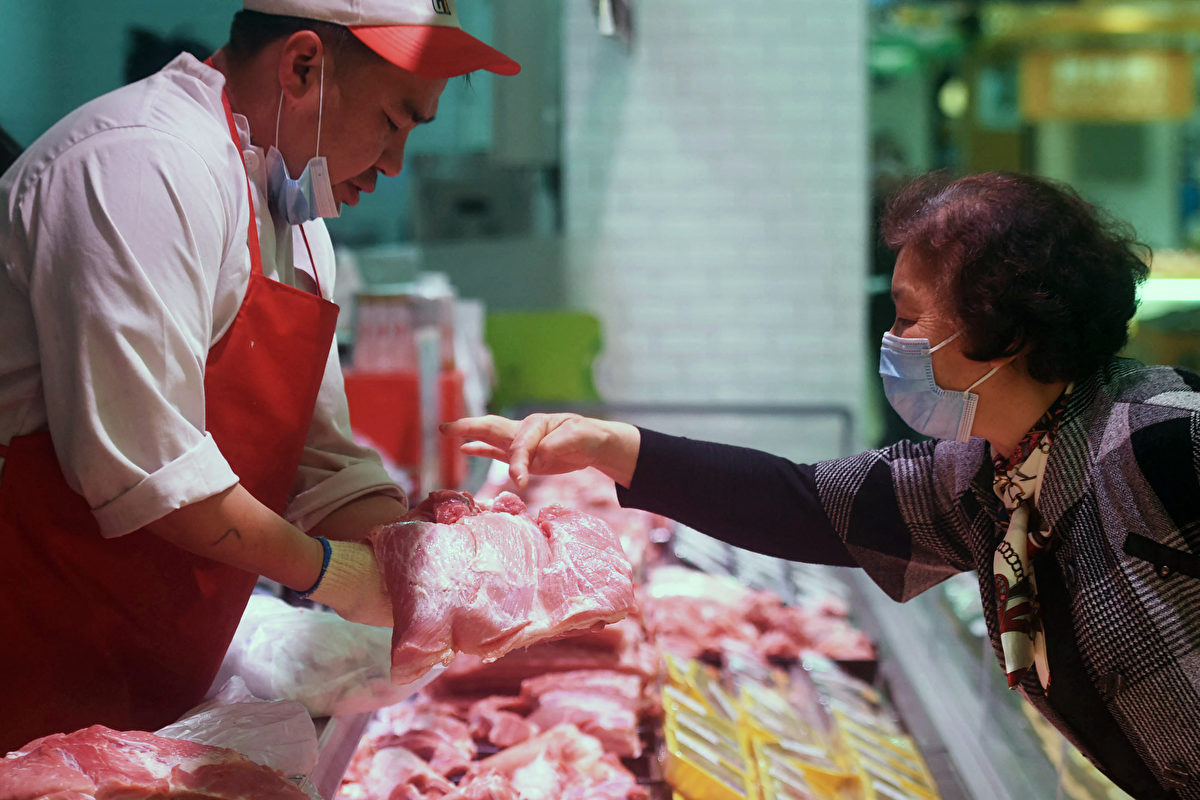
In a report from July 19th, 2026 by Epoch Times, the pig prices hit a near 10-year low, dragging down the performance of Chinese listed pig companies, with half-year performance forecasts indicating an industry-wide loss. Analysts believe that the rapid decline in pork demand signifies the continued weakness in the Chinese economy and consumer confidence.
Twenty A-share listed pig farming companies have released their half-year performance forecasts. The data shows that these pig enterprises are expected to incur a total net profit loss attributable to shareholders of listed companies of up to 18.338 billion yuan. The vast majority of companies have transitioned from profitability to losses compared to the same period in 2025 when these 20 listed companies collectively made nearly 14 billion yuan in profits.
According to a report by the Economic Observer on July 19th, the performance announcements of listed pig farming companies show that Muyuan shares, the largest pig farming company in China, is expected to incur a net loss of 5.7 to 6.7 billion yuan in the first half of the year, ranking at the top among the 15 listed pig enterprises in terms of losses. Calculated for the first 181 days of 2026, Muyuan shares are expected to incur daily losses of 31.49 to 37.02 million yuan.
Following closely behind, New Hope Group and Tianbang Food are expected to incur losses of 1.6 to 1.8 billion yuan and 1.5 to 1.6 billion yuan respectively in the first half of the year, with New Hope Group’s second-quarter losses remaining relatively flat compared to the first quarter, while Tianbang Food’s second-quarter losses increased.
Many companies stated in their performance forecasts that the main reason for the losses is the sharp decrease in pig selling prices year on year. New Hope Group stated in its announcement, “Due to fluctuations in the pig market, the decrease in pig prices year on year is greater than the decrease in costs, resulting in a decline in the company’s pig farming profits compared to the same period.”
Data shows that in the second quarter of this year, pig prices continued to decline compared to the first quarter, staying consistently between 9 to 10 yuan per kilogram, falling below the cost line for companies. The breeding costs for pig companies are nearly above 11 yuan per kilogram, with most companies exceeding 12 yuan per kilogram.
Muyuan shares reported that the average selling price of their commodity pigs in the first half of the year was around 10.4 yuan per kilogram, a year-on-year decrease of about 28%. The breeding cost for Muyuan shares is around 11.7 yuan per kilogram.
Muyuan shares mentioned to mainland media that in the face of the severe situation of deep industry losses, reducing production capacity and cutting costs will be one of the adjustment measures.
Compared to listed companies, a large number of non-listed small-scale pig farming companies are already struggling to survive. According to a report from the South China Morning Post, a pig farmer in Dalian, Liaoning with 3,000 pigs confessed that they can only survive by borrowing money, having worked hard to raise the pigs, yet now struggling to even pay for the feed. Another large pig farmer in Jinshan District, Shanghai, engaged in pig farming for 42 years, used to have a scale of up to 50,000 pigs but now must close due to long-term losses.
Analysts at Changjiang Securities said that China’s pig industry is now facing a double blow of “price collapse” and “rising costs.” Whether the pig industry can truly emerge from this trough depends on whether pig production capacity can be substantially reduced and if terminal consumption can recover.
A previous report by The New York Times suggested that the plummeting pork prices in China are a “ominous sign” for the economy, as pork prices in China often represent not just food prices but also a microcosm of Chinese consumption, domestic demand, and inflation sentiments. Pork has always been one of the core staple foods in China, and its price fluctuations have strong indicative meanings for overall inflation and consumer confidence. When Chinese people begin to weaken even in the most basic pork consumption, it often reflects not only issues with production capacity but more profound cooling of domestic demand.
Hannah Liu, an economist at Nomura Securities, stated that construction workers and the social group that dines out frequently are the two major groups with the highest levels of pork consumption in China. When both of these groups experience a consumption collapse, the demand for pork will rapidly decline, indicating that the Chinese economy and consumer confidence are still quite weak.