
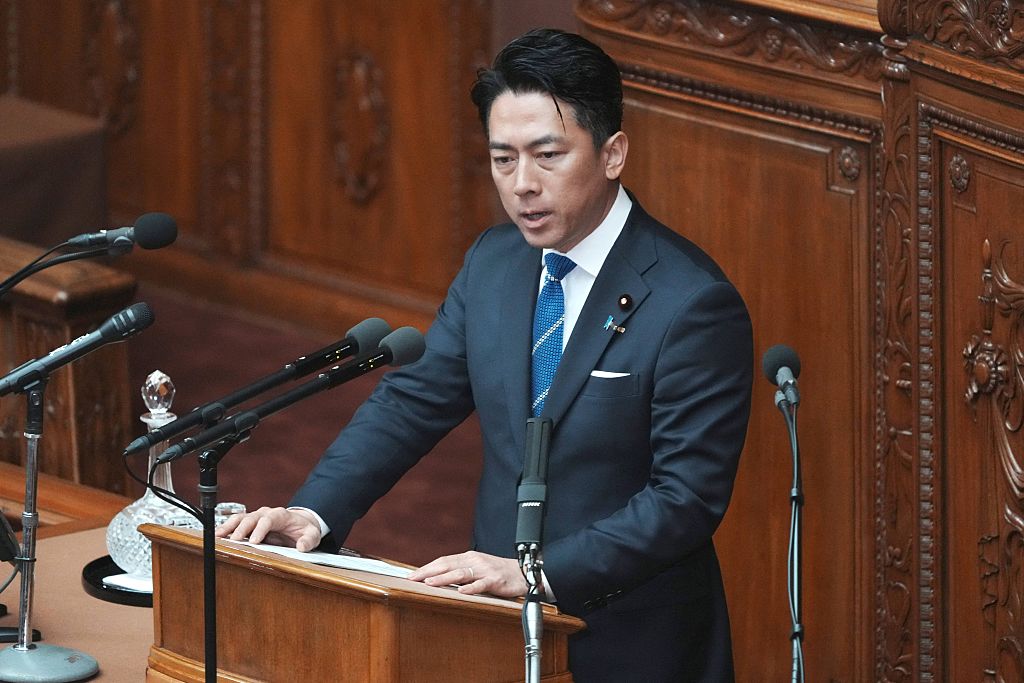
Japan’s Defense Minister Shinjiro Koizumi recently stated that, given the increasingly severe security environment in Japan, the country should have a more open discussion about the role of nuclear weapons in its national defense. This is a rare occurrence in recent years for a serving Japanese cabinet member to publicly raise such a highly sensitive and controversial topic.
In a web news program released on Friday, Koizumi said, “Although this is a very difficult issue for Japan to discuss, the topic we cannot avoid is nuclear weapons.”
His remarks come at a time when the Japanese government is considering updating its security policy, including potentially revising Japan’s longstanding “Three Non-Nuclear Principles” of not possessing, not producing, and not permitting the introduction of nuclear weapons.
As the only country that has suffered nuclear attacks, with the atomic bombings of Hiroshima and Nagasaki over 80 years ago, the Japanese public remains highly sensitive to the issue of nuclear weapons. Consequently, senior Japanese government officials have traditionally avoided making public statements on matters related to nuclear weapons.
However, Koizumi stated that Japan’s current security environment is increasingly severe, and he believes that Japan needs to change the status quo of certain issues being off-limits for discussion. Former Defense Minister Itsunori Onodera also stated at the end of last year that Japan needed to debate the future of its non-nuclear principles.
Commenting on the situation, Koizumi pointed out that Russia’s invasion of Ukraine prompted France to enhance its nuclear capabilities and pushed Finland to approve the deployment of nuclear weapons on its territory. He viewed these significant changes as being made “under the serious assumption of potential emergencies.”
“In light of this, I believe we must make greater efforts to explain to the public: Japan’s security environment demands that we examine every policy with a strong sense of crisis, discussing and advancing these policies without taboo,” Koizumi said.
Japanese authorities have often linked Russia’s invasion of Ukraine with the Indo-Pacific region and warned that “today’s Ukraine could be tomorrow’s East Asia.” This analogy has been widely interpreted as implying a potential invasion of Taiwan by the Chinese Communist Party. Last November, in parliamentary questioning, Koizumi stated that a military conflict in the Taiwan Strait could be considered a “threat to Japan’s survival.” This statement provided legal grounds for Japan to exercise collective self-defense and intervene militarily in the event of a Taiwan Strait conflict. China reacted strongly to this, subsequently launching a series of retaliatory actions.
Koizumi has consistently advocated for bold reforms in Japan’s defense policy to address the “increasingly tense regional security environment.”
Earlier this year, when asked about the possibility of amending the non-nuclear principles, Koizumi stated that, in order to enhance deterrence, “we should not exclude any possibilities and explore all options.”
One method to strengthen nuclear deterrence is by formally allowing U.S. nuclear-powered vessels to dock in Japanese ports. Last November, sources within the government disclosed that Koizumi was considering a review of Japan’s longstanding “Three Non-Nuclear Principles.”
The sources stated that, as a signatory to the Treaty on the Non-Proliferation of Nuclear Weapons, Koizumi had no intention of modifying the principles of not possessing and not producing nuclear weapons. However, they indicated that Koizumi was concerned that adhering to the third principle of not allowing the introduction of nuclear weapons to Japan could hinder the docking of U.S. nuclear-powered vessels in Japanese ports, thereby weakening Japan’s nuclear deterrence in the event of an unforeseen incident.
For Japan, the security challenges posed by China are becoming increasingly severe. Earlier this month, China test-launched a submarine-launched strategic missile (SLBM) into the Pacific Ocean without following normal international procedures. Japan, the United States, Australia, and other countries criticized China for not providing prior notification of the exact landing location of the missile, leading to insufficient preparedness on their part.
Faced with China’s ongoing military provocations, the ruling Liberal Democratic Party (LDP) and its coalition partner, Nippon Ishin no Kai, separately submitted revisions to Prime Minister Koizumi on the “Three Principles of Security” to seek concrete measures to enhance extended nuclear deterrence while also revisiting Japan’s longstanding “Three Non-Nuclear Principles.”
China has criticized the Koizumi government’s efforts to strengthen defense capabilities as “neo-militarism.” However, Defense Minister Koizumi countered these claims at the Shangri-La Dialogue held in Singapore at the end of May, stating that China continues to maintain a high level of defense spending and expand its military capabilities with a lack of sufficient transparency. China’s foreign posture and military activities are not only of serious concern to Japan but to the international community as a whole.
“Imagine a country possessing a vast arsenal of nuclear weapons and a fleet of strategic bombers, while Japan has none of these weapons, yet is labeled as ‘neo-militarist’?” Koizumi remarked.
(This article was referenced from The Japan Times.)