
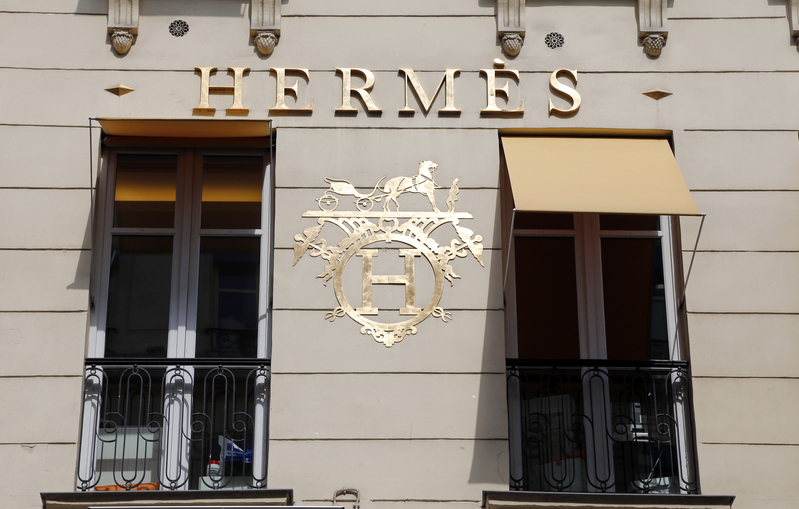
Citibank has lowered its revenue expectations for French luxury giant Hermès, and maintained a “neutral” rating on its stock, citing factors such as continued sluggish demand in the Chinese market. Axel Dumas, the CEO of Hermès, previously mentioned in a financial briefing that they would assess the Chinese consumer market by monitoring pork prices.
In a report released on September 30th, Citibank revised down Hermès’ target stock price from €1689 to €1540, while keeping its “neutral” rating, citing the ongoing soft demand in the Chinese market. Performance in the domestic French market also showed signs of weakness.
Ahead of Hermès Group’s announcement of third-quarter sales performance, Citibank also adjusted its revenue expectations, expecting sales trends in other countries and regions to remain largely consistent with the second quarter.
Citibank lowered its growth expectations for Hermès’ leather goods division in the second half of the year (calculated at a fixed exchange rate) by 0.5 percentage points. The growth expectation for the non-leather goods division was also reduced from 4% to 3%, as the soft sales of high-end consumer goods are expected to further deteriorate.
The bank downgraded its forecasts for Hermès’ group sales in 2026, 2027, and 2028 by about 0.5%. The anticipated growth rate for 2026, based on a fixed exchange rate, is now 6.4%, lower than the previous forecast of 6.8%. Assuming gross margin and operating costs remain unchanged, Citibank lowered its expectations for Hermès’ business profit and earnings per share for the next three years by approximately 1%.
Compared to its competitors, Hermès has a higher reliance on the Chinese market. As of the end of the second quarter, revenue from the Greater China region accounted for about 43%; in the same period, LVMH Group’s revenue from Asia markets excluding Japan was 29%.
In late July, Hermès released its second-quarter financial report. CEO Axel Dumas stated during the briefing that the Chinese market has not yet recovered, and aside from monitoring the local real estate market, they look at an unusual indicator when assessing Chinese consumer market trends – pork prices.
Dumas mentioned, “In China, pork is commonly consumed during feasts and in restaurants, so pork prices serve as a good indicator of celebratory activities,” and stated that a rise in pork prices could reflect a warming optimism.
However, according to the mid-year performance reports officially disclosed by various listed pig farming companies in September this year, and the latest market trends, pork prices hit a near-lowest point in the first half of 2026 in nearly a decade, leading to deep overall losses for the listed pig companies in China. Among the 23 A-share listed companies mainly engaged in pig farming, as indicated in their mid-year reports, as many as 21 recorded losses, with a total loss exceeding 21 billion RMB. The industry has shown a drastic turnaround from profit to loss, as during the same period in 2025, these 23 listed pig companies collectively made a profit of approximately 17.888 billion RMB.
Several companies mentioned in their mid-year reports that the main reason for the performance losses was the impact of fluctuations in the pig market, with a greater year-on-year drop in pig prices compared to cost reductions.
The latest data from the National Bureau of Statistics of China indicates that domestic demand remains weak, with consumption showing a lackluster performance. Retail sales of consumer goods grew by 0.4% year-on-year in August, and 1.1% from January to August; meanwhile, fixed-asset investment fell by 7.2% year-on-year, with real estate development investment declining by 19.9% during the same period.
Reuters reported that consumer spending during the long holiday season is typically indicative of Chinese household consumption trends. During the extended holiday on October 1st, Chinese people are traveling longer distances, including outbound travel.
A survey revealed that during the Mid-Autumn Festival and the National Day holiday, 33% of travelers chose mid-range hotels, 29% opted for budget hotels, totaling over 60%; only 5% planned to stay in luxury hotels.