
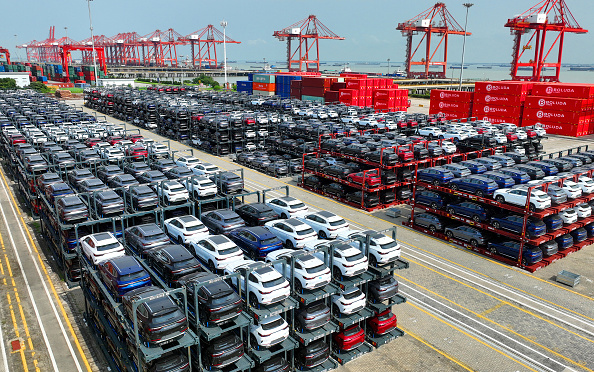
China’s smart vehicles are rapidly entering overseas markets with on-board cameras, microphones, GPS, and internet connectivity, raising concerns in multiple countries about data and national security. Currently, countries like the UK, the US, Poland, and Israel have implemented varying degrees of restrictions.
According to a report from The Guardian on October 1st, the UK Ministry of Defense has banned vehicles containing Chinese components from entering certain sensitive military facilities, including the RAF Wyton airbase and the headquarters of the Special Boat Service in Dorset. Last year, UK defense contractors had also warned employees against pairing phones with Chinese-made electric vehicles to mitigate data security risks.
On September 30th, MI5 issued a rare public warning to British universities to halt cooperation with the China General Technology Research Institute, citing it as a front for Chinese intelligence activities that fund UK scholars to acquire sensitive technologies and research outcomes in high-tech projects.
Similarly, the Dutch intelligence and security service (AIVD) released a report on the same day cautioning that networked vehicles could be used for espionage activities. AIVD highlighted that modern networked vehicles equipped with cameras, microphones, GPS, and internet connectivity could collect vast amounts of data on passengers, vehicles, surrounding individuals, and objects. They cautioned personnel handling sensitive information against connecting devices like phones to vehicles.
In a test conducted earlier on a Chinese electric vehicle, researchers found that the vehicle continued attempting to connect to servers in China even after deliberately cutting off external networks. According to a report by Yahoo Autos in September, researchers drove a NIO ES8 into a Norwegian underground mine and found that the vehicle persisted in seeking connections with external servers despite network disconnection.
Over a monitoring period of approximately two and a half years, researchers discovered that about 90% of external connections from the vehicle were directed towards servers in China, with the remainder in Germany, the US, the Netherlands, and Switzerland. However, due to encryption, researchers were unable to determine the specific data being transmitted.
Concerns surrounding the security of networked vehicles have been reflected in several countries’ policies. The US Department of Commerce announced final rules on January 14, 2025, restricting certain networked vehicle software, hardware, and manufacturers related to China and Russia from entering the US market. The US government fears that such technologies could enable foreign adversaries to access sensitive data and potentially remotely control vehicles.
The regulations came into effect on March 17, 2025. Restrictions on software and hardware related to networked vehicles from China and Russia will be implemented starting from the 2027 models and 2030 models, respectively.
In February 18, the Polish military prohibited Chinese-manufactured vehicles from entering protected military facilities and banned official phones from connecting to these vehicles’ entertainment systems. Poland expressed concerns that on-board cameras, sensors, positioning, and networking devices could collect sensitive data.
Israel’s restrictions came even earlier. In November last year, Israeli media reported that the Israeli Defense Forces had begun withdrawing around 700 Chinese-made vehicles, primarily Chery models, previously issued to officers. Security agencies were worried that cameras, microphones, and other smart devices in the vehicles could lead to the leakage of sensitive information. Prior to this, Israel had already restricted Chinese-made vehicles from entering military bases.
The potential data security risks posed by Chinese electric vehicles have also sparked discussions in Canada. An initial trade agreement reached between Canada and China on January 16 allowed a maximum of 49,000 Chinese electric vehicles to enter Canada annually with a 6.1% tariff.
According to a report by Global News in June this year, Canadian government data revealed that over 2,900 Chinese electric vehicles had entered Canada in May. Internal briefing documents obtained by the media indicated that government officials identified privacy and national security as potential risks when evaluating Chinese electric vehicles. The documents suggested that data collected by vehicles could be utilized to understand individuals’ lifestyles and activities, as well as conduct surveillance at sensitive locations.
Following the preliminary trade agreement with China, on January 19, Ontario Premier Doug Ford publicly opposed the importation of Chinese electric vehicles, expressing concerns not only about the impact of low-cost Chinese automobiles on Ontario’s auto industry but also raised national security issues.
Ford referred to Chinese electric vehicles as “spy cars,” indicating a lack of trust in the installed equipment and suggesting that the technology could be used to eavesdrop on Canadians’ phone calls. He likened the arrangement to “Huawei 2.0.”