
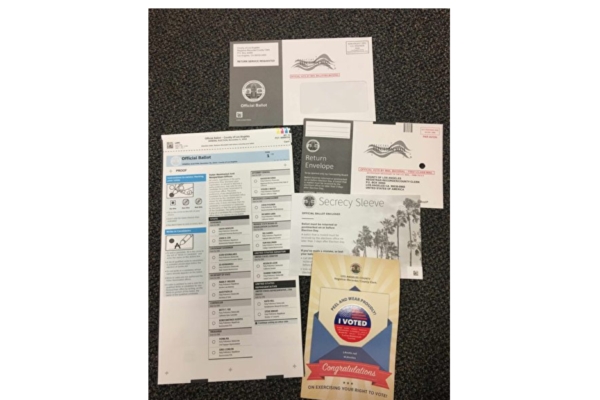
Voting is one of the most important rights of American citizens, and the mail-in ballots for the November 2026 election in California will be sent to the post office on Friday and Saturday (October 2-3) for delivery, with voters able to receive them as early as Monday. The Supreme Court’s decision in September did not change the way voters register and cast their ballots in California.
On October 5th, California voters will start receiving their mail-in ballots.
October 19th is the deadline for online voter registration. (In-person registration at polling centers is still possible using “provisional ballots” for voting.)
For over 20 counties in California implementing the Voter’s Choice Act, the first batch of voting centers will open 10 days before election day on October 24th. On October 31st, all in-person voting locations across the state will open four days early.
On November 3rd, the last day for in-person voting will be until 8 PM; while mail-in ballots postmarked on that day can arrive at the county election center up to 7 days later.
Orange County Registrar of Voters began printing ballots on September 7th; on September 8th, staff started inserting the ballots and instructions into envelopes (dates and procedures may vary for different counties in California). The United States Postal Service (USPS) expects to receive about 1.9 million mail-in ballots for active voters by October 3rd, with voters able to receive them as early as October 5th. If voters prefer not to wait, they can personally pick up and fill out their ballots at the Santa Ana election center on October 5th.
After receiving their ballots, Orange County voters have four ways to vote: mailing their ballots, dropping them off in ballot drop boxes (128 locations), submitting them at voting centers, or scanning them in person (191 locations).
For the first three methods, voters must sign their names and addresses on the envelopes, and the ballots will undergo a complex processing flow: collection and transport to the tabulation center, machine sorting, ballot retrieval, scanning, signature verification, ballot inspection and verification, duplication of ballots if necessary, and sending letters to voters for signature verification. While voters can avoid casting their ballots in person (and instead have someone else do it for them), this elongates the counting process, increases the workload and costs of election officials, and also adds risks.
According to the Orange County Election Center, the barcode on the envelopes is only used to identify the ballot issued to each resident, along with USPS mailing data, and does not contain information about a voter’s party affiliation or voting choice.
Voting in person at the polling center, on the other hand, bypasses the aforementioned process. Voters can simply take their pre-filled ballots to scan directly on the machine, with the data (without internet connection) stored in a chip, usually counted in the county’s election results the same evening of November 3rd. California typically announces final results a month after the election day. Usually, there are no queues at polling centers before November 3rd, but this method requires personal voting, with staff only asking for names and addresses without actively requesting identification.
In this year’s November election, Orange County has 2,377 precincts with a total of 549 different ballot styles for various precincts, each with five different barcodes linking to different election contents. The tabulation center will only count the content of the first ballot you submit, ignoring any subsequent ballots. Voters can also track their ballot status on the California and Orange County websites.
On September 25th, the U.S. Supreme Court ruled 6-3, allowing local officials in states to utilize the federal database to verify the citizenship of registered voters during ongoing lawsuits, pausing the expanded use of the SAVE system as proposed by the Department of Justice. The SAVE system links Social Security Administration data with Homeland Security immigration records, facilitates searches using Social Security numbers (SSN), and allows for multiple inquiries.
Orange County Registrar of Voters office stated that the Supreme Court’s decision will not change how voter registration is conducted in California. Both federal and California laws require voters to sign an affidavit, declaring their U.S. citizenship and bearing the responsibility of perjury, though California law does not mandate providing proof of citizenship during registration.
California law stipulates that, for voting eligibility, a voter’s self-declaration is considered proof of citizenship. Voter registration officials are not authorized to independently verify a voter’s citizenship. As such, Orange County Registrar of Voters (ROV) will comply with these laws; however, in case of allegations against a voter’s non-citizenship, the matter will be referred to the Orange County District Attorney’s Office or the Secretary of State’s office for investigation.
Moreover, the Registrar of Voters will also adhere to the federal Help America Vote Act, which requires individuals registering to vote by mail for the first time to provide either a valid California driver’s license number or state identification number. If the applicant cannot provide said identification numbers, they must supply their name, date of birth, and the last four digits of their Social Security number (SSN), which must match the data stored at the Department of Motor Vehicles (DMV).
Federal law prohibits election officials from removing voters from the registration books within the 90 days preceding a federal election (August 5th for California).
California law deems voter registration information as confidential public records, including the voter’s California driver’s license number, California identification number, Social Security number, language preference, and signature as absolute confidential information, not to be disclosed or made available to anyone. The Registrar of Voters will only provide voter registration information in compliance with state laws for purposes such as election and political activities, academic research, news reporting, government work, and record audits.
On the afternoon of October 6th, the Orange County Election Center will host an open house event, allowing local residents to understand and witness the ballot processing procedures. Center staff will demonstrate the relevant processes and answer questions from residents to showcase how the election process is secured, fair, and transparent. Interested residents can directly register at the entrance to participate.
The demonstration will include: utilizing the chain-of-custody to collect ballots from drop-off boxes and voting centers, scanning the ballots, understanding tests and audits of election equipment and software, and the state-funded “Your Vote, Counted 1st” new voter education campaign aiming to encourage residents to vote early. ◇