
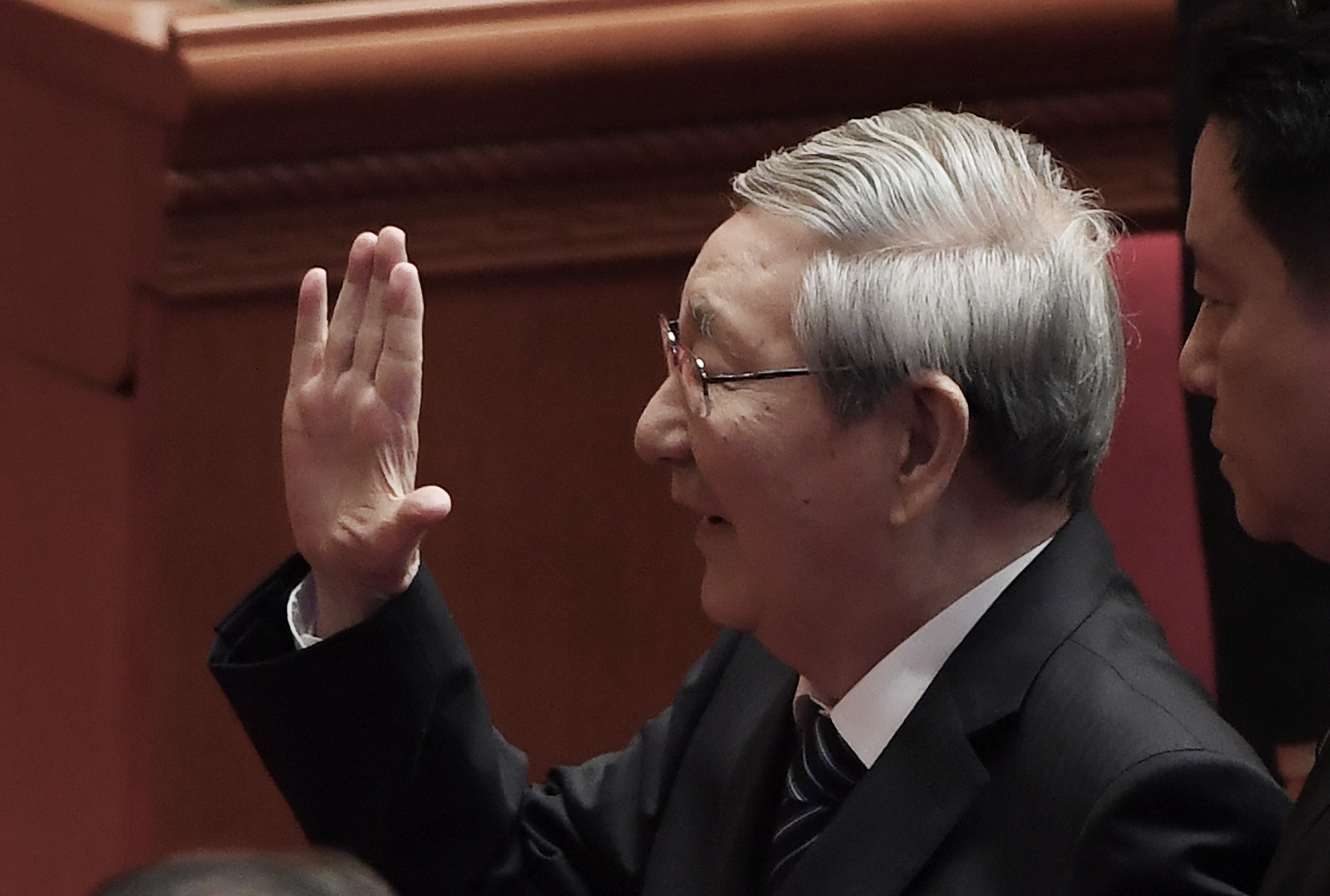
Former Chinese Premier Zhu Rongji passed away in Beijing on August 12, according to overseas observers. They believe that the details in the official obituary, involving the authorities covering up true history and Xi Jinping using Zhu Rongji’s death for political gain, reflect a part of the so-called end of the reform and opening-up era in China.
Born on October 23, 1928, Zhu Rongji’s first thirty years in his career were not smooth. In 1957 during the Anti-Rightist Campaign, he was labeled a “rightist” in January 1958. During the Cultural Revolution, Zhu Rongji was sent to labor for five years at the National Planning Commission farm school.
However, the official obituary did not mention Zhu Rongji being labeled as a rightist or even the Cultural Revolution. It only stated that he had been sent to labor at the National Planning Commission’s “Five-Seven” farm school.
Chinese affairs expert and seasoned political commentator Chen Pokong told Epoch Times that the obituary completely omitted Zhu Rongji being labeled a rightist, indicating that the authorities still intend to cover up the history of those years.
The obituary emphasized that Zhu Rongji “dared to speak the truth and was not afraid to offend people.” Chen Pokong noted the irony in this statement, highlighting the current era’s stark contrast. While Zhu Rongji could speak the truth without facing great danger back then, in the era of Xi Jinping, speaking the truth might result in loss of life and various forms of suppression, showing a regression in the times.
The official obituary stated that Zhu Rongji firmly supported and endorsed both Hu Jintao and Xi Jinping’s leadership during their terms.
Chen Pokong mentioned that Zhu Rongji indeed supported Hu Jintao and Wen Jiabao, but not Xi Jinping, whom he considered extremely leftist. During the 19th National Congress when Xi Jinping was reelected, the news footage showed Zhu Rongji as the only one in the entire assembly who did not applaud. Zhu Rongji, a political veteran and a reformist, was feared by Xi Jinping who is wary of political elders and reformists.
On March 15, 2022, The Wall Street Journal published an article titled “China’s Economic Contraction Exposes Cracks in Xi Jinping’s Power,” citing internal sources from the Chinese Communist Party revealing that some retired CCP heavyweights, including Zhu Rongji, openly opposed Xi Jinping’s desire to break the established leadership succession system.
The obituary concluded by stating the need to “turn sorrow into strength by uniting more closely around the Central Committee with Xi at the core.”
Chen Pokong believed this was a forced narrative, indicating that Zhu Rongji was likely under some form of soft detention before his passing, with Xi Jinping now trying to exploit Zhu Rongji’s legacy for his own benefit.
However, Chen Pokong believed that Zhu Rongji’s passing was likely due to natural causes and wouldn’t trigger spontaneous national mourning as it did for the late Li Keqiang.
In recent years, Xi Jinping has cracked down on the financial system, targeting many individuals nurtured by Zhu Rongji.
Zhu Rongji and Wang Qishan are widely regarded as having a mentor-mentee relationship. Wang Qishan, who used to be in the Central Commission for Discipline Inspection and the financial system, has been investigated multiple times by the Xi administration, with rumors of him being under house arrest circulating.
Chen Pokong pointed out that many reformists emerged from Zhu Rongji and Wang Qishan’s circle, including former Finance Minister Lou Jiwei, who surfaced again after some trouble. However, Xi Jinping’s administration views them all with hostility.
During his twelve-year tenure as Vice Premier and Premier, Zhu Rongji led China’s economic development, including reforming state-owned enterprises, relaxing currency controls, opening the real estate market, implementing a tax-sharing system, and joining the World Trade Organization. However, his reforms led to significant criticism from the public due to widespread layoffs in state-owned enterprises.
The official obituary extensively highlighted Zhu Rongji’s reform measures, stating that he “vigorously promoted reform and opening-up.”
Chen Pokong believed that Zhu Rongji’s passing symbolizes the end of the reformist era as the authorities have declared an end to reform and opening-up, entering the so-called “new era” under Xi Jinping. “The era before Xi Jinping’s time was called the reform and opening-up era, the period before that was Mao Zedong’s era known as the construction era, and before 1949 was the revolutionary era. This means that the reform and opening-up era has come to an end. Zhu Rongji’s passing is just a part of the closure of the reform and opening-up era.”