
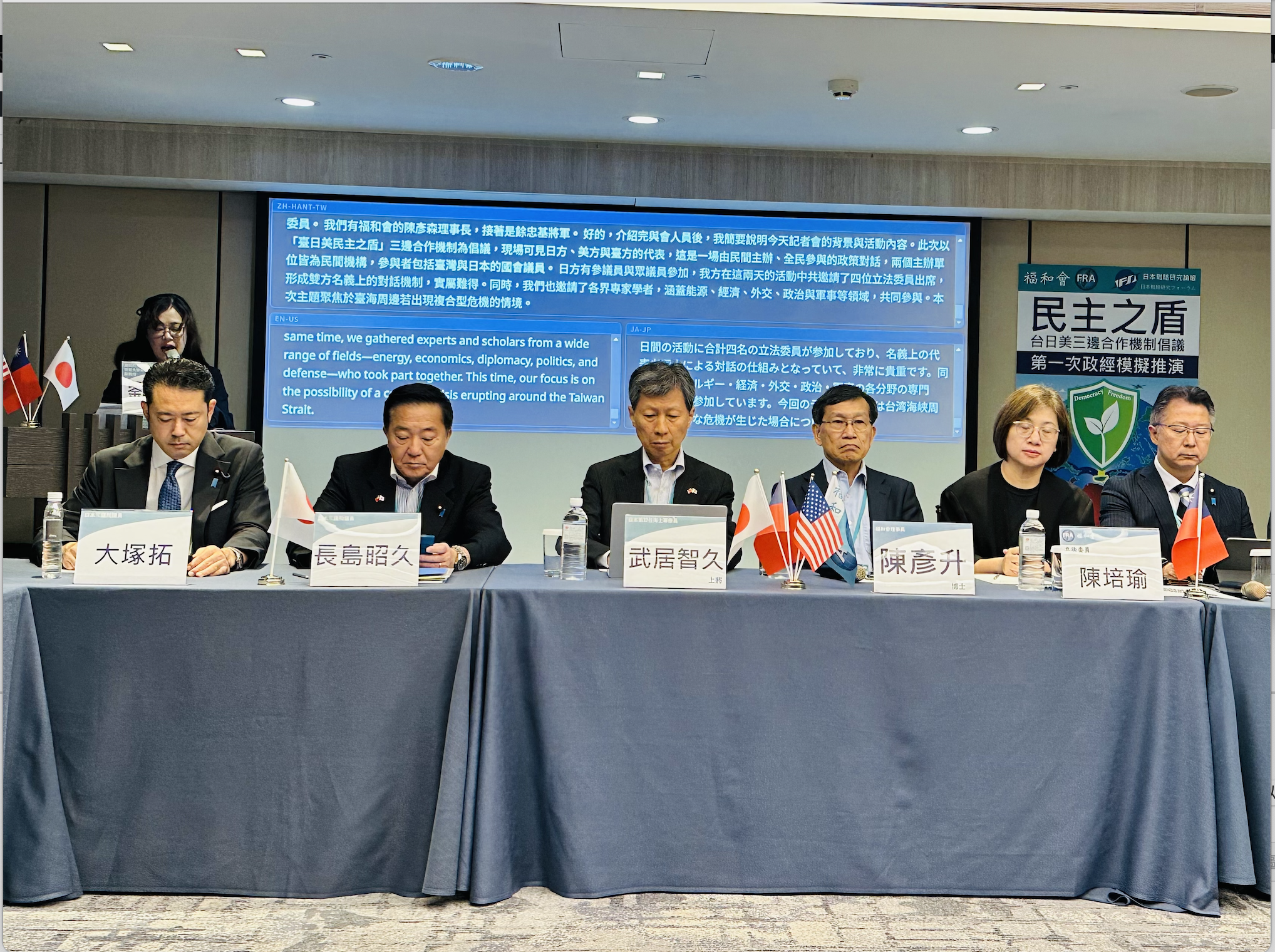
TAIPEI, August 10, 2026 – The Formosa Republican Association and the Japan Forum for Strategic Studies (JFSS) recently held the “Shield of Democracy: First Political and Economic Simulation Drill Proposal for Trilateral Cooperation among Taiwan, Japan, and the United States” in Taipei. The event gathered parliamentarians, retired military officers, government officials, and think tank experts from Taiwan, Japan, and the United States to discuss various issues including energy, humanitarian aid, transportation, healthcare, cognitive warfare, supply chains, and societal defense resilience.
The Formosa Republican Association emphasized that this event was a civilian-led “political and economic simulation drill,” not a military exercise involving troop deployment. American and Japanese experts present at the event highlighted the importance of preparedness in addressing potential natural disasters, energy disruptions, maritime transportation blockades, communication or financial crises, and various man-made emergencies. They stressed the need to establish communication and mutual assistance mechanisms across different sectors and nations.
Former Commander of the U.S. Seventh Fleet, Mark Montgomery, stated during the press conference that the significance of the simulation was not in how troops would be deployed but in preemptively considering various crises and needs. He emphasized the importance of different government departments establishing “interoperability” to ensure smooth communication and rapid planning in times of crisis.
Montgomery further pointed out that the challenges to Taiwan’s societal resilience have transcended purely domestic issues and require close cooperation with partners and allies such as the United States and Japan.
According to the organizers, the political and economic simulation exercise brought together individuals from different fields to discuss political, economic, and social crises that could be encountered in the future.
Guermantes Lailari, former researcher at the Institute for National Defense and Security Research (INDSR) and retired U.S. Air Force Colonel, explained in an interview that traditional war exercises and troop deployments are typically conducted by military personnel. However, the participants in this event came from various sectors, including political figures, placing the focus on discussing potential challenges rather than conducting war exercises.
He noted that crises are not limited to warfare but can also include natural disasters such as earthquakes, tsunamis, and typhoons. Different crises may result in similar civilian needs, such as ensuring hospital operations, food and drug supply, water supply, and energy sustainability during significant disasters.
Lailari highlighted that if energy sources such as oil and natural gas cannot be delivered to Taiwan or Japan, the issue extends beyond military implications to affect economic, financial, and societal operations. It may even necessitate a review of existing legal frameworks to ensure adequacy in response. Planning for various scenarios and drawing from the legal and contingency experiences of different countries are essential during crises.
He emphasized that the core of this political and economic simulation drill is not to predict the outbreak of a specific war but to facilitate discussions among Taiwan, the United States, and Japan on “what we can do, what we need, and how we can assist each other in times of crisis.”
Non-military topics, particularly maritime transportation and safe navigation, were central points of discussion at the event.
Montgomery highlighted the importance of maritime forces in delivering vital supplies such as food and water to threatened or crisis-affected regions. With approximately 95% of global trade conducted via sea routes, advance planning is crucial to ensuring maritime safety, guiding commercial vessels, and providing necessary rescue efforts during crises.
He mentioned that the U.S. National Security Council follows established procedures for decision-making during crises. In certain situations, the military or the Coast Guard may take preemptive humanitarian actions; however, the timing of implementing relevant measures still involves political decisions at the national security level.
“The timing of actions is not determined by the military but by the National Security Council,” he stressed. He further pointed out that crisis response involves not only military aspects but also political decisions, administrative coordination among departments, coast guard cooperation, and collaboration with international partners.
Montgomery also addressed Taiwan’s ongoing efforts in promoting societal defense resilience, particularly focusing on ensuring the operational continuity of Taiwan’s systems in energy, communication, and finance during crises. He emphasized that Taiwan’s challenges have surpassed domestic scopes, necessitating closer cooperation with partners such as the United States and Japan. “Dealing solely with domestic issues is insufficient,” he said. Establishing coordination mechanisms with partners in advance is crucial.
He mentioned that while artificial intelligence (AI) did not dominate the roundtable discussions, AI has been increasingly integrated into planning tools in the United States. AI tools can aid in analyzing and planning operations, such as mobilizing ships, determining required resources, assigning responsibilities, and cargo selection on each vessel during military operations and crisis scenarios.
This signifies that future crisis response involves not only manpower and resources but also encompasses information and technological capabilities. Utilizing AI to enhance decision-making efficiency while ensuring the exchange of necessary information among countries may become a new focal point for Taiwan-U.S.-Japan cooperation.
Japanese House of Representatives member Akihisa Nagashima pointed out that due to the absence of formal diplomatic relations between Japan and Taiwan, the official dialogue channels between the two sides are limited. Thus, parliamentary exchanges have played a complementary role over the years.
Nagashima believed that while fostering goodwill and building mutual trust through parliamentary exchanges are important, it is insufficient. Clarifying shared perceptions on what Japan, Taiwan, and the United States can do and when they should take action in times of sudden crises requires a clearer common understanding.
Therefore, Nagashima affirmed the value of the policy simulations, suggesting that discussions in various scenarios enable the three parties to understand each other’s perspectives and bring back issues for further consideration in their respective countries.
He mentioned that in recent years, Taiwan’s promotion of societal defense resilience has provided valuable lessons for Japan. Conversely, Japan has experiences in energy reserves and supply chain diversification that could offer insights for Taiwan.
Japanese House of Representatives member Hiroki Otsuka stated that the economies of Taiwan and Japan are highly interconnected, particularly in the semiconductor industry. Besides natural disasters, preparations for artificial crises can mitigate damages in advance. Therefore, collectively pondering on how Taiwan, the United States, and Japan can prepare effectively is imperative.
Another Japanese House of Representatives member, Yusuke Shikashima, highlighted that beyond preparedness and information sharing, establishing face-to-face trust among the three parties was a significant achievement of the event.
Taiwanese legislator Pei-Yu Chen expressed hopes that through such exchanges, Taiwan can convey to the international community its active efforts in enhancing societal defense resilience, including preparations in material transportation, medical readiness, cognitive warfare, and humanitarian aid.
Chen Yan-Sheng, Chairman of the Formosa Republican Association, stated that the greatest gain from the policy simulation was the demonstrated high willingness for cooperation among attendees from Taiwan, Japan, and the United States, who expressed readiness to closely collaborate, support, and assist each other when circumstances allow.
He stressed that strength guarantees peace, and therefore, preparedness should be prioritized during peacetime. Through mutual participation in the political and economic simulation among the three parties, each side can understand the capabilities and needs of the others before crises occur, leading to more comprehensive future readiness planning for Taiwan.
Lailari suggested that the significant aspect lies in establishing long-term connections across all societal levels, including government, parliament, businesses, and civil society. Maintaining these relationships continuously, even in the absence of crises, is critical because political figures in democratic nations and parliament members undergo changes, and collaboration should not halt with political transitions.
He reiterated that in the event of man-made or natural disasters in the future, all parties should know “who to turn to” and how to directly contact for assistance.
Following the press conference, the Formosa Republican Association stated that it would continue to advance similar forums and consider inviting neighboring countries such as the Philippines, Australia, and more partners to participate, expanding the cooperation network.