
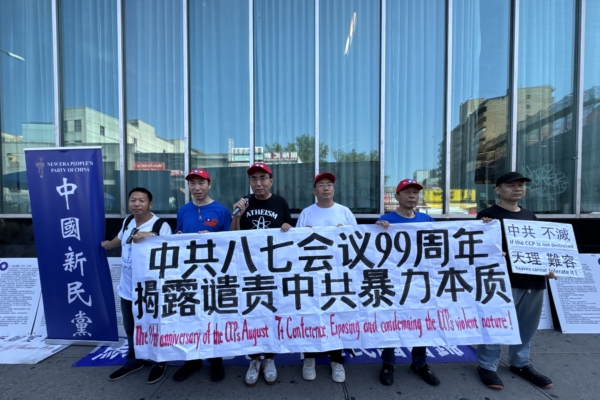
On August 8th, the China New Era People’s Party held a gathering in Flushing, New York, to commemorate the 99th anniversary of the Chinese Communist Party’s “87 Conference” in 1927. The party pointed out that from the establishment of the armed struggle route at the “87 Conference” 99 years ago to the current high-pressure control of society by the Communist Party of China (CCP), its essence has always been maintained through violence and struggle. They urge the Chinese people to understand the history and essence of the CCP and not to be deceived by its lies.
In 1927, the first cooperation between the Nationalist Party (Kuomintang) and the CCP collapsed, leading to a significant setback for the CCP. On August 7th of the same year, the CCP Central Committee convened an emergency meeting in Hankou, where they revoked Chen Duxiu’s leadership position and established the route of land revolution and armed struggle. Mao Zedong suggested at the meeting that “political power grows out of the barrel of a gun” and subsequently initiated a series of armed actions like the Autumn Harvest Uprising. The “87 Conference” was a crucial historical turning point in which the CCP shifted from political cooperation to armed struggle.
Yang Maosen, the founder of the China New Citizens Party, believes that compared to the previous Nanchang Uprising, the “87 Conference” had a greater impact later on, marking the beginning of suffering for the Chinese people. He stated that the path of violent revolution not only influenced the CCP’s seizure of power but also continued into the political governance after the establishment of the People’s Republic of China in 1949. Land reforms, suppression of counter-revolutionaries, anti-rightist movements, Great Leap Forward, Cultural Revolution, and a series of political campaigns resulted in a significant number of abnormal deaths, endless persecution, and deep societal trauma.
Exactly one year ago on August 7th, it was the day when Yang Maosen organized the first solo street event while establishing the China New Citizens Party. When asked why he and his team have been holding street gatherings every week regardless of the weather for the past year, Yang Maosen replied, “The CCP maintains its rule through violence and whitewashes it with lies. We aim to expose the CCP’s atrocities and lies to help people understand the truth. When people no longer believe in the CCP, its tyranny will have difficulty continuing.”
Yang Maosen also mentioned the recent film “The Endgame of Winnie” broadcast on the “Clean World” platform, suggesting that when the time comes, the end is truly near for the CCP, with figures like Maduro and Khamenei becoming their future. He emphasized that opposing the CCP is not just about opposing certain leaders or periods but the entire regime.
During the gathering, former Fujian entrepreneur Chen Shufu shared insights into China’s current economic situation and the survival conditions of private enterprises. Chen previously ran an environmental protection company in Fujian and highlighted how local governments and townships owe a significant amount of project payments to businesses, some even reaching billions of yuan. Due to the lack of sufficient cash from the government, companies have to scrape by to keep operations running.
Chen also mentioned instances where local governments compensate for overdue project payments with real estate properties. Even if business owners do not need these properties, they often have little choice but to accept them. He shared that during his time in business in China, he faced long-standing issues of delayed project funds, leading to his company eventually closing down; the phenomenon of “triangle debts” formed between overdue project payments and companies is quite widespread, not just limited to his company, but affecting many other business owners he knows.
“It’s quite common, there’s no way out, it’s hard to survive,” Chen remarked. After coming to the United States, he chose to openly participate in anti-CCP activities, aiming to shed light on the real struggles faced by private Chinese enterprises through his own personal experiences.