
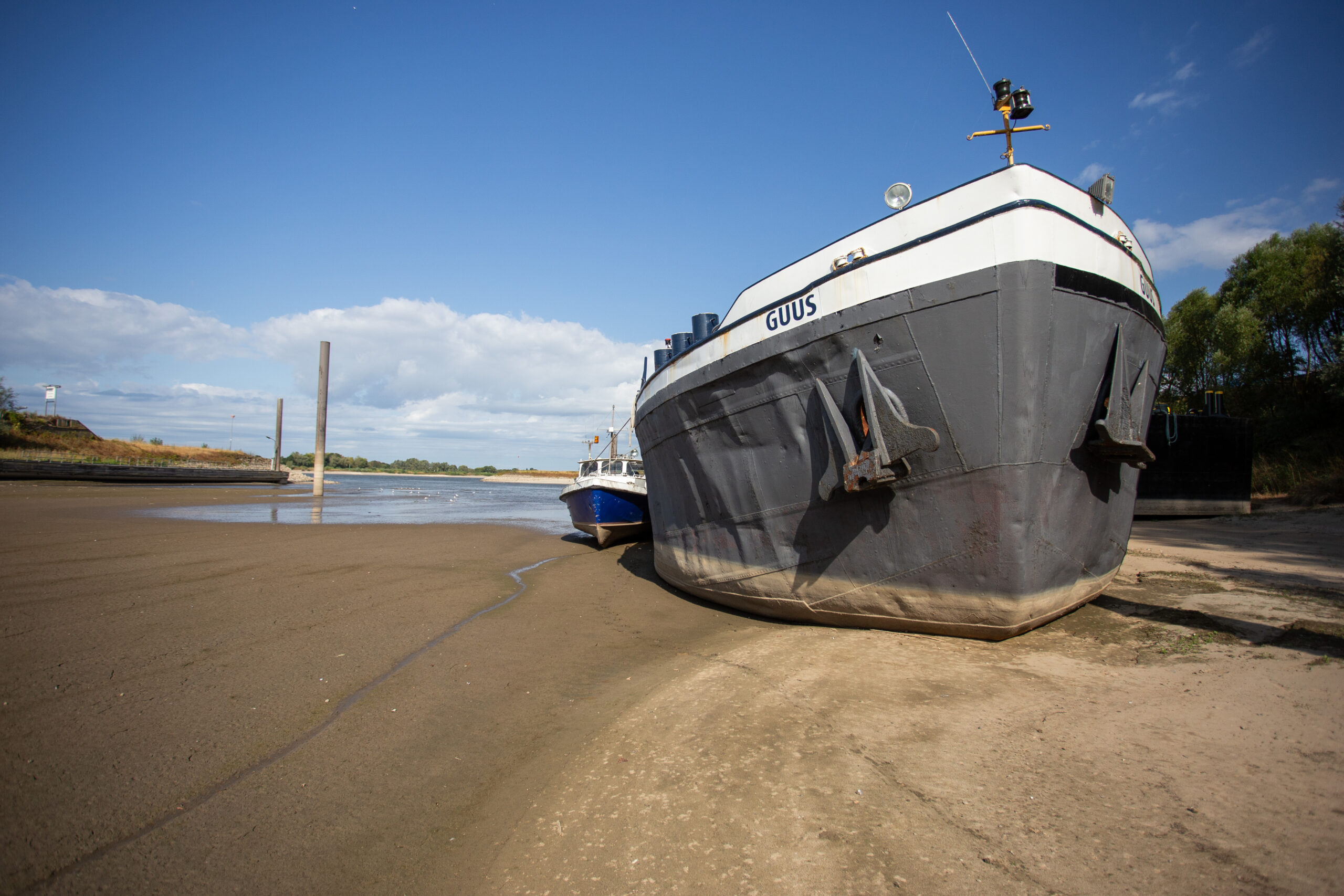
Amid historical high temperatures and drought in Southeastern Europe and Central Europe, the water levels of the two key European river systems, the Danube and the Rhine, have fallen to historic lows, leading to the shutdown of nuclear power plants and directly impacting the economy.
The scarcity of water resources has not only caused sunken World War II warships and historical relics to resurface but also severely disrupted European energy supply, industrial production, and supply chains, forcing multiple governments to take extreme measures such as blasting riverbeds to address the crisis.
The Danube River, which traverses nearly 1,800 miles of Eastern Europe, has seen the vast majority of its water levels hitting record lows. In the Hungarian capital Budapest, the dried-up riverbed has brought to light the long-silent “Hungerstones” and remnants of old bridges, prompting many people to gather stones on sandbars to build towers.
Meteorological forecasts indicate that local temperatures have surpassed 100 degrees Fahrenheit (about 37.8 degrees Celsius) at times, with little hope of rain in the near future.
Meanwhile, in Germany, the economic heartland of Europe, the Rhine River at the Kaub hydrological station has dropped to 24 centimeters, setting a nearly 150-year record low since 1880, far below the normal navigational threshold of 78 centimeters.
Numerous freight barges have had to significantly reduce their loads, leading to a surge in shipping costs and low water surcharges.
The drying up of rivers directly threatens nuclear power plants and hydropower facilities that rely on river water for cooling:
In Hungary:
Hungary’s Paks Nuclear Power Plant, which accounts for about 50% of the country’s electricity generation, is on the brink of complete shutdown. As of early August, three of the plant’s four reactors have been shut down, and the remaining one can only sustain about 50% power.
The newly appointed Prime Minister, Péter Magyar, has urged national unity in conserving electricity, and the government has ordered the nighttime lighting to be turned off in over 300 government buildings and famous landmarks in Budapest, while doubling electricity imports from neighboring countries to fill the gap.
In Serbia:
Hydropower production has been forced to decrease due to insufficient water.
In France and Switzerland:
Some nuclear power plants have also reduced electricity production due to high water temperatures or inadequate cooling water.
Faced with a worsening energy crisis, the Romanian government has taken extreme measures.
The Romanian Navy has deployed underwater blasting missions in the Danube near the village of Izvoarele to dredge and deepen the waterway by controlling rock explosions. This is to forcibly divert a larger flow of Danube water to the cooling system of the Cernavoda Nuclear Power Plant, the country’s only nuclear power plant, to ensure its operation.
Experts warn that the extreme climate is making Europe the continent with the fastest warming globally, with its warming rate more than twice the global average.
Stefan Kooths, an economics professor at the Kiel Institute for the World Economy (IfW), told CNBC that disruptions in transportation and supply chain chaos caused by low water levels in the Rhine River could lead to Germany losing an estimated 10 to 20 billion euros in value added in the third quarter, potentially lowering GDP growth by 0.2 percentage points.
In addition to the energy crisis and disrupted freight transport, frequent forest fires and extreme high temperatures in Southern Europe are also significantly eroding Europe’s overall productivity.