
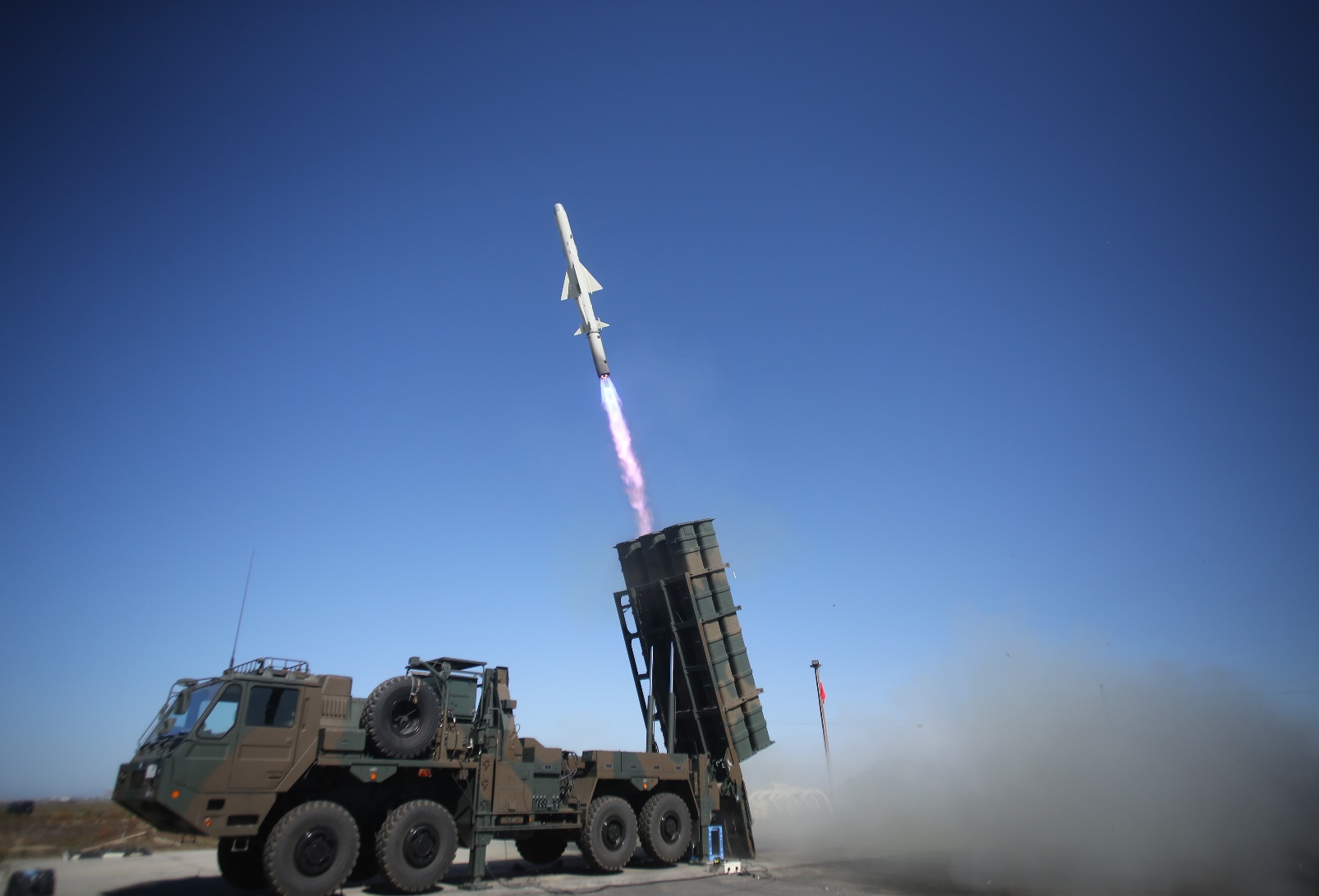
On July 30th, Japan conducted a flight test of the Type 12 anti-ship missile uplift model (air-launched type). The domestically developed Type 12 anti-ship missile uplift model has a range of up to 1,000 kilometers, covering the waters near Taiwan and parts of coastal areas in China, which will significantly enhance Japan’s defense capabilities.
A photo captured by an aviation enthusiast in Japan near the Gifu Base in central Japan on July 30th showed a Mitsubishi F-2B fighter jet carrying two Type 12 missiles without warheads underneath its wings—confirming the first public flight test of the Type 12 anti-ship missile uplift model. The flight test aimed to verify the missile’s aerodynamic characteristics and structural loads in preparation for subsequent separation testing and live-fire exercises.
The Type 12 anti-ship missile uplift model is part of Japan’s comprehensive plan to establish indigenous multi-domain counterattack capabilities. The land-based version of the missile was officially deployed in March of this year, increasing the range of Japan’s domestically produced anti-ship missiles from about 200 kilometers (primarily for targeting enemy vessels entering Japan’s surrounding waters) to approximately 1,000 kilometers. The ship-based and air-launched versions are expected to enter service in the next fiscal year, while the submarine-launched version is still under development.
The Type 12 anti-ship missile uplift model (land-based) has been stationed at the Kumamoto Base of the Japan Ground Self-Defense Force. With a range of 1,000 kilometers, it can cover the northern part of the Taiwan Strait, the coastal areas of Zhejiang, Jiangsu, and Shandong in China, as well as most regions of North Korea. Due to the aircraft’s forward deployment and maneuverability, the air-launched anti-ship missile can further expand the actual attack range beyond the missile’s original range.
According to Naval News, the aircraft captured in the photo belongs to the Air Development and Test Wing of the Japan Air Self-Defense Force, a unit responsible for testing new weapons. The development of the Type 12 anti-ship missile uplift model began with the Type 25 anti-ship missile in Japan’s fiscal year 2022. During the development phase, this land-based weapon was referred to as the Type 12 anti-ship missile uplift model (land-based).
The missile incorporates a design with low detectability to reduce its chances of being detected by enemy radars. Additionally, it is equipped with satellite-based “Up-to-Date Command” capability, allowing post-launch missile commands to be updated by the launch platform, including changing the designated target. This capability is expected to enhance the missile’s effectiveness against moving naval vessels.
The most striking feature of this missile is its range. The Type 80 Air-to-Ship Missile (ASM-1) previously used by the Japan Air Self-Defense Force had an estimated range of about 50 kilometers, while the Type 93 Air-to-Ship Missile (ASM-2) was believed to have a range of approximately 200 kilometers. In comparison, the Type 12 anti-ship missile uplift model can target objects up to 1,000 kilometers away.
This extended range is achieved through a combination of technologies, including increased fuel capacity, the use of large wings, and engines capable of effective operation at high altitudes. To accommodate this new missile, the Japan Air Self-Defense Force is upgrading its F-2 fighter jet fleet. The Japan Air Self-Defense Force plans to deploy upgraded F-2 fighters and the upgraded Type 12 anti-ship missile (air-launched type) at the Hyakuri Base in Ibaraki Prefecture starting in the fiscal year 2027.
In order to effectively utilize these long-range missiles, the Japan Self-Defense Forces must continuously detect and track enemy warships operating thousands of kilometers away and provide accurate target location data to ensure successful hits.
Therefore, Japan is rapidly developing a constellation of low Earth-orbit satellites and researching tactical drones capable of penetrating enemy threat ranges to carry out intelligence-gathering missions. Only when these comprehensive reconnaissance, surveillance, and target locating capabilities are fully established can the Type 12 anti-ship missile uplift model truly unleash its combat potential.
This missile will become a core component of Japan’s “stand-off defense capabilities.” In late 2018, the Japanese government released a new version of the “National Defense Program Guidelines,” which for the first time explicitly introduced the concept of “stand-off defense capabilities.” In the same year, Japan began exploring the acquisition of long-range precision strike missiles developed by the United States while advancing its own missile development.
The core idea of “stand-off defense capabilities” is that Japan’s aircraft, ships, or ground forces can launch weapons beyond the range of enemy air defense systems to prevent aggression against Japan. With the continued expansion of China’s navy and the increasing missile threats from North Korea, “stand-off defense capabilities” give Japan a stronger defense against threats from neighboring countries.
As the threat from the People’s Republic of China intensifies, Japan has accelerated its defense construction. When the Japan Ministry of Defense released information on the Type 12 anti-ship missile uplift model on August 29th last year, it stated, “Given that our country’s surrounding security environment has become the most severe and complex situation since World War II, we continue to relentlessly promote related work to rapidly establish stand-off defense capabilities.” The announcement also noted, “The development of domestically produced stand-off missiles is progressing smoothly.”
In addition to advancements in domestically developed missiles, Japan conducted its first test launch of the Tomahawk cruise missile on July 29th. This marks a significant milestone in enhancing operational capabilities through cooperation between the U.S. and Japanese navies.