
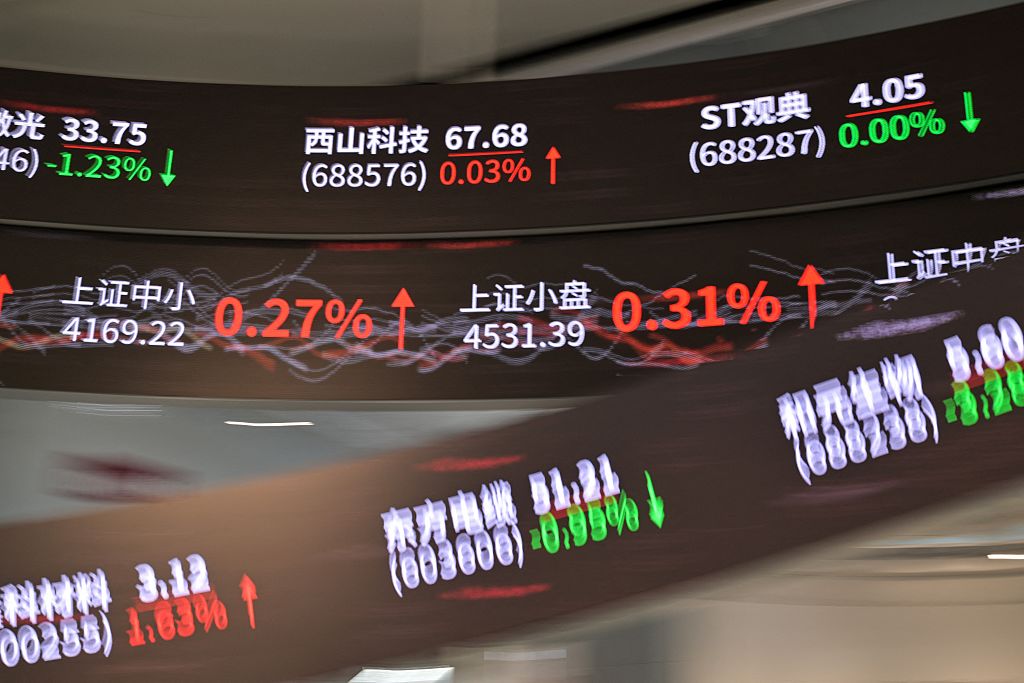
The mainland A-shares plunged again on July 30, with the ChiNext Index dropping nearly 4% and the Sci-Tech Innovation 50 Index plummeting over 5%. Over 3600 individual stocks across the market saw declines, with semiconductor, CPO (Chip Package Optics), and PCB (Printed Circuit Board) technology hardware sectors being hit hard.
According to reports from mainland China media, the Shanghai Composite Index closed at 3804.69 points, down by 0.62%; the Shenzhen Component Index fell by 2.73%; the ChiNext Index closed at 3244.62 points, a decrease of 3.97%; and the Sci-Tech Innovation 50 Index dropped by 5.38%.
The trading volume in Shanghai and Shenzhen markets increased to 2.34 trillion yuan, up by 46.2 billion yuan compared to the previous trading day.
Semiconductor, CPO, and PCB sectors led the declines. Stocks like Dongshan Precision, Gigalight Technology, Jiaxing Technology, Changdian Technology, and Tongfutech hit the limit down; Yuanqijie Technology fell by 17.2%, Xincheng Tech dropped by 17.35%, and Xysilicon fell by 11.89%.
Zhongji Xuchuang dropped by 9.15%, with a transaction amount reaching 59.773 billion yuan, setting a record high. Xin Yuan Technology and Allwinner Technology fell by more than 10%.
Prior to the sharp decline in technology stocks, institutional funds were heavily concentrated in related sectors. According to the Shanghai Securities News, Chen Guo, Chief Strategy Officer of Oriental Wealth Securities, and team estimated that by the end of the second quarter, the combined allocation of active equity funds to the electronics and communications industries reached 60.2%, the highest since 2010.
The Securities Times quoted He Xianfa, General Manager of Guolian’an’s Active Quantitative Department, saying that the short-term focus on the artificial intelligence industry might lead to premature price hikes and exhaust corporate returns. Short-term speculative funds, long-term investors, quantitative strategies, and passive index investments concentrated in the same area could also amplify price fluctuations.
Zhang Yidong and Zhou Linhong, Chief Economists of Haitong International, warned in a recent research report that the deleveraging impact following the collapse of the leveraged bull market in the South Korean stock market before mid-August may exceed expectations and potentially affect Japanese, Taiwanese, and American stock markets, even triggering a chain of global AI-related asset sell-offs.
A financial author on the Oriental Wealth platform described the technology sector as “needing artificial respiration,” and described July as potentially the “most distressing month” for most investors in the past two years, with losses ranging from tens to twenties of points.