
A Chinese man who concealed his Communist Party membership and 17-year military experience was recently arrested on the spot when entering the United States with a 10-year visa, exposing the tightening scrutiny on the identities of overseas Chinese. Analysts point out that in recent years, the U.S. has been intensifying investigations into backgrounds related to the CCP, urging Chinese people to recognize the true nature of the CCP and promptly complete organizational dissociation proof.
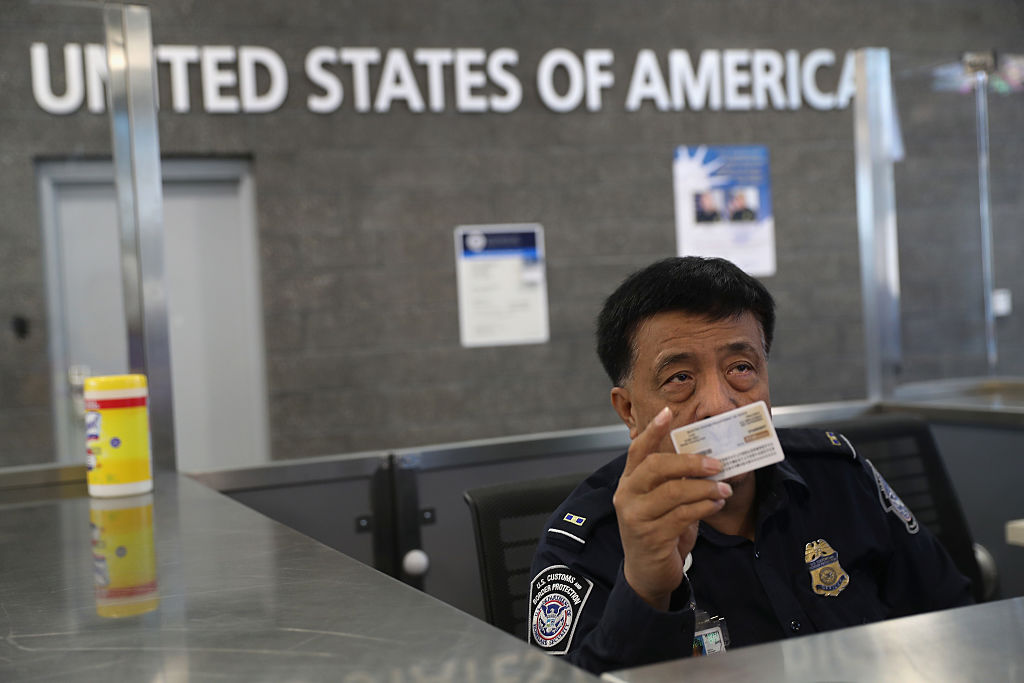
On July 1, Lin Fanlin, a 51-year-old Chinese national, holding a 10-year B-1/B-2 business and tourism visa, was arrested on the spot at the Daniel K. Inouye International Airport in Honolulu, Hawaii, while preparing to enter the United States.
According to sworn statements submitted by special agents of the U.S. Homeland Security Investigation (HSI) and federal court documents, Lin Fanlin, born in Beijing in 1975, in June 2017 when applying for a ten-year visa, listed his occupation as the general manager of Beijing Moral Responsibility International Cultural Development Co., Ltd., claiming to have served as the deputy director of the Education and Training Center of the China Foreign Languages Bureau, graduated from Beijing Sport University with a major in physical education, and stated that his purpose of visiting the U.S. was for “cultural exchange.”
On key questions in the application form such as “Have you served in the military” and “Do you have professional skills or weapon training,” as well as whether he is a member of the CCP, he ticked “No” for all.
However, upon entry on July 1, he was stopped and questioned by the U.S. Customs and Border Protection’s “Threat Response Team.” After examining his iPhone, investigators discovered a retirement certificate from the CCP military, documenting his enlistment in 1994 and retirement in 2011 with the rank of Army Colonel, having served at the Military Academy of Chemical Defense Command Engineering.
Lin Fanlin admitted to the investigators that he had indeed attended a CCP military academy, received basic firearms training, and currently is a CCP member.
He explained that he did not disclose this military background in his visa application out of concern that the information would affect the approval process. The prosecution has now charged him with federal crimes of visa and document fraud and has requested that the court deny bail.
This is not an isolated case. In 2020, CCP Lieutenant Ye Yanqing was similarly indicted for visa fraud. While studying at Boston University as an exchange student in 2017, she concealed her active military status. These two cases, six years apart, indicate that U.S. authorities continue to maintain a high level of vigilance against the concealment of military backgrounds – and such vigilance is only expected to increase.
In terms of legal consequences, visa and document fraud are federal felonies. If convicted, Lin Fanlin could face up to ten years in prison. The prosecution’s explicit request for no bail at the outset signals that they believe this case involves more than just administrative errors but rather a sensitive concealment of identity with national security implications.
Wang Zhiyuan, Chairman of the Global Quit CCP Service Center, stated in an interview with Epoch Times that this incident will cause a “major earthquake” in the Chinese community overseas.
He believes that many Chinese people have long been influenced by CCP propaganda and have not truly distinguished between “China” and the “CCP.” “Many still fail to see the difference between the CCP and China. ‘Loving the party is loving the country’ is what the CCP wants to see.”
He pointed out that this cognitive distortion has caused some Chinese people to be unaware of the significant changes in attitudes towards CCP-related activities in overseas societies in recent years.
Shen Mingshi, a researcher at the Taiwan Institute for National Defense and Security Studies, pointed out that the image of the CCP regime itself will be impacted by this case. He told Epoch Times, “Within the CCP system, having a military background or party membership is a privilege, but in Western societies, it becomes a burden or the main basis for suspicion.”
Shen believes that the U.S. has been strengthening background checks on former CCP military members and party members in recent years, which will also make it more challenging for the CCP to use related individuals for overseas infiltration or intelligence collection activities.
In recent years, the U.S. scrutiny on individuals with CCP affiliations is not an isolated action.
FBI Director Kash Patel recently released a counterintelligence report on the X social media platform: In the past year and a half, the FBI has arrested and handled 113 foreign intelligence officers within the U.S., with 62 of them identified as Chinese spies, accounting for over 55%. Patel used strong language, stating that these actions had “completely crushed Beijing’s secret operations.”
In handling spy cases in the past, U.S. intelligence agencies typically sentenced spies quietly or deported them discreetly. This departure from the norm this time in openly publicizing the results is one way to send strategic deterrence signals to Beijing, as well as a political statement to the American people and Congress.
On June 16, 2026, the U.S. Senate unanimously passed Resolution No. 444 (S.Res.444), directly identifying the CCP as a transnational criminal organization that poses a serious threat to global stability and peace. The resolution listed various crimes of the CCP, such as COVID-19 origins tracing, the global fentanyl crisis, espionage activities, aggression against Taiwan’s territory, genocide against Uighur people, forced organ harvesting, forced labor, and infringements on Hong Kong’s freedom. It strongly encourages the federal government to utilize the Global Magnitsky Human Rights Accountability Act to implement targeted sanctions on CCP officials participating in human rights abuses.
The U.S. Immigration and Nationality Act’s Section 212 (a)(3)(D) clearly states that members of Communist parties or other totalitarian parties are generally not admissible to the United States. This law has been in existence for decades and was seldom strictly enforced in the past; however, the situation has now changed significantly.
Shen Mingshi believes that this case will significantly deter CCP members. He said, “Many people used to think they could get through by not voluntarily declaring party membership when applying for a visa. But with the development of big data technology, this idea is becoming increasingly difficult to sustain.”
This case not only affects party members but may also impact the entire overseas Chinese community. Shen Mingshi analyzed that U.S. immigration authorities and customs may further enhance background checks, making the visa, green card, or naturalization application processes longer and more stringent for Chinese applicants.
He also believes that an individual’s credibility in the American Chinese community may be affected by their proximity to the CCP. “If you do not clearly oppose the CCP or have not clearly dissociated from interactions with the party, you will not gain trust from others.”
Against the backdrop of tightened law enforcement and legislation, how overseas Chinese and individuals intending to go to the U.S. should deal with the accompanying pressures has become a focus of concern for interviewees.
According to relevant U.S. immigration and naturalization provisions, those who were members of the Communist Party or other totalitarian parties within ten years before applying for naturalization are generally not eligible for citizenship unless they can provide evidence proving they have renounced that identity. However, within the CCP system, there is no official provision for party members to formally renounce their membership.
Wang Zhiyuan, Chairman of the Global Quit CCP Service Center, told Epoch Times that if overseas Chinese wish to prove their dissociation from the CCP, the most direct way is to obtain relevant proof documents. He said, “As a Chinese person, one should quickly break away from the CCP and its identity, and have concrete evidence to prove one’s innocence.”
Wang suggested applying for a Quit CCP Service Center’s issued declaration of quitting the party, stating that this proof can be applied for online or in person at the center’s office in Flushing, New York.
He believes that this proof has at least three meaningful aspects: “First, it proves that the holder has severed ties with the CCP; second, it shows a determined effort to oppose the CCP; and third, it provides concrete evidence to show others.”
Since its establishment in 2005, the Global Quit CCP Service Center has long provided free online “quitting declarations” services. Applicants can use their real names or pseudonyms for security reasons, and the center retains complete declaration records with timestamps.
According to the latest statistics from the Global Quit CCP Service Center, as of July 30, 2026, the total number of people who have quit the CCP globally has exceeded 464.53 million.
Wang Zhiyuan emphasized, “As a Chinese person, one should quickly break away from the CCP and its identity, and have concrete evidence to prove one’s innocence.” He believes that such proof documents will help immigration officials or lawyers assisting with identity-related matters understand the relationship between the applicant and the CCP, “This will be of great help to overseas Chinese or those planning to come overseas.”
Shen Mingshi said, “If you want to pursue freedom, you must break away from the Communist Party. Otherwise, you will face a political organization that violates human rights and restricts freedom. You have nothing to gain by blindly loyal to it.”
He pointed out that breaking away from the Communist Party is not just a formal dissociation but also means rebuilding one’s credit, conscience, and values.