
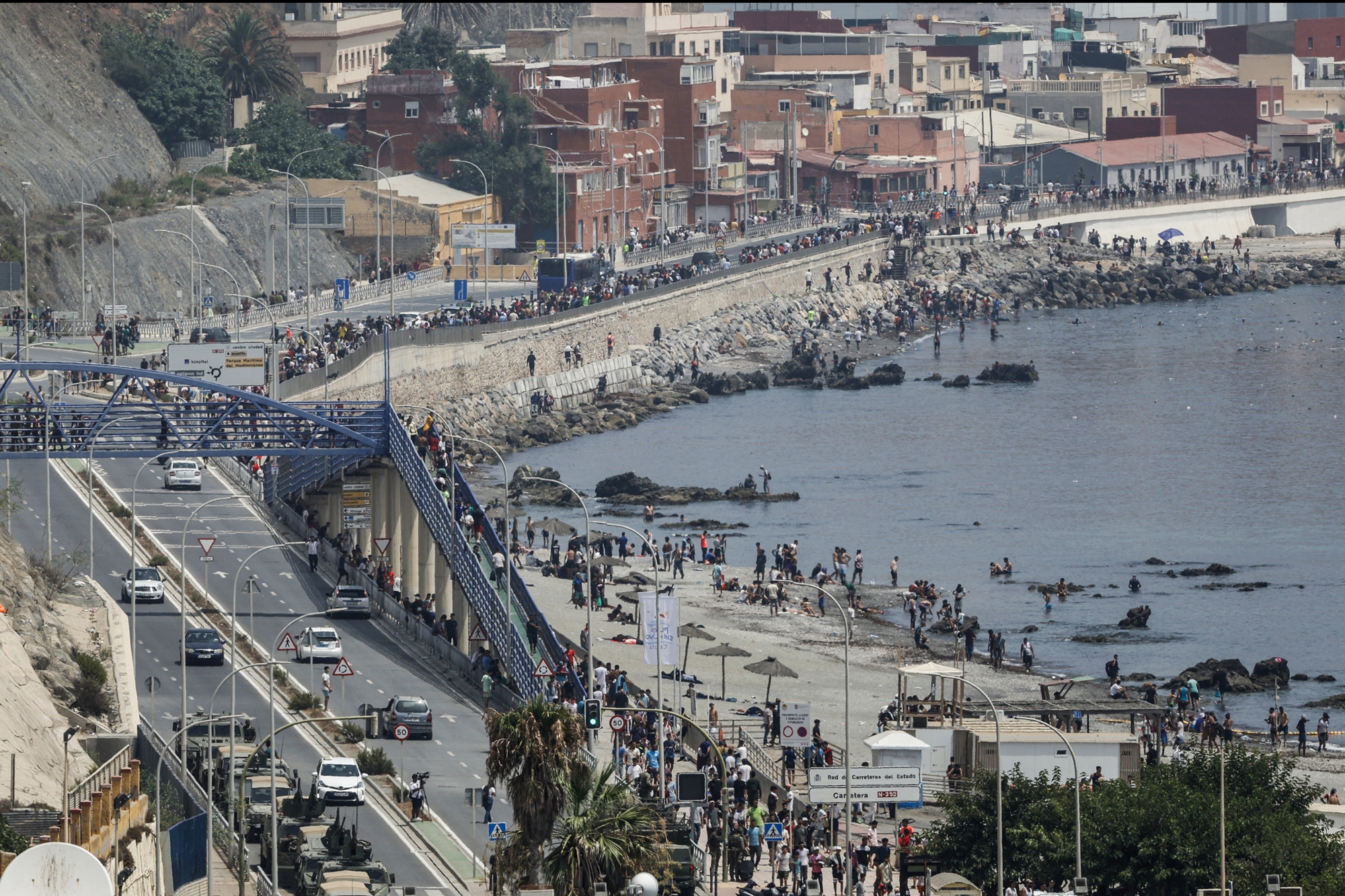
On Tuesday, August 11, Spanish Foreign Minister José Manuel Albares visited Ceuta and stated that the large influx of illegal immigrants at the end of July would all be deported back to Morocco or their home countries with no exceptions.
During his visit to Ceuta, Minister Albares warned, “Do not risk your life, money, and future by attempting a destined-to-fail adventure.”
He emphasized that entering the Spanish enclaves of Ceuta or Melilla in North Africa does not grant the right to residency in Spain. Illegal border crossers will not be allowed to move to mainland Spain.
Albares stressed that all those illegally entering Spain will be deported back to Morocco or their home country, with no exceptions.
Despite the “extremely special and complex” border situation, the Spanish government asserts full control and is in direct communication with Morocco to prevent similar border crises from happening again.
During the visit, Albares also met with Juan Jesús Vivas, the conservative leader of Ceuta.
According to the Spanish government, around 72,000 people surged into Ceuta on July 30 and 31. The city, with a population of about 84,000, is located in North Africa bordering Morocco. It is a Spanish enclave and one of the few land borders between the EU and Africa.
Many illegal immigrants crossed the border by sea or land, resulting in at least 80 deaths. Some drowned while swimming across the border or were trampled during the attempt to enter Ceuta forcibly.
Madrid previously stated that most of those who entered Ceuta during the migrant crisis had returned to Morocco in early August, but around 2,000 people remain in the area.
However, Ceuta’s local leader Vivas, after meeting with Albares, told reporters that the actual number of people stranded could be as high as 10,000, and the local capacity to accommodate them is reaching its limit.
He welcomed Albares’ commitment to repatriate all illegal border crossers but noted that there is currently no clear timeline in place for the process.
Regarding those fleeing conflict or persecution, Spain stated that they can apply for asylum under the law, while unaccompanied minors will be dealt with according to their family and personal circumstances by local authorities.
Albares mentioned a widespread misinterpretation of a recent ruling by the Spanish Supreme Court on social media, causing some to believe that entering Ceuta or Melilla would allow them to stay in Spain.
In late June, the Spanish Supreme Court ruled that the government cannot directly deport migrants arriving by sea in Ceuta and Melilla without due process back to their home countries.
The Spanish government highlighted that the misinterpretation of this ruling on social media was one of the factors contributing to the recent influx of migrants.
Spanish Prime Minister Pedro Sánchez referred to the migrant crisis as “an invasion and attack on Spain’s territorial integrity” and blamed human trafficking groups.
He stated, “Human trafficking groups selfishly misinterpreted a ruling of the Supreme Court.”