
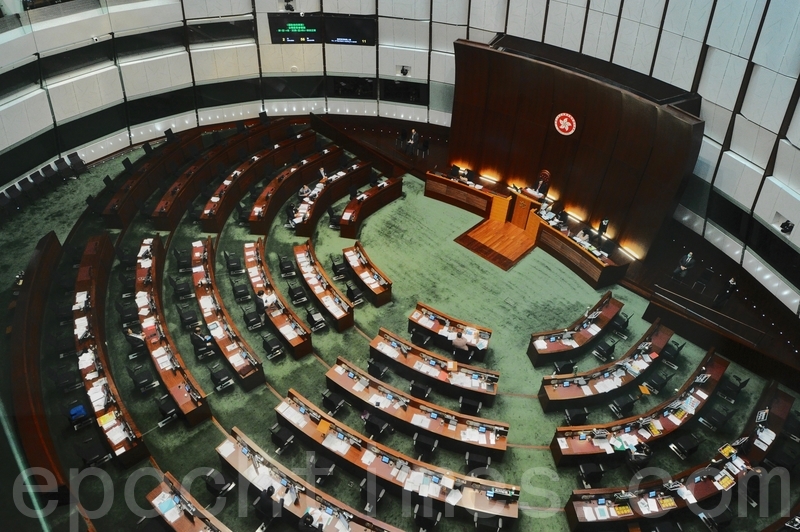
Recently, the UK think tank, China Strategic Risk Institute (CSRI), released a research report pointing out the increasingly close connection between Hong Kong legislators and companies identified by the United States as having backgrounds in the People’s Liberation Army of China (PLA). At the same time, the assets held by Hong Kong legislators on the mainland are also continuing to increase, raising questions about the future of Hong Kong as an international financial center and the effectiveness of Western sanctions.
The CSRI, based in London, conducted research on the publicly disclosed information of all current members of the Hong Kong Legislative Council. It found that the number of legislators associated with companies on the “List of Enterprises Linked to the PLA’s Military-Industrial Complex” has significantly increased. From 4 in the first term implementing the so-called “patriots governing Hong Kong” principle in 2021, it has risen to 8 in the most recent term.
Researcher Anouk Wear stated that these findings reflect the growing ties between Hong Kong legislators and highly politically sensitive Chinese enterprises, indicating an increase in loyalty to Beijing while drifting further away from the West.
The report identified several legislators: Ben Chan Han-pan serves as the Vice President of China State Construction International Holdings Limited, a subsidiary of China State Construction Engineering Corp., which has been listed by both the US Department of War and Treasury.
Duncan Chiu Tat-kun is an independent non-executive director at artificial intelligence enterprise Sensory Group, which is listed on the Entity List by the US Department of Commerce.
Additionally, Gary Zhang Xinyu served as a strategic advisor at state-owned Chinese banking giant, Industrial and Commercial Bank of China; Chan Hak-kan has worked at Sinopec Hong Kong, a subsidiary of China Petroleum & Chemical Corporation.
Johnny Kit-chong Ng is an independent director at China Unicom.
Both Ben Chan Han-pan and Duncan Chiu Tat-kun did not respond to requests for comment from Nikkei Asia.
The report also noted that the newly elected legislators in December 2025 collectively declared ownership of 123 properties in mainland China and Macau, a three-fold increase from the previous term’s 39 properties, with most legislators also owning residential properties in Hong Kong.
The CSRI believes that these corporate positions and asset allocations link legislators directly to Beijing in terms of commercial interests related to defense, surveillance, and strategic infrastructure.
This diminishes the space for independent oversight by the legislature, concentrating legislators’ personal wealth within the legal jurisdiction of mainland China and Hong Kong, and significantly reduces the impact of Western legal systems and sanctions.
Shortly before the release of the report, the 89 members of the Legislative Council of Hong Kong had just concluded a week-long historic collective visit to Beijing for a “study tour” on the country’s situation.
Legislative Council Chair Starry Lee Wai-king described the visit upon her return to Hong Kong on July 25th as “historical” and mentioned that during the inspection period, legislators listened to Chinese officials explain governance concepts, development strategies, and the country’s Five-Year Plans.
Analysts believe that this visit further confirms that since the implementation of the National Security Law in Hong Kong in 2020, the reforms in the election system ensuring only Beijing-approved “patriots” can run for office, Hong Kong and Beijing have been increasingly aligned in governance.