
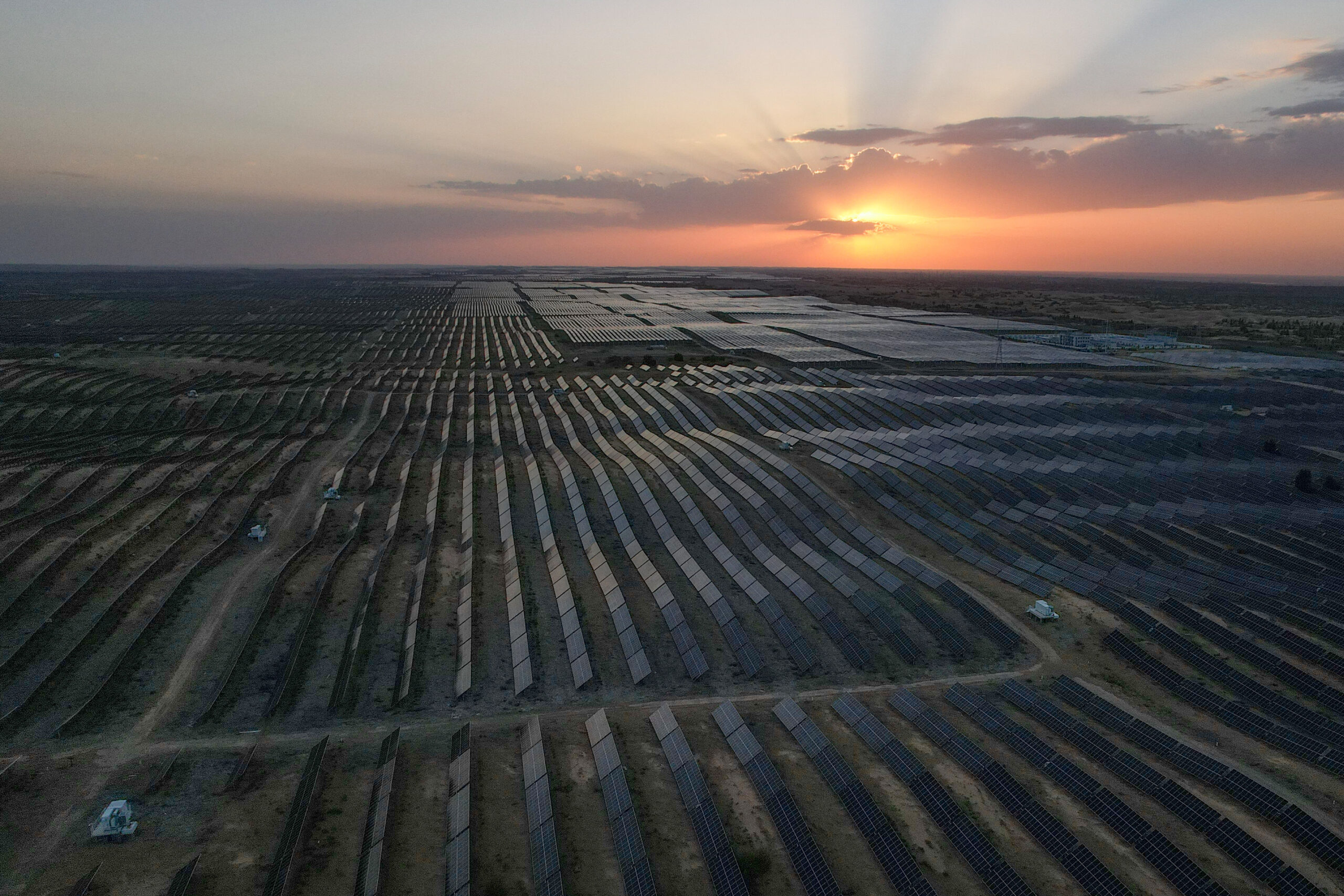
In the first half of this year, the Chinese photovoltaic industry has been facing challenges. Not only did the newly installed capacity of photovoltaics drop by more than 60% compared to last year, but three giant companies, including Longi Green Energy, are expected to incur losses exceeding 10 billion yuan. Insider analysts attribute this situation mainly to the mismatch of supply and demand in the industry and the shrinking market demand.
As listed companies successively release their semi-annual reports for the period from January to June this year, the operational conditions of various industries in the first half of the year are being laid out.
According to a report by “First Financial” on July 25th, the latest statistics from the National Energy Administration of China show that in the first half of this year, China’s newly installed photovoltaic capacity was 72.07GW, a decrease of about 66% compared to the same period last year, ending the growth trend of previous years. At the same time, 21 photovoltaic listed companies that have already announced their forecasts are expected to collectively incur losses ranging from 13 billion to 16.8 billion yuan, with three industry giants – Longi Green Energy Technology Co., Ltd., Tongwei Co., Ltd., and TCL New Energy Technology Co., Ltd. – expected to incur losses exceeding 10 billion yuan in the first half of the year.
Longi Green Energy’s “2026 Semi-Annual Performance Forecast” shows: “It is expected to achieve a net loss attributable to shareholders of the listed company of 3.4 billion to 3.8 billion yuan in the first half of 2026. It is expected to achieve a net loss attributable to shareholders of the listed company after deducting non-recurring gains and losses of 3.7 billion to 4.2 billion yuan in the first half of 2026.”
Tongwei Co., Ltd. declared in its “2026 Semi-Annual Performance Forecast”: “The company is expected to achieve a net profit attributable to owners of the parent company of about -4.8 billion to -5.4 billion yuan in the first half of 2026. After deducting non-recurring gains and losses, the company expects to achieve a net profit attributable to owners of the parent company of about -4.8 billion to -5.4 billion yuan in the first half of 2026.”
Another industry giant TCL New Energy also released its “2026 Semi-Annual Performance Forecast” showing: “It is expected to achieve a net profit attributable to the parent company of -3 billion to -3.3 billion yuan.”
Based on the data released by these three companies, the combined net losses of these three top-tier enterprises in the first half of the year reached 11.5 to 12.2 billion yuan.
Longi Green Energy cited the following reasons for the losses: “During the reporting period, there was no significant improvement in the supply-demand relationship in the photovoltaic industry, and companies continued to be under operational pressure.” Additionally, “During the reporting period, the sales volume and revenue of the company’s components decreased year-on-year, the capacity utilization rate was insufficient, the gross profit margin was low, and the impact of investment losses from joint ventures and exchange losses caused by the appreciation of the renminbi, resulting in operational performance losses.”
Tongwei Co., Ltd. also stated: “The overall imbalance between supply and demand in the industry has not fundamentally improved, and product prices at all stages remain weak, leading to significant operational pressure for companies. As a result, the company’s performance in the reporting period remains in a loss.”
During a seminar for the review of the development in the first half of 2026 and the outlook for the second half of the year in the photovoltaic industry held in Ningbo, Wang Bohua, former secretary-general of the Chinese Solar Industry Association, pointed out that the industry is currently facing a triple squeeze of supply-demand imbalance, shrinking demand, and escalating trade barriers, stating that “the deep adjustment cycle is still lengthening.”
Liu Yiyang, executive secretary-general of the Chinese Solar Industry Association, also stated at the half-year conference in Ningbo that the industry is still confronted with “internally competitive” competition that has not fundamentally changed.