
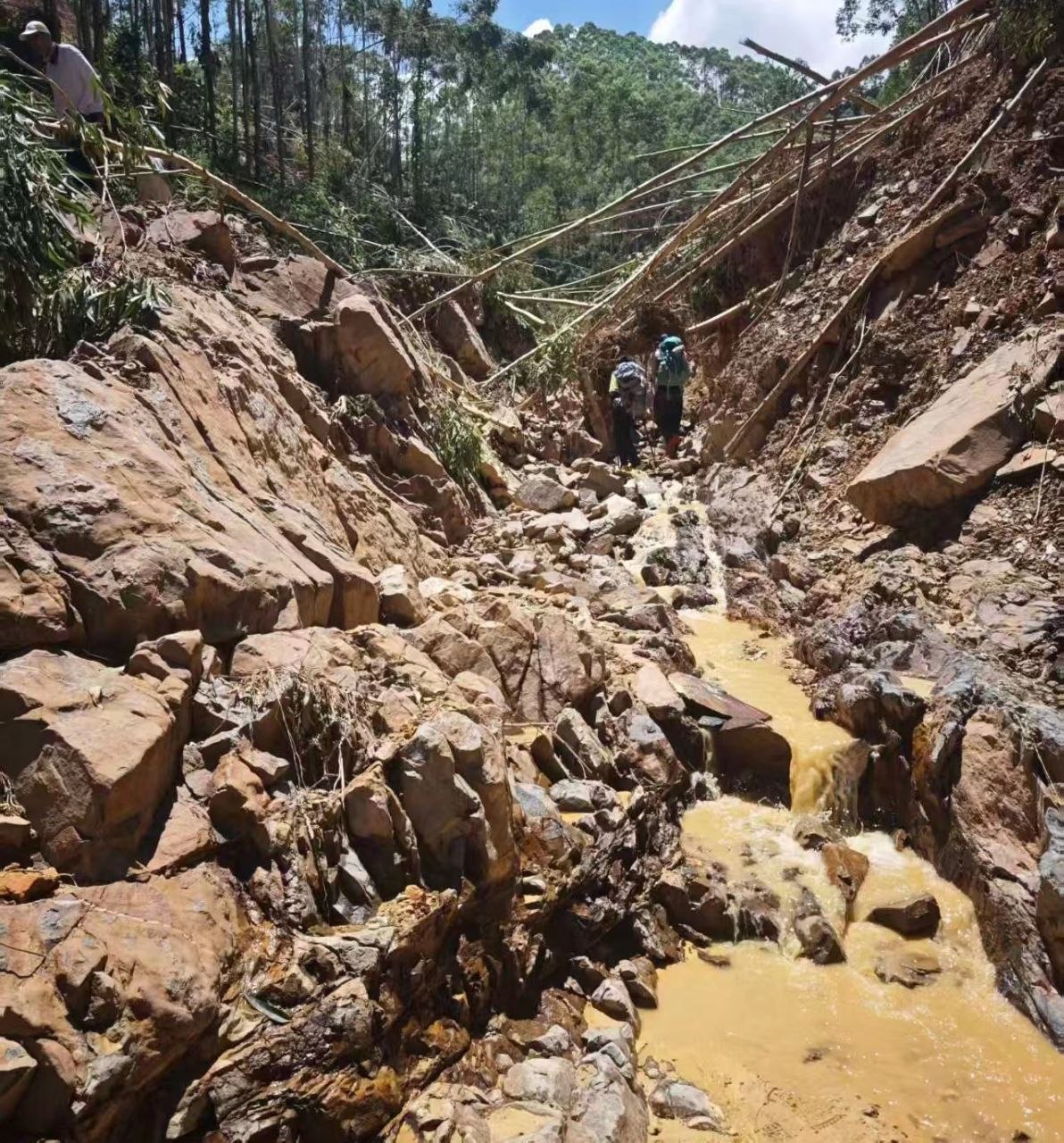
Severe floods in Hengzhou, Guangxi have devastated several downstream towns, with large numbers of houses washed away and the remote mountainous areas turning into “islands.” Frontline rescue volunteers who ventured into the disaster zone shared with Epoch Times the dire situation: severe injuries and fatalities in some areas, many villagers cut off from water and food supplies for days, and ongoing questioning of donation distribution, highlighting the long road ahead for post-disaster reconstruction and rescue efforts.
From July 4th to 6th, Guangxi experienced continuous heavy rainfall, with historical rainfall records in Nanning, Hengzhou, Guigang, leading to overflowing and dam breaches at reservoirs like Liulan and Yunbiao, causing multiple villages downstream to be hit by flood peaks. Yabei Village in Yunbiao Town was one of the severely affected areas.
Yabei Village in Yunbiao Town, Hengzhou is located downstream from Liulan Reservoir, with a population of over two thousand. After the flood, the entire village lost power and internet connection, becoming an isolated “island” cut off from the outside world.
Local volunteer Liang Jiancheng has been rushing to the frontline for rescue efforts consecutively. On July 23rd, he described the grim scene he witnessed to Epoch Times over the phone.
“The waters from two reservoirs directly hit Yabei Village,” Liang Jiancheng described the moment the flood struck, “the flood washed away a large number of houses; this is the most tragic village in Yunbiao Town.”
The villagers had little time to react. “After the flood came, villagers who ran fast fled to the mountains or climbed onto roofs, while those who ran slowly were swept away by the flood.”
According to Liang Jiancheng, “Yabei Village has 73 households in five teams, and currently, 28 people are missing.” As per official data cited by Xinhua on July 9th, “Guangxi has witnessed 39 deaths and 9 missing persons.”
Due to complete road blockages, external rescue efforts have been delayed, leaving villagers who fled to the mountains relying on leaves to sustain themselves.
“For two to three days, they had nothing to eat and had to rely on leaves to stave off hunger on the mountains,” said Liang Jiancheng, “when we delivered supplies for the first time, villagers scrambled for them, having been starved.”
Clearing the roads took several days after the disaster. Liang Jiancheng described his emotions upon entering the village for the first time. “The road was cleared on the 9th or 10th, and seeing the devastation in the village, even as a grown man, tears streamed down my face.”
“At that time, it was all debris inside, and many houses were washed away. The villagers were like statues,” he added.
The flood took away more than just houses. “From what I know, many people were swept away by the flood. Upon entering the village, I saw a body wrapped in garbage, with dead pigs and other animal carcasses,” Liang Jiancheng shared.
Due to the excessive number of collapsed houses in Yabei Village, the cleanup is temporarily suspended, awaiting further assessment of dangerous buildings. The displaced villagers will be relocated to Maling No.1 Middle School in Maling Town.
Liang Jiancheng, residing in Song Village in Hengzhou Town, also in the disaster zone, has been on the frontline of rescue operations almost without a break since the night the flood hit.
In contrast to the destructive impact downstream of Yabei Village, another mountainous area faces a different kind of hardship, being completely isolated after road closures.
Nanning volunteer Ye Jizhen has been assisting at the Love Kitchen in Zhenlong Township for five consecutive days, offering insights into the frontline situation to Epoch Times.
For native Guangxi residents, this disaster far surpasses anything Ye Jizhen had seen before. He expressed, “I cannot put into words the extent of this flood. As a Guangxi native, this is the largest disaster I have ever witnessed.”
He emphasized that this was not a typical flood but was triggered by reservoir collapses. “Do you know, this flood was caused by reservoir collapses, washing away all the villages downstream. The flood reached Guigang and submerged the town,” he explained.
Following the dam breach, the downstream villages were almost flattened, leaving returning residents to face only ruins. “Now that the flood has receded, villagers returning to their homes see that everything is gone, essentially restarting their lives from scratch,” Ye Jizhen remarked.
Unlike downstream of Yunbiao Reservoir, Zhenlong Township is facing isolation, being turned into “islands.”
“From Yunbiao to Zhenlong, the road isn’t open, as the roads leading to the villages within the township have not been cleared,” Ye Jizhen noted. While some houses in the mountainous area of Zhenlong remain intact, landslides have blocked all roads and bridges, coupled with no signals or networks, isolating them completely from the outside world.
“The elderly, children, and women in the village were drinking rainwater continuously for several days. The water in the village was muddy, so they had to rely on rain to get some clean water,” Ye Jizhen said. The whole village held on for three days before some supplies were finally brought in.
With machinery unable to enter, supplies had to be carried in on foot by civilian volunteers. “Only these trekking enthusiasts could carry goods in. The civilian volunteers are bringing things in bit by bit—what else can we do?” Ye Jizhen remarked. Presently, about seven to eight villages are without access, with the farthest village requiring a seven to eight-hour trek.
The journey is fraught with danger, with Ye Jizhen stressing the importance of caution due to volunteer casualties. “Yesterday, a volunteer died. We outdoor enthusiasts, who often go hiking and mountaineering, can barely cope, not to mention someone who isn’t an enthusiast,” he warned, highlighting the physical toll of an eight-hour climb into a village.
Ye Jizhen described the current relay method as more feasible: “Villagers come out to seek aid, and we pass the goods to them on the way. They then carry them back on their own.”
After the flood, Guangxi survivors have been fleeing and seeking refuge, with dozens of villages left without resources. In such dire circumstances, villagers have run out of supplies, even as millions of donations from the public fail to reach them.
In the rear, volunteers have established Love Kitchens to provide hot meals for frontline rescuers and survivors.
Initially helping in the kitchen for five days, Ye Jizhen shared that this was prompted by reports online about rescue personnel “lacking even a meal.” He elaborated, “We immediately set up Love Kitchens, around seven to eight of them, each cooking between eight to ten thousand meals of love.”
Acknowledging the severe shortage of manpower, Ye Jizhen emphasized the strategic distribution of supplies: “We must first cater to the Liberation Army personnel, with the remaining aid going to the survivors. It’s only when there are surplus items available that the survivors get to eat.” However, Ye Jizhen didn’t specify why the support troops lack field kitchen equipment for meal provisions.
In post-disaster reconstruction in Yunbiao Town, Heng County, the grassroots volunteer-run Love Kitchen initiatives are grappling with unprecedented challenges. Volunteer Han Liang shared the harsh realities they are facing with Epoch Times.
He bluntly stated that in Heng County, he is practically the sole operator of Love Kitchens, as most others have withdrawn. “I’m the only one running these Love Kitchens in the whole of Heng County; everyone else has pulled back,” Han Liang lamented.
Han Liang repeatedly highlighted the most pressing issue at hand: the current lack of meat and disposable containers. For a Love Kitchen preparing meals for disaster victims daily, meat is a source of nutrition, and disposable containers are essential for distribution. Without a stable supply, sustaining meal services becomes nearly impossible.
To address the shortage of ingredients, Han Liang personally sought assistance from the Yunbiao Town government, following in the footsteps of many volunteers who received nearly identical responses.
“The government officials stated they have their rules and principles,” Han Liang disclosed. “Especially now, the government won’t just distribute rice, oil, and meat to our voluntary Love Kitchens.” According to his account, the official stance is that resources follow fixed distribution channels, which do not include the grassroots Love Kitchen initiatives. As for the allocation of donations from various sectors, he remains unaware.
Han Liang commented, “It doesn’t concern us how much was donated and how much reached Yunbiao. Understand?”
Another volunteer, Zhou Jie, who previously worked at a Love Kitchen in Yunbiao Town, revealed to Epoch Times that the funds donated by volunteers did not flow into the kitchen. Now, with volunteers struggling to feed themselves, the misdirection of donations raises questions, possibly tied up in official institutions.
Zhou Jie explained, “The kitchen is a civilian organization run by volunteers. Currently, the Yunbiao Town kitchen lacks ingredients, having no vegetables or meat to prepare ten thousand meals daily; what can we do?”
(For safety reasons, all interviewees mentioned above have been given pseudonyms.)
The devastating floods in Hengzhou, Guangxi, have left many villagers homeless and in distress. However, as the scars of the flood remain fresh, the government has begun evicting displaced residents from temporary shelters, sparking public outrage.