
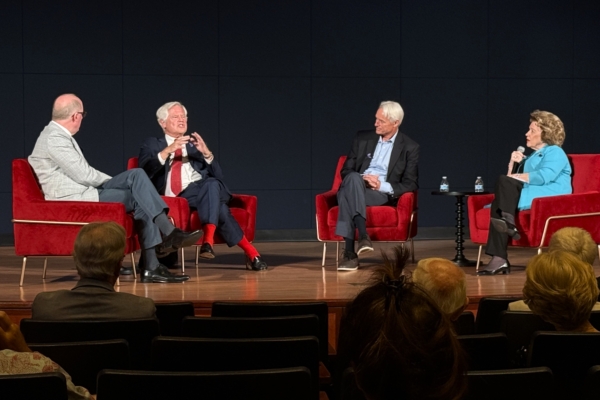
On July 11th, the non-partisan civic organization “USA250-OC” in Orange County, Southern California, held a seminar on the American Constitution at the Nixon Library. Two professors and a former judge were invited to discuss topics such as the founding principles of the Constitution, federal jurisdiction and state rights, checks and balances, democracy, the Supreme Court, and civic education.
Chairing the seminar on “Revolutionary Principles of the Constitution – Past Challenges and Looking to the Future” was JoEllen Chatham, co-chair of “USA250-OC”. The guests included Austin Carey, Dean and Law Professor at UCI School of Law, Andrew Guilford, former Federal Judge for the Central District of California, and Barry McDonald, Law Professor at Pepperdine Caruso School of Law.
The dialogue excerpted from the seminar focused on the historical significance and contemporary relevance of the Constitution.
In 1776, after the approval of the Declaration of Independence, the Continental Congress authorized each state to formulate its own laws. The Articles of Confederation, drafted by the 13 colonies, was more like a contract. It was in 1787, after 3 and a half months of debate, that the representatives formulated the US Constitution, which officially went into effect in 1788. Despite being the highest law of the land, there have always been calls for amendments, with differing opinions on its effectiveness.
The Constitution forms the framework for defining what it means to be an American and the implications of the federal government. Respecting its importance while acknowledging its limitations is crucial for moving forward.
Guilford expressed his steadfast support for the Constitution, highlighting its forward-thinking nature in establishing a democratic system without precedence. He emphasized the importance of the balance of powers it maintains between smaller and larger states, ensuring no voice is drowned out.
The seminar delved into the complexities of democracy, the role of the judiciary, the challenge of balancing majority rule with minority rights, and the ongoing relevance of the Constitution in today’s rapidly evolving society. The varying perspectives of the panelists shed light on the enduring importance of civic education and the need for a well-informed citizenry to navigate the complexities of governance in the 21st century.
The discussions also touched on the evolving role of the Supreme Court, the challenges of media bias, the significance of economic education in civic literacy, and the imperative of engaging with diverse viewpoints to foster a robust and inclusive democracy.
The dialogues at the seminar underscored the need for continuous dialogue and education to navigate the complexities of governance and uphold the principles of democracy in an ever-changing world. In an era marked by political polarization and growing divide, the importance of informed civic engagement and a commitment to upholding democratic values was emphasized.
In conclusion, the seminar highlighted the enduring relevance of the Constitution as a foundational document that continues to shape the American experiment in democracy. The diverse perspectives and insights shared underscored the importance of civic education, critical thinking, and an inclusive dialogue to navigate the challenges and opportunities of the present and future.