
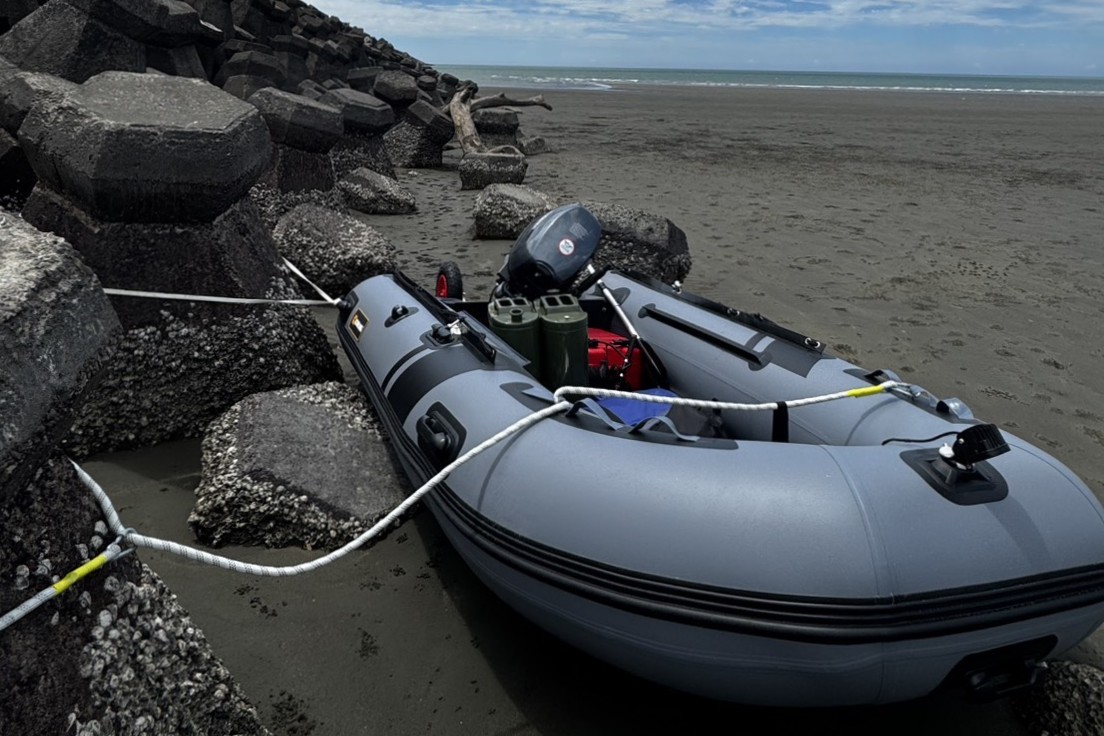
Two Chinese nationals were recently suspected of landing on the coast of Bali, Taiwan by rubber dinghy. In response, Legislator Chen Guan-ting called for Taiwan to swiftly establish a “Coastal Smart Sensing Network” to enhance coastal surveillance and evaluate the introduction of a fixed autonomous surveillance system to expand the continuous monitoring capabilities of the coastline with technology.
Before the Han Guang exercise in Taiwan, on July 24th, fishermen discovered an unmanned rubber dinghy on the Bali Beach in Taipei City, which was found to have Chinese-made oil drums, toilet paper with simplified Chinese characters, Pepsi, fishing rods, 3 life jackets, and other items on board, prompting a report to the authorities. The Coast Guard arrested the two individuals on July 30th. Due to the sensitive timing of the incident, it caught the attention of national security agencies.
The Taiwan Ocean Affairs Council’s Coast Guard Administration explained on the 11th that radar operators had previously detected faint light spots on the sea surface, but misjudged the targets as waves and canceled tracking, admitting to human error. The Coast Guard Administration apologized for the human error on the 11th and pledged to hold individuals accountable.
Legislator Chen Guan-ting stated that Taiwan’s coastline is extensive, and Coast Guard personnel must constantly face a large amount of radar signals, surveillance images, and marine weather noise, making it possible for anyone to misinterpret the data. This incident really requires further consideration on how to establish multi-tier surveillance methods, allowing single radar signals to be validated by other sensors to assist the frontline in earlier detection and more accurate interpretation of abnormal targets.
Chen Guan-ting pointed out that in recent years, cases of Chinese nationals using small boats to reach the main island of Taiwan have occurred repeatedly. In 2021, a Chinese national arrived in Taichung by rubber dinghy; in 2022, two Chinese nationals arrived in Taitung’s Fugang Fishing Port on a rubber dinghy with a water scooter; an incident in June 2024 involved a Chinese national driving a speedboat into the Tamsui River, and in September of the same year, another Chinese national arrived on the coast of Linkou by rubber dinghy. Similar incidents have also occurred along the coasts of Taoyuan and New Taipei in recent years.
“These cases collectively reflect the technical challenges of small boat surveillance under the existing monitoring system. Small boats have limited radar reflection signals and can easily be mixed with sea noise in windy and complex marine environments. In this case, there was even radar detection of a light spot but it was excluded during the manual interpretation stage, so Taiwan needs to establish second and third levels of sensing and confirmation mechanisms.” Chen Guan-ting said.
Chen Guan-ting further explained that internationally, there has been gradual development of concepts such as “Fixed Autonomous Surveillance Systems” and “Coastal Smart Sensing Networks,” combining long-endurance drones, tethered drones, and coastal fixed automatic take-off and landing drone stations to form continuous aerial surveillance coverage over specific high-risk coastlines, supplementing blind spots that may exist in ground radars, fixed surveillance cameras, and human patrols.
“In the future, priority can be given to evaluating deployment in important ports, estuaries, areas where illegal entry cases have occurred in the past, and other high-risk coastal regions. When an unidentified weak signal is detected at the coastline radar, nearby fixed drone stations can automatically dispatch drones for confirmation; tethered drones can linger in the air for a long time, providing continuous optical and infrared monitoring in fixed areas, and establishing a surveillance network of cross-verification between sea, air, and shore.” Chen Guan-ting emphasized.
“What we need is a network that can continuously watch over the coastline.” Chen Guan-ting stated that Taiwan cannot assign a large number of manpower to every kilometer of coastline, but can use fixed autonomous surveillance equipment to extend the field of view of frontline personnel. Radar detects abnormalities, drones further identify them, coastal systems continue tracking, and personnel make the final judgments and decisions to truly improve overall surveillance efficiency.
Chen Guan-ting mentioned that this system can also further integrate AI image recognition, multisensor fusion, and edge computing. Abnormal behaviors such as small boats without AIS signals, low-speed approach to the coastline at night, deviation from normal routes, or prolonged sailing toward specific coastlines can be screened by the system to increase the alert level and reduce the burden on frontline personnel of monitoring a large number of normal signals.
He also warned that the Chinese Communist Party has been consistently pressuring Taiwan through military aircraft, warships, coast guard vessels, and other gray-zone methods in recent years. The true objectives of individual Chinese nationals arriving in Taiwan by small boats should still be clarified by judicial and national security agencies based on evidence; however, from a national security perspective, the risk that small boats could be used to test our coastal surveillance capabilities must also be incorporated into overall maritime defense planning.
Chen Guan-ting emphasized that each occurrence should be turned into data for enhancing surveillance capabilities in the future. The Coast Guard should systematically organize the types, materials, speeds, tracks, marine conditions, radar signals, and coastal images of past incidents, while taking stock of existing radar, optical, infrared, and drone deployments to assess the feasibility of establishing the “Coastal Smart Sensing Network” and fixed autonomous surveillance system.
“The coastline is long, but technology can help extend our vision further.” Chen Guan-ting said that facing threats from small boats and increasingly complex gray-zone threats in the future, Taiwan’s coastal surveillance must also be upgraded. The integration of fixed autonomous surveillance, smart sensing, and unmanned vehicles should be the key direction for strengthening maritime defense in the next phase.