
Japan’s Ministry of Defense recently publicized detailed information about a joint cruise by Chinese and Russian warships that almost encircled the Japanese archipelago. This was followed by the release of the “2026 Defense White Paper,” reiterating China as the “greatest strategic challenge ever.” Experts believe that Japan’s concern is no longer just a single joint cruise but a new security challenge posed by China’s recent combination of gray-zone operations, maritime expansion, and military cooperation with Russia. Japan has started reflecting this understanding comprehensively in its defense policy, military construction, and ally cooperation.
The Joint Staff of the Japanese Ministry of Defense announced on August 3 on its official website that Chinese and Russian warships had recently completed an 18-day joint cruise almost encircling the Japanese archipelago.
Publicly available data shows that on July 16, three Chinese navy ships and one Russian navy ship passed through the Miyako Strait into the Pacific Ocean, sailed south of Ogasawara Islands and Minamitorishima, through waters off Chiba Prefecture, then north along the northeast coast, passed through the Soya Strait into the Sea of Japan, and eventually sailed southwest through the Tsushima Strait on August 3, before returning to the East China Sea. Over 18 days, they completed a maritime operation that almost encircled the entire Japanese archipelago.
The Japanese side also released the cruise route and images of the three Chinese naval ships: the 055-type missile destroyer with hull number 103 (Anshan), the 052D-type missile destroyer with hull number 124 (Kaifeng), and the comprehensive supply ship with hull number 903 (Kexi Lake).
The Japanese Ministry of Defense stated that the Maritime Self-Defense Force deployed ships and patrol aircraft to monitor the movements of the Chinese and Russian fleets. The incident has raised high levels of alertness in Japan.
It is noted in publicly available information that the extensive cruising operation by the Chinese and Russian navies around Japan is not the first of its kind. Since 2021, Chinese and Russian warships have been jointly patrolling, crossing the Tsugaru Strait for six years and gradually normalizing, with this being the closest they have come to circumnavigating the Japanese archipelago.
Of concern, during this joint cruise, on July 19, one of the Chinese warships conducted live-fire exercises in the waters southwest of Minamitorishima Island (known as the inflamed island by China).
The Joint Staff of the Japanese Ministry of Defense stated that this was the first time Japan confirmed China conducting live-fire exercises within Japan’s Exclusive Economic Zone (EEZ). However, the department added that the activity did not violate international rules.
Nevertheless, Japan pointed out that this action could endanger the safety of shipping in the vicinity, and lodged a protest with China through diplomatic channels. As of now, no reports confirm any damage to ships.
Shen Mingshi, a researcher at the Taiwan Institute for National Defense Security, analyzed, “The major difference in this joint patrol between China and Russia and previous ones is the live firing near Minamitorishima Island.”
He further pointed out that the activities of the Liaoning aircraft carrier have been gradually moving eastward in recent years, approaching the Ogasawara Islands and Minamitorishima, indicating that China is expanding its “anti-access/area denial (A2/AD)” capabilities beyond the first island chain and moving toward crossing the second island chain.
The Ogasawara Islands are located between mainland Japan and the US military base on Guam, serving as a crucial passage for the US and Japan to deploy forces to the western Pacific. In the event of a conflict in the Taiwan Strait, it is also considered a strategic node for US and Japanese reinforcement actions.
In response to this, Mark, a host on the Military Technology Channel, told Epoch Times that China has been carrying out a series of actions, from coast guard patrols, maritime surveys, to aircraft carrier activities and joint patrols with Russia. These actions are not isolated but collectively aim to create favorable conditions for potential conflicts in the Taiwan Strait, including deterring US and Japanese reinforcements to Taiwan.
The analyses of the two experts converge on Japan’s recent reevaluation, no longer focusing solely on the activities of Chinese warships, but on the long-term security implications of China’s continued expansion of maritime strategy into the western Pacific.
After revealing the route of the Chinese and Russian joint cruise, the Japanese Ministry of Defense publicized the “2026 version of the Defense White Paper” the next day (on the 4th). It continues to position China as Japan’s “greatest strategic challenge ever” and notes that China and Russia have been intensifying their joint military operations in recent years, deepening their strategic cooperation further.
It is worth noting that while evaluating the Chinese and Russian joint cruise, the White Paper also analyzes China’s recent maritime activities and military cooperation with Russia within the same security framework, reflecting Japan’s further adjustments to the surrounding security environment.
Regarding the positioning of the White Paper, Shen Mingshi believes that Japan chose to release the White Paper during the joint Chinese-Russian exercise not only to fulfill its annual policy explanation function but also to explain the changes in the security environment to the domestic society, consolidate national consensus, and lay the groundwork for future modifications to national security documents and increased defense budgets.
Mark believes that the timing of the White Paper release and the joint cruise by China and Russia may not necessarily be deliberately arranged, but the overlapping timing objectively allows the Japanese people to feel the real pressure from China and Russia. This assessment also reflects Japan’s overall evaluation of China’s maritime activities in recent years. China has continuously deployed buoys and ocean research equipment around Japan and the western Pacific in recent years.
Just before the attention was drawn to the Chinese and Russian joint cruise, Japan’s Ministry of Foreign Affairs announced on July 31 that China had advanced a new structure west of the “Japan-China median line” in the East China Sea. Japan lodged a “strong protest” with China through diplomatic channels.
According to official Japanese statements, if this new structure is completed, it would be the 24th related facility set up by China on one side of the median line.
Reuters reported in March this year that China is expanding its “Transparent Ocean” program from the South China Sea to the east of Japan, east of the Philippines, and around Guam, deploying a large number of buoys, sensors, and underwater monitoring arrays in the western Pacific, with some equipment in important sea areas where US submarines may pass through. The Ocean University of China’s “Dongfanghong 3” scientific research ship has been repeatedly traveling between Taiwan, waters near Japan, and the Guam area, responsible for testing and maintaining relevant equipment.
Mark believes that from setting up ocean buoys, dispatching coast guard ships to joint cruises by Chinese and Russian warships, these actions are part of China’s long-term advancement of its maritime strategy. The core of this strategy is to gradually alter the current state of the surrounding waters through continued presence, administrative jurisdiction, and gray-zone operations, constantly testing Japan’s tolerance and reactions in the process.
Shen Mingshi points out that China has long highlighted its sovereignty claims through gray-zone operations, from setting up buoys, deploying marine survey ships to regular coast guard patrols. As long as it involves the Japan-China median line or the Diaoyu Islands area, Beijing will continue to exert pressure; once Japan takes countermeasures, China will further dispatch large coast guard ships in response.
He believes that Japan’s annual Defense White Paper in recent years has gradually assessed these gray-zone operations in the same strategic context as the situation in the Taiwan Strait, becoming an important background for Japan’s recent adjustments in threat assessments, considering China as the “greatest strategic challenge ever.”
Why has Japan’s defense strategy undergone such significant adjustments in recent years? Shen Mingshi explains by analyzing that in 2021, when China and Russia first crossed the Tsugaru Strait, there were still voices in Japanese society belittling the Chinese Navy. However, with China’s aircraft carrier, the 055 destroyer, and the normalization of joint patrols between China and Russia alongside continued gray-zone operations, Japan’s official stance now unequivocally identifies China as the “greatest strategic challenge ever.”
For Japan, what truly changed their security perceptions was not merely the passing of Chinese and Russian warships through the Tsugaru Strait but the continuous advancement of Chinese military power into the waters around Japan, along with the gradual normalization of Sino-Russian military cooperation.
Facing this new scenario, Shen Mingshi states that Japan’s defense policy adjustment is not just a shift from “passive defense” to “active offense” but a response to changes in the security environment along the First Island Chain, aiming to enhance its “deterrence capability” during crisis situations.
Mark mentions that the biggest change brought about by the joint cruise by China and Russia is Japan facing “dual pressures.” He explains that while Japan has historically focused on the northern threat from Russia, as Russia weakens and China’s military capabilities grow quickly, Japan’s defense focus is shifting southward towards Okinawa, the Taiwan Strait, and others. However, with the warming of Sino-Russian military cooperation, Japan has had to reconsider the possibility of facing pressure simultaneously from the northeast and southwest directions.
In the backdrop of this changing security environment, the focus of Japan’s defense policy is not merely to enhance its own defensive capabilities but to try and develop a deterrence capability against Chinese military actions along the First Island Chain by strengthening long-range strike capabilities, deepening ally cooperation, and forming a deterrence capability against Chinese military actions along the First Island Chain.
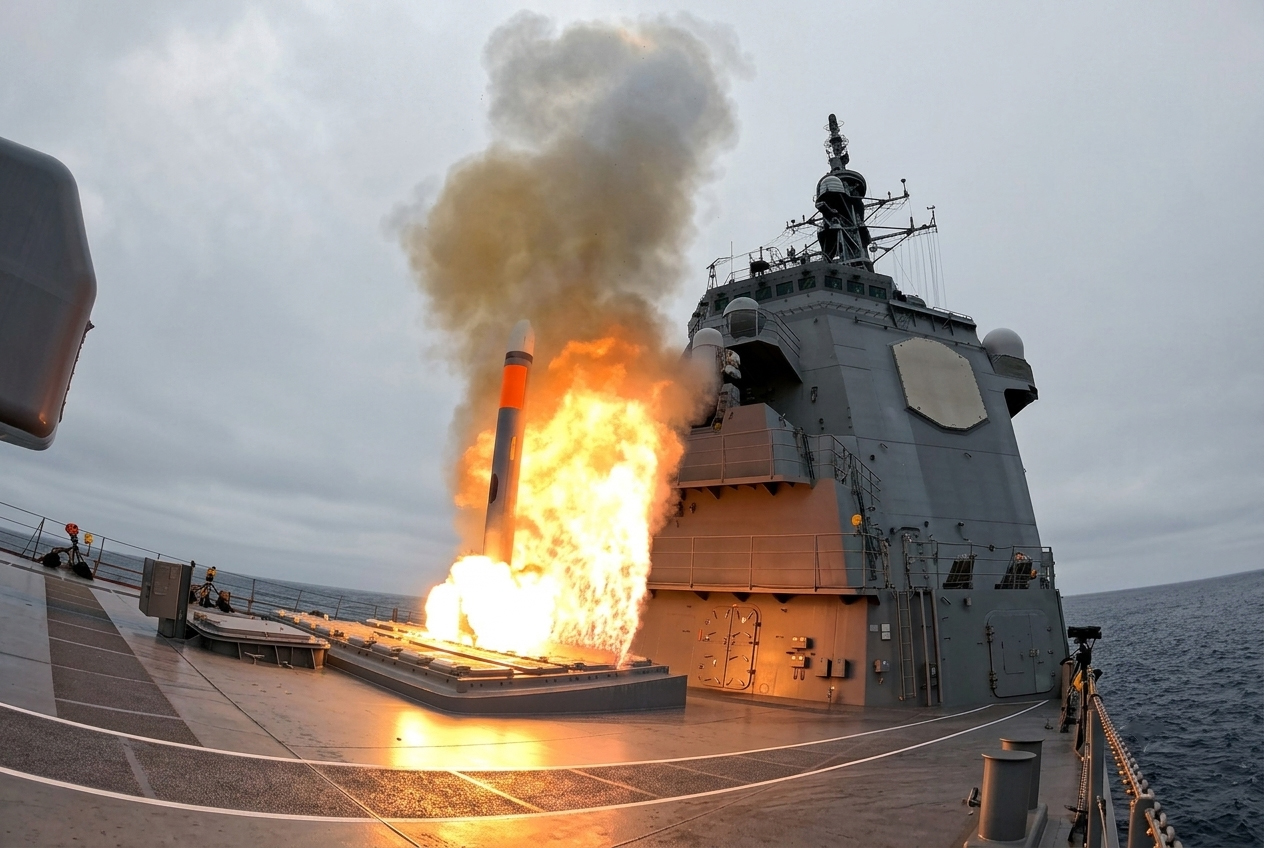
Japan’s military deployments in recent years have started putting these strategic concepts into practice. On July 29, for the first time, a Japan Maritime Self-Defense Forces warship successfully launched American-made Tomahawk cruise missiles, signaling Japan’s beginning to possess long-range precision strike capabilities. The test launch conducted on the Kongō-class destroyer “Chokai” certified the crew’s operations, making Japan the third US ally after Australia and the Netherlands to have the capability to launch Tomahawk missiles from surface ships.
The Japanese government plans to procure up to 400 Tomahawk missiles and concurrently advance the development of domestically-produced long-range missiles. These deployments reflect Japan’s gradual institutionalization of its “counterattack capability.”
The Japanese government believes that in the face of potential missile attacks or crises in the Taiwan Strait, relying solely on interception defense is insufficient to form an effective deterrence. Therefore, Japan is gradually institutionalizing its “counterattack capability” by deploying Tomahawk missiles and developing domestically-produced long-range missiles.
The Tomahawk missile embodies Japan’s improved long-range strike capability, while the new version of the Defense White Paper indicates the beginning of concurrently building an overall defense system to support long-term conflicts.
Mark believes that another significant change in this year’s Defense White Paper is Japan’s shift from traditional military construction towards building a “sustained combat capability.” Japan’s goal is no longer just to increase the number of weapons but to establish a comprehensive system supporting long-term conflict, encompassing decision-making aided by artificial intelligence, unmanned system applications, ammunition stockpiles, defense industry, and talent supplementations.
Shen Mingshi points out that another important direction of Japan’s defense adjustment is integrating its military capabilities with the allied system along the First Island Chain. In the future, Japan will emphasize cooperation with countries like the US, Australia, the Philippines, and others, enhancing the ability to collectively respond to crises through joint exercises, information sharing, and regional defense capacity building.
Mark further indicates that Japan’s defense adjustments in recent years have gone beyond strengthening its own military power to extending defense capabilities into a network of allies along the First Island Chain. Besides enhancing the Japan-US alliance, Japan is also boosting defense capabilities in the Philippines, Australia, and other countries through arms exports, joint exercises, and defense cooperation, aiming to form a regional network to collectively address Chinese military pressures.
From the new structure near the Japan-China median line and the regular activities of coast guard ships to the joint cruise by Chinese and Russian warships, Japan is now facing not just individual military events but a new model in which China continues to modify the surrounding security environment through gray-zone operations, maritime force expansion, and Sino-Russian military cooperation. The “2026 Defense White Paper” reflects Japan’s gradual establishment of a new defense framework covering long-range strikes, sustained combat, and cooperation with allies along the First Island Chain.