
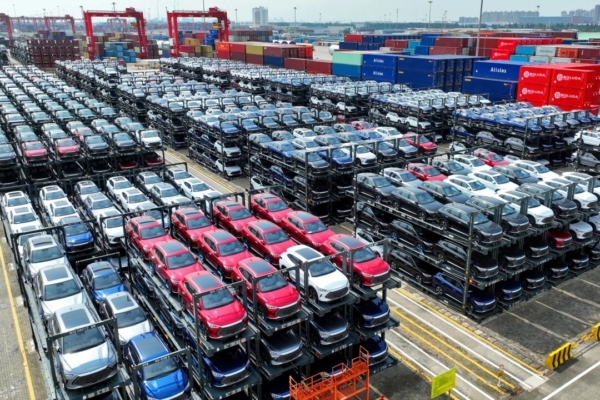
The United States Senate Commerce Committee passed a legislation on Wednesday (July 22nd) aimed at strengthening the U.S. government’s measures to prohibit networked vehicles from hostile countries, including China, from entering the U.S. market.
According to Reuters, the “Connected Vehicle Security Act” was jointly proposed by Republican Senator Bernie Moreno and Democratic Senator Elissa Slotkin.
Based on national security considerations, starting from January 2027, vehicles produced in China, as well as in countries such as Russia, Iran, and North Korea, or designed in these countries, are strictly prohibited from being imported, manufactured, sold, resold, or operated within the United States.
These restrictions not only apply to Chinese brands such as BYD and Geely but also extend to all vehicles in the global automotive supply chain that contain vehicle-to-vehicle communication and networking modules developed by Chinese companies.
The legislation also prohibits U.S. domestic automakers from using vehicle communication systems (VCS) hardware and software, autonomous driving system (ADS) software, and related technology from entities in adversarial countries like China and Russia in connected vehicles.
The ban covers communication technologies such as Bluetooth, Wi-Fi, cellular networks (4G/5G), and satellite communication. These technologies are fundamental for modern vehicle-to-vehicle communication systems to enable features like over-the-air software updates, traffic information transmission, synchronized vehicle data, and remote control.
Moreno told Voice of America that connected vehicles can continuously collect sensitive data such as user identities, driving patterns, and in-vehicle images, with the capability for remote control. If these technologies fall under Chinese legal restrictions, it could lead to data breaches and remote manipulation of vehicles.
He stated, “The aim of this legislation is to ensure that countries listed in the ‘Foreign Entities of Concern List’ – seemingly China is currently on that list – do not undermine our automotive industry and jeopardize our national security.”
Additionally, the legislation requires foreign companies with Chinese entities holding over 15% ownership stakes not to sell their automotive products in the U.S.
Regarding this provision, Senate Commerce Committee Chair and Republican Senator from Texas, Ted Cruz, cautioned that Chinese companies like BAIC holding a 9.98% stake in Mercedes-Benz, and Geely Holding founder Li Shufu holding a 9.69% stake in the company, collectively nearing 20% Chinese ownership. If this provision remains unchanged in the future, Mercedes-Benz products could be excluded from the U.S. market.
Republican Senator Moreno from Ohio revealed that Mercedes-Benz has been granted an extension until 2030 to achieve compliance and can also apply for exemptions during this period.
The legislation has garnered support from General Motors, the United Auto Workers union, and the CAR Coalition.
United Auto Workers Chair Shawn Fain stated that this move sets up “common-sense protective measures” for the domestic automotive industry.
Senator Moreno also mentioned that General Motors plans to relocate production of the Buick Envision from China to the United States starting with the 2028 model, and Ford has agreed to move certain Lincoln models back to the U.S. for production.
Moreno disclosed ongoing discussions with Chinese automaker Geely to adopt Google’s autonomous driving department, Waymo, on Chinese platforms. Waymo has committed to considering products from Detroit-based manufacturers for its future driving platforms.
The legislation also includes a provision requiring automakers to purchase more expensive universal batteries. Cruz noted that this measure would increase the cost of each vehicle by $5,000. An amendment proposed by electric vehicle maker Rivian to modify battery management software was not approved.