
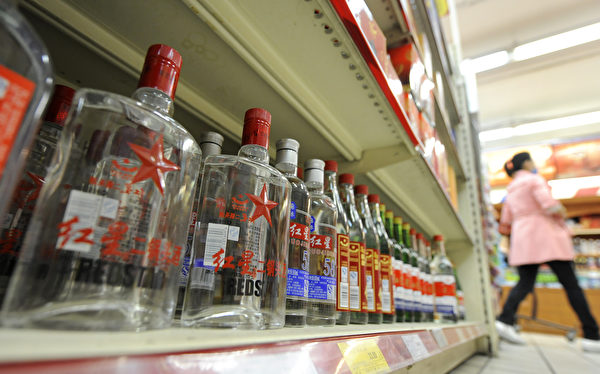
In the first half of 2026, Chinese liquor listed companies witnessed a simultaneous decline in production, prices, and profits. This indicates that the liquor industry on the mainland is still in a phase of deep adjustment, with an overall sluggish state. Some industry insiders believe that this current downturn in the industry will likely continue.
Recently, Chinese listed liquor companies have successively released their performance reports for the first six months of 2026. According to a report by “The Paper” on September 2, the semi-annual reports of 19 A-share listed companies in China and one H-share listed company in Hong Kong showed that these 20 liquor enterprises achieved a total revenue of 200.44 billion yuan, a 6.65% year-on-year decrease, and a total net profit attributable to the parent company of 73.681 billion yuan, an 8.28% decrease from the same period last year.
Official data from the Chinese government also confirms a decline in liquor production. According to data from the National Bureau of Statistics of the Communist Party of China, from January to June 2026, the total liquor production by large-scale enterprises in China amounted to 1.679 million kiloliters, a 4.7% decrease compared to the same period last year. This indicates that the liquor industry is still in a stage of intense competition.
“The Paper” noted that from the semi-annual reports of liquor companies, there has been a simultaneous decline in “quantity, price, and profit”. For instance, leading liquor company Moutai saw its first year-on-year decline in net profit since 2015 in the first half of the year, even though it managed to increase revenue.
Regarding the current situation of the liquor industry, independent liquor industry commentator Xiao Zhuqing told “The Paper”, “The semi-annual reports of the liquor industry in 2026 have shown a simultaneous decline in quantity, price, and profit, which is a reflection of the overall industry.”
Liquor industry analyst Cai Xuefei believes that the fundamental change in the liquor industry is that the growth paradigm has shifted from channel-driven to consumer-driven, forcing companies to shift from making money by pushing products to selling based on consumer demand.
When discussing the future trends of the liquor industry, Xiao Zhuqing believes, “The industry has not experienced a complete reversal yet and is still in a phase of bottoming and grinding. There won’t be a quick V-shaped rebound, but rather more local structural repairs or adjustments. Stronger companies will recover faster, while weaker ones will continue to face pressure.”
Cai Xuefei shares a similar view, stating that the overall demand in the liquor market remains weak, with no confirmed turning point yet. Additionally, the fundamental change in this cycle is not cyclical but a generational shift in demand: there is a structural contraction in business banquets and gift-giving scenarios, as younger consumers opt for less extravagant choices, which is a slow change that won’t reverse due to a single peak season. Furthermore, in the “quantity, price, and profit” decline, the stabilization of quantity is faster than that of price and profit, indicating that fundamental issues such as price inversion in bulk sales and a backlog of inventory in the mid- to high-end segments are yet to be resolved. The industry as a whole may need to wait until the first quarter of 2027 to see a trend of recovery.
“The adjustment in the liquor industry is not yet complete, and it is still in the later stages of clearance, but the fastest decline phase has passed, and what follows may be an L-shaped bottoming out,” Cai Xuefei said.