
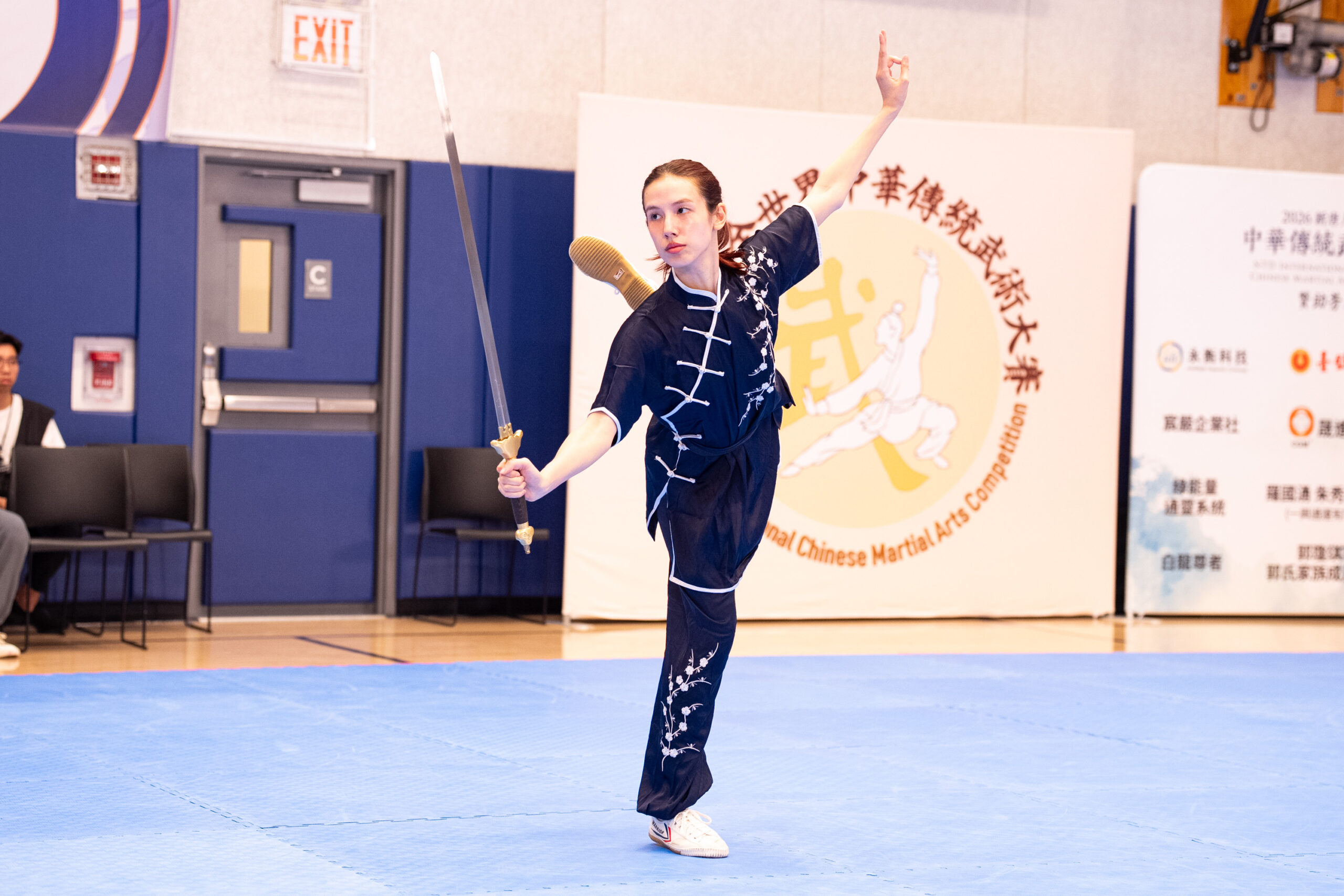
“This is a great experience,” said Joy Keat, participating in a martial arts competition for the first time. She admitted that this experience, both physically and mentally, was more challenging than her past piano performances, ballet dances, and debate competitions. However, under the nervousness and pressure, she also learned a lot from other competitors and gradually realized that the competition is not just about winning or losing, but also a process of self-discovery and continuous improvement.
The 9th NTD World Chinese Traditional Martial Arts Competition took place in Manhattan, New York on August 13-15, 2026, where Keat participated in the women’s apparatus category with a set of Wudang Seven-Star Sword.
She mentioned that even just observing other competitors’ performances taught her a lot.
Keat currently works in the government sector, engaging in geopolitically related work, primarily international political analysis. She has been involved in martial arts for some time, having practiced for several years when living in upstate New York and studied at a nearby martial arts school. After moving to New York City, she found Master Yang Longfei and studied with him for about three to four years.
In the past, she had participated in numerous piano performances, learned ballet, and engaged in speech and debate competitions in college. Therefore, performing or expressing herself in front of others was not entirely unfamiliar to her.
However, Keat expressed that despite being physically prepared for the competition, the mental pressure was still a challenge she needed to confront. She said, “I have to say, this competition has been the most challenging for me, both physically and mentally, surpassing any of my previous experiences.”
She observed that some competitors would calm themselves through meditation before the competition.
Nevertheless, the competition did not just bring pressure to her. She felt that there was a great camaraderie among the competitors, with everyone helping each other, which made her feel joyful in the tense competition environment and helped her maintain balance.
For her, the biggest gain from participating in the competition was learning a lot. She said, “Rather than focusing on achieving a certain result, I prefer to see this experience as a learning opportunity.”
Speaking of martial virtue, Keat thinks of humility, persistence, and continuous improvement.
She mentioned that during the process of learning from her master, there were times when she thought she was doing well, but the master would point out areas where she needed correction. This realization gradually made her understand that even though she had put in a lot of effort, she could not consider herself good enough just because of that.
“There is always room for improvement, always room for progress,” she said.
Therefore, for Keat, martial arts taught her humility.
She believed that one could be proud of their efforts but should also recognize that there is still room for significant growth. Otherwise, if one already thinks they are good, they will not continue to progress. This is one of the martial virtues she learned from traditional martial arts.
In addition, Keat also realized that martial arts require long hours of practice and effort. She enjoys things being completed quickly and efficiently, but martial arts made her understand that some things cannot be rushed.
“In martial arts, in this part of my life, it requires deep breathing and genuine effort to see growth,” she said.