
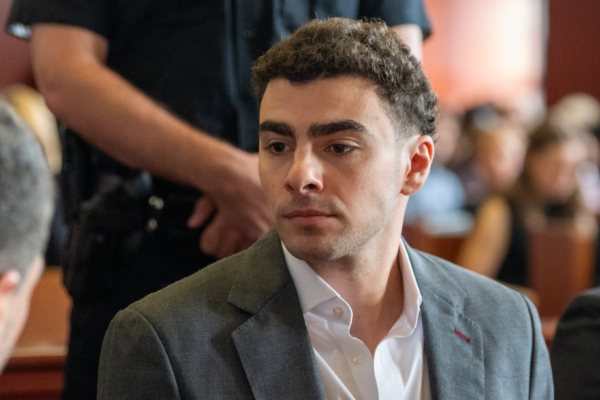
Shocking the entire United States and sparking a heated debate on the healthcare insurance system, the CEO of UnitedHealthcare, Brian Thompson, who was murdered, saw a major breakthrough on Friday (14th). The 28-year-old defendant, Luigi Mangione, made a significant development in the Manhattan Federal Court by officially admitting to federal stalking charges, finally confessing to cold-bloodedly gunning down Thompson on December 4, 2024.
This plea deal resolved one of the two lawsuits against Mangione, but it could also have a chain effect on subsequent New York state-level murder charges.
Mangione remained calm and recounted the criminal process in court. He admitted to disguising himself as an investor from a billion-dollar company before the incident, to extract information from UnitedHealthcare and track Thompson’s whereabouts.
During the hearing, Thompson’s wife took several deep breaths and wiped tears repeatedly, while friends and family members hugged her tightly for comfort. When United States District Judge Garnett asked Mangione if he understood he could face life imprisonment, he coldly responded, “Yes.”
The judge is scheduled to sentence him on December 18.
According to investigations by the police and medical institutions, Mangione graduated from the prestigious University of Pennsylvania, hailing from an affluent family in Maryland, and had never been a client of UnitedHealthcare.
However, in court, he claimed that his actions stemmed from personal suffering: “After enduring years of excruciating spinal fractures and facing multiple obstacles within the healthcare insurance system, I tracked Thompson.”
At the time of the incident, surveillance cameras captured a masked gunman ambushing 50-year-old Thompson from behind. Subsequently, the police found shell casings at the scene inscribed with words like “delay,” “deny,” and “depose,” commonly used to mock insurance companies for delaying and denying claims.
Mangione’s private journal was filled with accusations of “greed” directed towards the healthcare insurance industry. These details quickly turned this case into a public outcry against the dissatisfaction with the American healthcare system, even momentarily elevating Mangione to a “hero” in some people’s eyes.
Five days after the incident, Mangione was arrested by the police inside a McDonald’s store in Altoona, Pennsylvania, approximately 230 miles away from Manhattan. In his backpack, authorities found a 3D-printed handgun and a notebook detailing his intent to murder insurance company executives.
Initially, this case faced the possibility of dual prosecution by federal and state authorities. Earlier this year, the federal judge dismissed additional charges that could have subjected Mangione to the death penalty.
Under New York state law, if a federal prosecution concludes with the defendant’s guilty plea first, the state-level prosecution may be barred by the principle of “double jeopardy.” It is expected that Mangione’s legal team will use this as a basis to request the dismissal of the murder charges in the New York state court.
Previously, state prosecutors strongly objected in documents to the potential nullification of the state-level case due to the federal plea. With Mangione’s formal admission in federal court, this legal battle surrounding legal procedures and the healthcare system controversy will reach its final sentencing phase in December.