
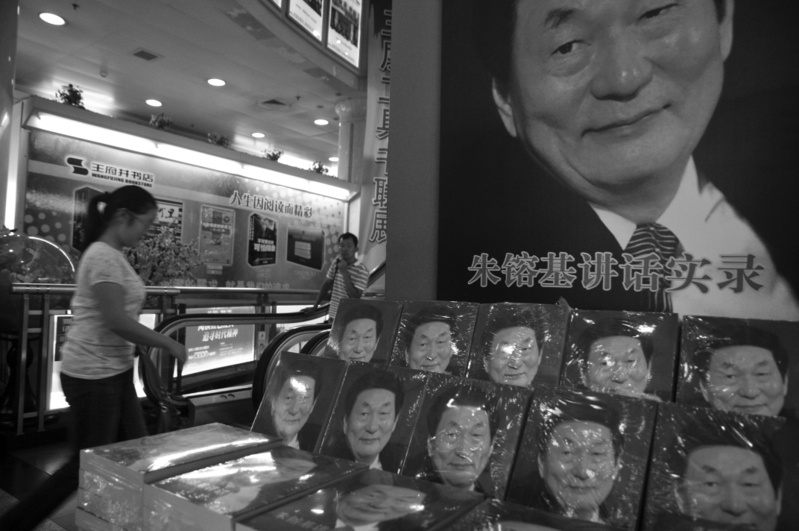
The news of the passing of Zhu Rongji has once again sparked discussions on the relationship between the 1998 Chinese housing reform and the current real estate crisis. Experts point out that Zhu Rongji’s housing reform only “turned on the tap”, and what truly led to the accumulation of risks was the continuous manipulation of real estate policies by the vested interest groups within the Chinese Communist Party and the hijacking of local finances.
According to official media reports, former Chinese Premier Zhu Rongji passed away in Beijing on Wednesday (August 12) at the age of 98. During his tenure from 1991 to 2003, Zhu Rongji served as Vice Premier and then Premier of the State Council of China for more than a decade. The power struggle between Zhu Rongji and then Chinese Communist Party leader Jiang Zemin has long been a subject of public attention.
Under Zhu Rongji’s leadership in 1994, the State Council of China launched comprehensive reforms in six aspects including fiscal system, financial system, investment system, enterprise system, housing system, and pricing system. In March 1998, at the age of 70, Zhu Rongji succeeded Li Peng on a temporary leave to become the Premier.
On July 3, 1998, the State Council issued the “Notice of the State Council on Further Deepening the Urban Housing System Reform and Accelerating Housing Construction” (State Development Letter [1998] No. 23).
This document explicitly proposed to “stop the physical allocation of housing and gradually implement the monetization of housing allocation”, establish a “multi-level urban housing supply system focusing on economic applicable housing”, and expand personal housing loans, develop housing provident fund loans and commercial bank housing loans, and cultivate a housing transaction market.
Historically, this reform was considered reasonable. It ended the long-standing welfare-based allocation of housing and promoted the commercialization and marketization of housing, thereby facilitating residential construction and urbanization.
However, it is analyzed that post-housing market reform did not develop a mature housing system centered around “residential security”, but rather evolved into an economic model where real estate development and rising housing prices became key drivers of growth, propelled by local finances, land regulations, credit expansion, and investment demands.
There have been expert interpretations provided regarding the relationship between the 1998 housing system reform and the current real estate crisis.
Chinese issues expert Wang He told the Epoch Times that it is simplistic to attribute today’s real estate crisis solely to Zhu Rongji’s era housing reform design. He described Zhu Rongji as merely “turning on the tap”, and the real issue lies in the subsequent evolution of the Chinese Communist Party’s policies, eventually resulting in the deep entanglement of real estate with the economy, finance, and residents’ wealth.
Wang He mentioned that in the mid to late 1990s, China still faced significant housing shortages while showing signs of monetary tightening in the economy. The real change in the operation logic of the real estate sector came with the subsequent rapid economic growth in China.
According to Wang He, the primary objective of Zhu Rongji’s housing reform in that era was to address the housing shortage and the prevalent monetary tightening at the time. However, following China’s accession to the World Trade Organization (WTO) and the subsequent rapid economic growth, real estate was increasingly tasked with driving GDP growth, supporting local finances, etc., eventually forming a complex network of interests between land, credit, real estate, and local finances.
Simultaneously, the tax reform in 1994 further altered the fiscal relationship between the central and local governments.
Wang He explained that this tax reform led to a significant fiscal contradiction: the central government controlled a larger share of fiscal revenues, yet a significant portion of public expenditures were still being borne by local governments. With a mismatch between local fiscal revenues and expenditure responsibilities, land gradually became a critical revenue source for local governments.
As a result, land finance emerged. Wang He stated that many local governments adopted a strategy of “low price acquisition, high price transfer”, obtaining higher land revenues through residential and commercial land, while attracting investment with low or even zero-priced industrial land, and utilizing land revenues for urban development and local finances.
In Wang He’s view, this mechanism ultimately transformed real estate from being a policy tool to resolve residents’ housing issues into an essential component of the local government fiscal system and economic growth model.
As the Chinese Communist Party’s land finance continued to expand, a solid network of interests formed among real estate, local governments, banks, and developers. Wang He indicated that a cyclic pattern of “real estate development, land acquisition, and land leasing” was established, leading to a phenomenon of “real estate speculation” among the populace.
He particularly highlighted that with the strengthening of the financial attributes of real estate, housing had transitioned from being a commodity that fulfills residential needs to an investment tool for wealth enhancement. Throughout this process, real estate prices continued to rise, burdening new market entrants with increasingly higher housing costs.
Wang He argued that the continuous rise in housing prices had vastly different impacts on various social groups. Those who owned property early on, especially individuals with system-related privileges and high-income groups, benefited from asset appreciation during housing price hikes. Conversely, young individuals and low to moderate-income groups entering the housing market later faced escalating loan pressures.
“For those in need and newcomers to the market, this creates immense pressure, turning them into ‘house slaves’,” he said. Particularly after 2015 and 2016, the financialization of real estate and soaring property prices further aggravated the situation.
After the Evergrande crisis in 2021, the Chinese real estate market entered a phase of continuous adjustment. Wang He believed that following the bursting of the real estate bubble, the market should ideally have undergone clearance through price adjustments, corporate exits, and debt restructuring. However, policies in practice attempted to prevent rapid price declines.
Wang He likened these policies to “building dams”. He compared the situation to a flood where the water level had risen significantly, and rather than allowing the flood to release naturally, more dams were constantly being built. He highlighted that while measures such as price and sale restrictions by various regions temporarily prevented rapid price declines, they could prolong the real estate market clearing process, leading to the continued accumulation of risks.
Real estate enterprise defaults are not limited to just Evergrande, with unfinished buildings scattered across the country, severely hindering the recovery of the Chinese economy.
Wang He referenced the long-term adjustment process following the burst of the Japanese real estate bubble as a benchmark. He suggested that Japan went through an extended period of real estate de-bubbling, whereas China’s real estate sector is intertwined with local finances, residents’ wealth, and economic growth, meaning that if a genuine market clearing is not achieved, the adjustment period could be prolonged.
He mentioned that during Premier Wen Jiabao and Premier Li Keqiang’s tenure, the decision-making echelon had already recognized the risks in the real estate sector. However, due to the involvement of real estate in local finances, banks, enterprises, and residents’ wealth, any drastic adjustments would bring about significant impacts.
“The reason why the Chinese real estate sector has struggled to break free from its reliance on land, credit, and local finances for a long time is that vested interests have deeply embedded themselves within the policy system,” concluded Wang He.