
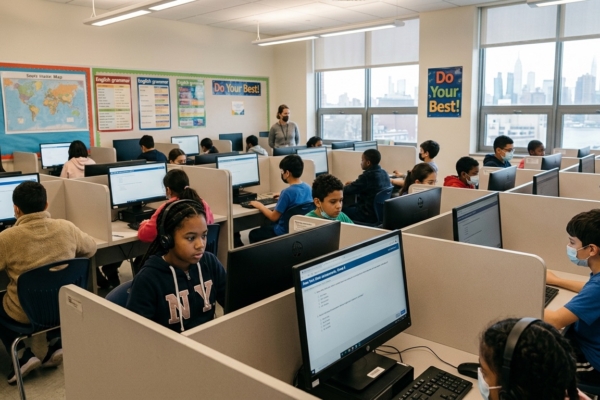
In New York State, a recent bombshell has been dropped on the education sector with the release of the latest 3rd to 8th-grade English Language Arts (ELA) state exam results. The data reveals that as high as half of the elementary and middle school students in New York City are not meeting the required reading standards. The city’s average scores have significantly plummeted by 6 percentage points, almost erasing the gains made the previous year.
However, this unflattering report card has not led to a unanimous examination of student or teacher issues by various sectors. Instead, it has sparked widespread questioning from education experts, policy analysts, and advocacy groups. Many experts believe that the rollercoaster-like data of sharp increases one year followed by steep declines the next is highly unusual, prompting calls for an independent investigation into the state exam papers and grading system.
Arlen Benjamin-Gomez, the executive director of the education advocacy group EdTrust-New York, expressed strong skepticism towards this data: “What happened with the reading exams in the last three years? Why the significant increase one year, followed by a drastic drop the next?”
Several education experts have pointed out that students’ overall reading abilities cannot undergo such dramatic reversals overnight. Upon closer analysis of the data, many puzzling and contradictory phenomena have been exposed.
The pass rates for 3rd and 5th graders citywide have seen a significant decrease of 13 percentage points, while the 4th grade only dropped by less than 6 percentage points.
In the Bedford-Stuyvesant school district in Brooklyn, the pass rates for even grades (4th, 6th, 8th grades) have all increased, while the odd grades (3rd, 5th, 7th grades) have all experienced declines. Particularly, the 7th grade saw a steep 10% drop, while the 8th grade saw a substantial 8% increase.
At the beginning of the school year, the New York City Department of Education’s reading screenings, conducted by teachers, showed that students’ reading abilities had steadily increased by about 3 percentage points since 2024. Yet, when faced with the state exam, there was a sudden “plunge,” with no consistency between the two sets of data.
Columbia University Teachers College sociology professor Aaron Pallas, speaking to Gothamist, bluntly stated that these results are “confusing.” He speculated that factors such as this year being the first time 3rd graders took a computer-based exam, varying difficulty levels of exam papers, or changes in the backend grading standards could likely be the main causes of the abnormal data.
The controversial report card has stirred heightened tension due to its implications for the “NYC Reads” large-scale curriculum reform initiative, launched by former Mayor Eric Adams and continued by current Mayor Mamdani. This initiative, which costs a significant amount, has standardized the shift of all schools in the city towards a new curriculum that emphasizes scientific phonics and reading comprehension.
Facing the seismic data shake-up, many parents and the teachers’ union (UFT) have complained about the new curriculum being too rigid, boring, and adding significant administrative burden. However, Mayor Mamdani emphasized in a statement that while the city government would deeply investigate the grading mechanism to clarify data concerns, there would be no wavering in the determination to continue the reading reform: “We have seen across the country that this proven effective teaching method has brought breakthrough improvements in reading abilities, and we will persist in this direction.”
In response to the overwhelming questions, the New York State Department of Education spokesperson J.P. O’Hare stated that the state exam itself has built-in regular review mechanisms, and officials will not ignore the issues reflected by the data. A detailed analysis will be conducted to understand which student groups are facing the greatest challenges.
Maria Odom, the executive director of Advocates for Children New York, emphasized that education reform is not instant and cannot be negated by a single suspect test: “What is certain is that the work is far from over. Education is not a quick fix, and true change cannot happen overnight.”