
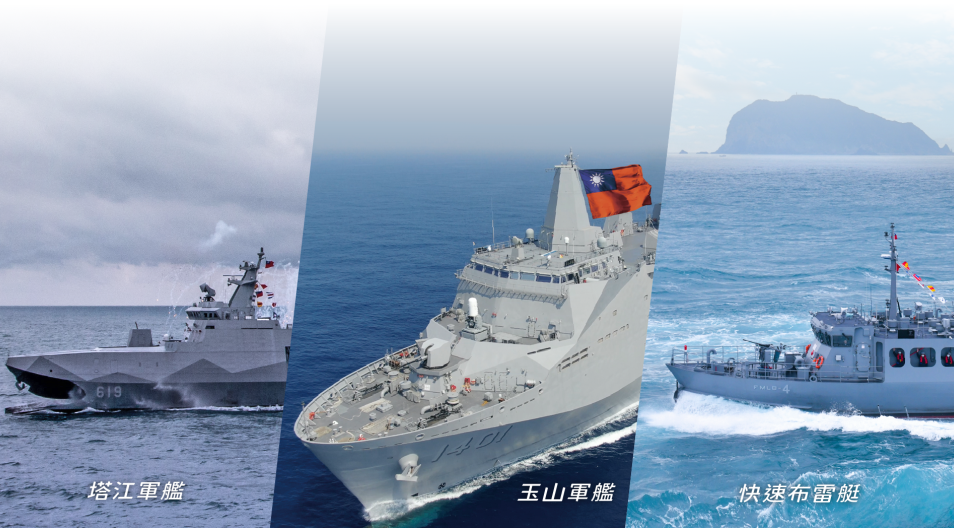
【Epoch Times, August 10, 2026】Colonel Liu Jianyuan, a military instructor of the Republic of China Air Force, published an article on the official website of the Taiwan Foundation for Defense and Security Studies titled “Opportunities for the Development of Taiwan’s Defense Industry from the Perspective of Shipbuilding Demand.” In the article, he pointed out that the Ministry of National Defense recently released a new shipbuilding list totaling up to 315.6 billion New Taiwan Dollars (NTD), marking the largest wave of shipbuilding in history with an anticipated multiplier effect of 1.8.
Liu Jianyuan stated that the latest shipbuilding list released by the Ministry of National Defense covers six emerging forces, including light patrol vessels, follow-up ships to the Yushan-class frigates, and rescue vessels. The “Golden Triangle” formed by Taiwan Shipbuilding, CSBC Corporation, and Lung Teh Shipbuilding actively compete for contracts, which is expected to drive the upgrade of Taiwan’s domestic industries.
Moreover, he mentioned that in response to the increasingly complex maritime situation and law enforcement needs, the Taiwanese government has allocated up to 42.6 billion NTD to promote the development of the Coast Guard vessel construction plan. This grand plan, spanning a period of 10 years (2018 to 2027), aims to add 141 new vessels to the Coast Guard Administration, ranging from 4,000-ton large patrol vessels to 35-ton high-speed patrol boats, fully replacing old vessels and expanding the fleet.
Liu Jianyuan stated that to address changes in regional security situations and enhance maritime defense capabilities, the government continues to promote the policy of building vessels domestically. Both the Navy and the Coast Guard Administration have put forward medium to long-term shipbuilding plans. The Navy plans to construct a total of 15 vessels including light patrol vessels, replenishment oiler ships, submarine rescue ships, and follow-up ships to the Yushan-class frigates, with a total budget of approximately 315.6 billion NTD.
Furthermore, he mentioned that in addition to continuing the implementation of the “Coast Guard Vessel Construction Plan for Maritime Rights Protection,” the Coast Guard Administration also plans to build high-latitude offshore patrol vessels and a new wave of Coast Guard vessel construction projects. The domestic demand for shipbuilding is expected to maintain steady growth over the next decade.
Liu Jianyuan emphasized that Taiwan will maintain a stable and significant demand for military and government vessels over the next decade, creating vital growth momentum for the domestic shipbuilding industry.
He pointed out that Taiwan’s major shipyards currently have the foundational capacity to undertake large shipbuilding projects. However, as multiple shipbuilding plans by the Navy and Coast Guard Administration progress simultaneously, factors such as production capacity allocation, supply chain resilience, and talent supply will become crucial in influencing delivery efficiency and industry competitiveness. He offered several suggestions in this regard:
1. Establish stable and predictable shipbuilding demand to improve industrial operational efficiency.
Taiwan’s future shipbuilding demands from the Navy and Coast Guard Administration are expected to support the development of the domestic shipbuilding industry for over a decade, providing a stable source of orders. To avoid multiple large projects being constructed simultaneously, strategies such as cross-year scheduling and phased contracting should be adopted to enhance the efficiency of shipyard production capacity utilization.
He recommended that a unit with cross-ministerial integration capabilities (such as a Shipbuilding Center) coordinate the requirements of the Navy, Coast Guard Administration, and shipbuilders, consolidating the demands of different agencies to reduce production bottlenecks and the risk of delayed deliveries.
2. Establish a continuous defense industry policy to avoid repeating the experience of the past National Aircraft Industries model.
The lack of follow-up research and development and production plans in the National Aircraft Industries model led to reduced production lines, gradual loss of talent, technology, and supply chain, resulting in higher costs when subsequently implementing the Indigenous Defense Fighter and other aviation projects.
He suggested that the policy of building vessels domestically should avoid completing only a single project and should establish a “continuous shipbuilding policy” to maintain a sustainable workload for new vessel construction, follow-up vessel development, performance enhancement, and maintenance logistics to sustain design, construction, and system integration capabilities.
3. Reduce reliance on government orders and enhance international market competitiveness.
Currently, the domestic shipbuilding industry relies mainly on government military and public sector orders, which may help maintain production capacity and talent but could lead to excessive dependence on the market, reducing the incentive for enterprises to expand into commercial markets and international competition.
He recommended that the government encourage domestic shipyards to develop dual-use military technologies, expand international cooperation and export markets to enhance autonomous order-taking capabilities and international competitiveness.