
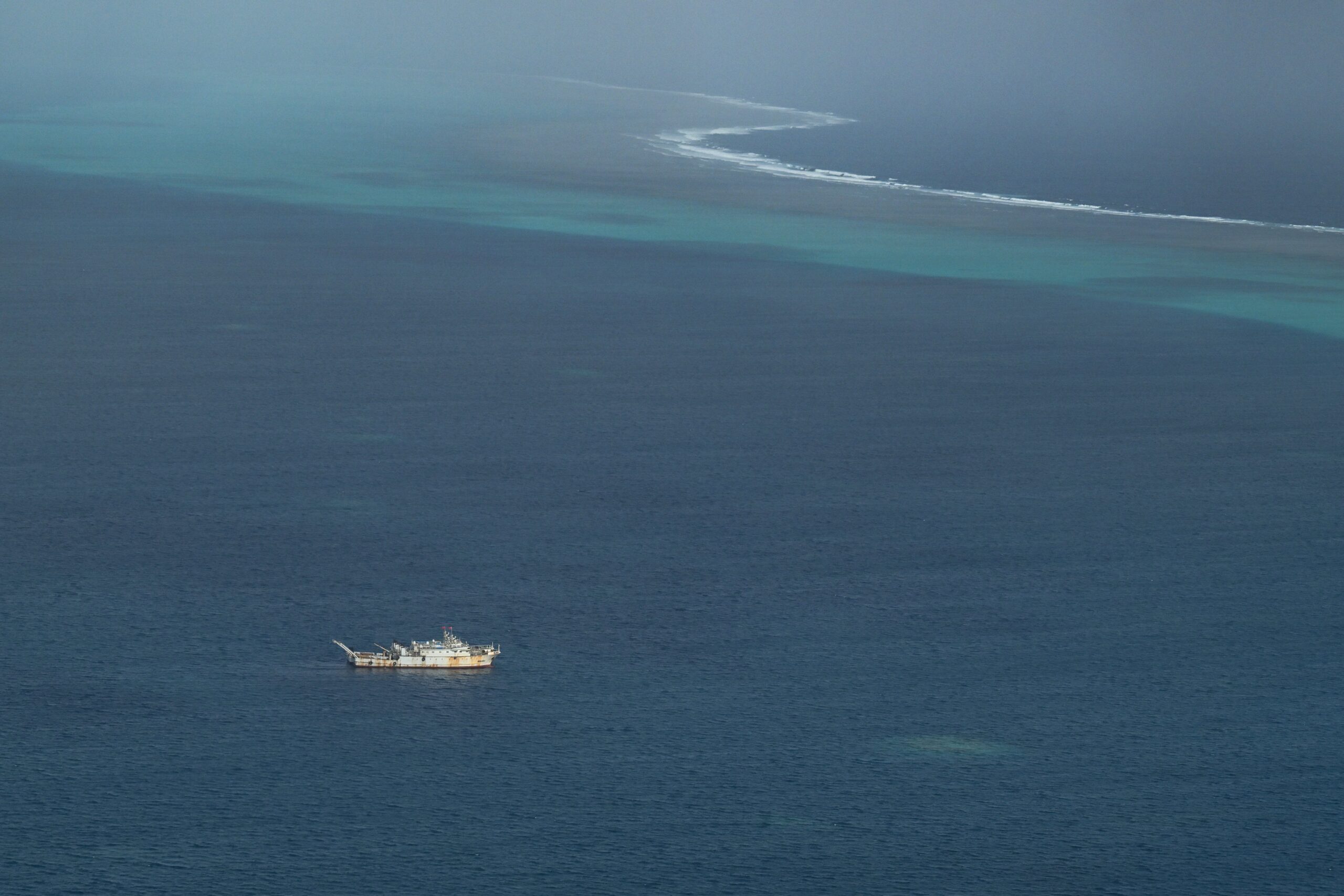
The United States has condemned China for designating a nature reserve in the disputed area of Scarborough Shoal in the South China Sea, accusing the move of being “destabilizing.” The U.S. stated that this not only deprives Filipino fishermen of the right to access traditional fishing grounds but also severely impacts the openness of the Indo-Pacific region.
On August 1, China implemented new regulations for the management of the Scarborough Shoal as a “national-level nature reserve.” The shoal is a triangular coral reef located within the 200-nautical-mile exclusive economic zone (EEZ) of the Philippines, but it has been under substantial Chinese control for over a decade. In 2025, China further designated a large area in the northeastern part of the reef as a nature reserve.
According to the new Chinese regulations, all fishing, mining, coral reef excavation, and other activities are completely prohibited in the designated area. In addition, Chinese maritime law enforcement and other agencies will establish a regular patrol mechanism in the area to crack down on activities deemed “illegal” by Chinese authorities.
In response to Beijing’s actions, the U.S. State Department issued a statement on August 8 condemning China. State Department spokesman Tommy Pigott stated, “This is China once again unilaterally using the environment and law as excuses to advance its expansionist claims in the South China Sea by coercion and sacrificing the interests of neighboring countries.”
He added, “The United States stands with our ally the Philippines in supporting a free and open Indo-Pacific region.”
The South China Sea is a resource-rich and strategically important maritime hub for global shipping, involving overlapping claims by China, the Philippines, Vietnam, Malaysia, Indonesia, and Brunei in their respective EEZs.
The Permanent Court of Arbitration in The Hague ruled in 2016 based on the United Nations Convention on the Law of the Sea that China’s expansionist claims in the South China Sea lack legal basis.
However, China not only refuses to accept the ruling but also continues to frequently dispatch maritime law enforcement and military vessels to the disputed waters to assert sovereignty. In July of this year, China and the Philippines had three maritime standoffs in less than a week, leading to a rapid escalation in regional tensions.
The escalation of maritime conflicts between China and the Philippines has prompted the United States to reaffirm its commitment to mutual defense.
According to Manila Coast Guard spokesman Jay Tarriela, on July 24, a Chinese coast guard ship near Scarborough Shoal not only fired water cannons at Philippine government vessels but also deliberately took more “dangerous actions.” He added that a Chinese vessel came within 7 meters of a Philippine vessel, nearly causing a “serious collision.”
On the previous day, July 23, the Philippines accused the Chinese coast guard of continuously using water cannons for over two minutes. The Chinese side, in response, argued that it was taking “control measures” in accordance with the law against Philippine vessels entering its jurisdictional waters.
On July 20, reports from Manila indicated a violent clash near another disputed hotspot in the South China Sea, Second Thomas Shoal, where a Philippine naval officer was injured by Chinese personnel, triggering high levels of concern from the United States, the European Union, Australia, and Japan.
Regarding the Second Thomas Shoal conflict, U.S. Secretary of State Blinken, speaking on the sidelines of an ASEAN meeting in Manila on July 23, disclosed to reporters that the U.S. Coast Guard ship was in the area at the time of the incident, not only facilitating coordination but also assisting in rescuing injured Philippine personnel.
He emphasized that while the U.S. and China, as the world’s top two economies and nuclear powers, must maintain their bilateral relationship, “it will never come at the expense of sacrificing our allies and partners in the region, or the U.S. presence in the Indo-Pacific region.”