
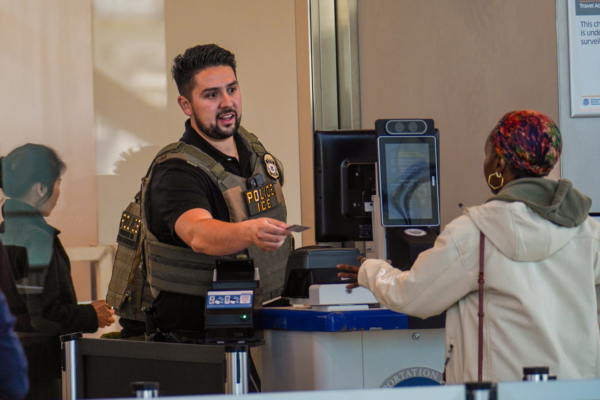
In recent times, the U.S. Immigration and Customs Enforcement (ICE) has expanded immigration enforcement at airports nationwide, leading to a significant increase in the number of arrests. According to an analysis article by the Center for Immigration Studies (CIS) on August 7th, immigration enforcement officers are now averaging approximately 20 to 40 arrests per day at airports across the U.S., a significant rise from less than 10 per day back in May 2025.
What’s particularly noteworthy is the shift in targets for airport enforcement. As reported by The Wall Street Journal, individuals being arrested by ICE at airports recently include those whose visas have expired but have pending legitimate applications for status adjustments such as green cards or asylum seekers. In contrast to earlier stages of airport enforcement which primarily targeted immigrants with final deportation orders.
This indicates that having an immigration application pending does not guarantee immunity from ICE enforcement actions.
Legal analyses of recent cases cited in the article state, “Having an immigration relief application pending does not exempt the individual from immigration enforcement.”
Furthermore, the article notes that if merely submitting an immigration application could shield someone from ICE enforcement, then anyone subject to deportation could exploit this by filing for immigration benefits to prolong their unlawful presence and indefinitely evade detention.
The recent increase in airport enforcement has also sparked tensions between airlines and ICE. According to The Wall Street Journal, on July 25th, an ICE agent tried to board a Southwest Airlines flight from Dallas to Orlando to arrest a man but was denied by airline staff. It has been reported that similar incidents have occurred at least six times on Southwest Airlines in recent weeks.
In the July 25th incident, ICE agents called out for a person named “David” near the boarding gate to confirm the target for arrest. The ICE personnel then presented an administrative warrant to board the aircraft, but airline staff at the gate refused access to the agents unless they had a judicially signed warrant.
Reportedly, ICE higher-ups have instructed enforcement officers to attempt arrests near Transportation Security Administration (TSA) checkpoints whenever possible. However, due to the congested nature of larger airport security areas, officers may not always be able to identify targets promptly, leading to an expansion of enforcement areas to boarding gates and ticket counters near airports in cities like San Francisco, Miami, and Kansas City.
Despite the increase in airport arrests, the CIS article emphasizes that the actual enforcement scale remains relatively small compared to the vast number of daily air travelers. On August 3rd, about 2.727 million people passed through TSA checkpoints nationwide; even at the higher end of ICE’s daily airport arrest rate of 40 individuals, the number of arrests would only represent around 0.0015% of that day’s TSA screened passengers.
Former immigration judge Andrew R. Arthur, the author of the article, believes that airports are crucial security checkpoints for verifying travelers’ identities. He cited a statement from the 9/11 Commission report, “Every such checkpoint or gateway is an opportunity for screening — confirming the identity those seeking access claim to hold…intercepting identified suspects and taking effective action.”
Based on this, former immigration judge Arthur suggests that ICE’s immigration enforcement at airports is not a new concept but rather aligns with post-9/11 U.S. policies of enhanced identity verification at transportation hubs.
It is imperative for immigrant communities to recognize that airport enforcement by ICE no longer exclusively targets individuals with final deportation orders. Individuals with expired visas, even those awaiting the results of asylum, green card, or other immigration benefit applications, may also become subjects of ICE enforcement.