
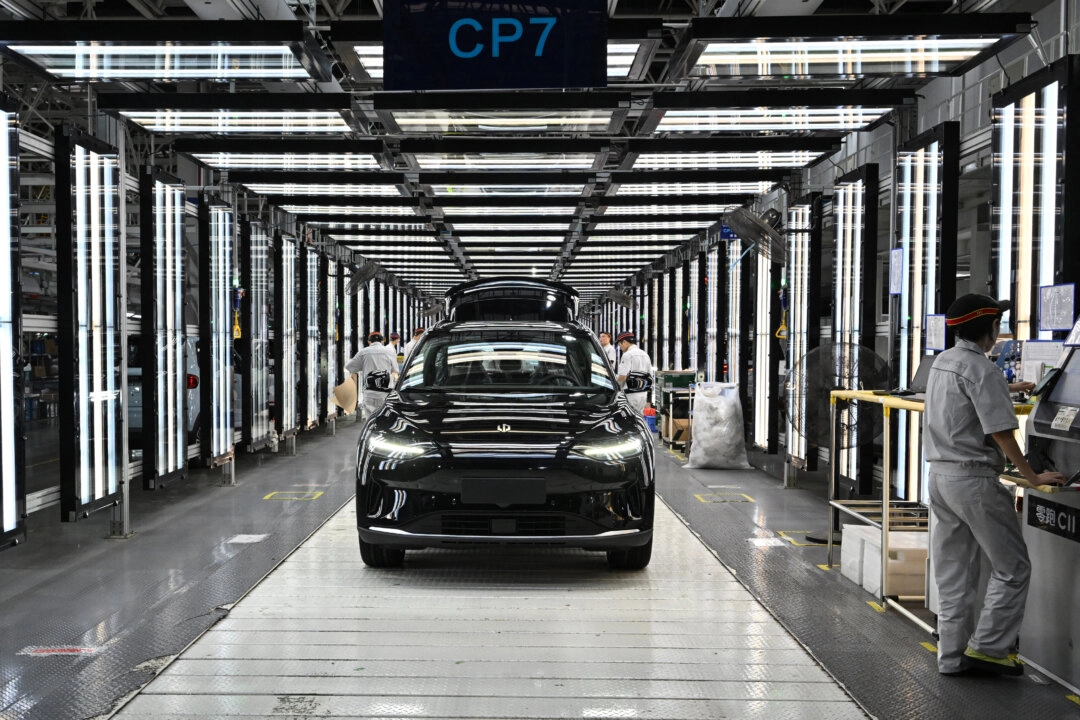
The State Administration for Market Regulation of the People’s Republic of China released statistics showing that the “new three items” that the Chinese Communist Party (CCP) once vigorously supported – new energy vehicles, photovoltaics, and lithium battery enterprises – had 12,876 companies deregistered in the first half of the year. This data has attracted more attention to the issue of China’s overcapacity.
According to the statistics released by the State Administration for Market Regulation on August 8th, in the first half of this year, related companies in the new energy vehicle industry saw 7,632 deregistrations, an increase of 4.6% year-on-year. For companies in the solar energy industry, there were 5,089 deregistrations, an 8.3% increase year-on-year. In the lithium battery industry, 155 related companies were deregistered, marking a 12.3% annual increase. In total, 12,876 “new three items” enterprises were deregistered.
The press release from the State Administration for Market Regulation stated that this action aimed to clear out “overcapacity industry enterprises.”
The Ministry of Commerce of the CCP recently released a document entitled “China’s Stance on the So-called ‘Overcapacity’ Issue,” denying the existence of overcapacity in China, government subsidies supporting related industries, and stating that the claim that “China’s insufficient domestic demand leads to overcapacity” is not in line with reality.
Regarding the denial by the Ministry of Commerce of the CCP, an article published by The Economist on August 3rd, entitled “China won’t apologise for overcapacity,” analyzed that Beijing, in the face of external criticism, is not backing down and even denying the issue of “overcapacity.” The real controversy lies not in the overcapacity itself but in the government’s deep involvement in industrial development.
The article argues that China’s high savings rate and relatively inadequate domestic demand have led to long-term high exports compared to imports, establishing an economic model heavily reliant on overseas markets to absorb excess capacity. Beijing has long been investing heavily in key industries, providing low-cost land, investing in semiconductor companies, requiring state-owned enterprises to prioritize purchasing domestic products, promoting technological self-reliance, and self-sufficiency policies. These measures not only reduce business costs but also enable Beijing to continue expanding production scale and gradually expand in the global market.
An article by Nikkei Asia suggests that Beijing is spreading its surplus industrial structure overseas through foreign investments, such as building factories in Southeast Asia and the Middle East.
According to data from the General Administration of Customs of the People’s Republic of China, in the first half of 2026, China exported 5.096 million vehicles, a 65.3% year-on-year increase, to over 210 countries and regions worldwide. Particularly, in the new energy vehicle sector, cumulative exports reached 2.355 million vehicles, doubling year-on-year. Meanwhile, domestic automobile sales in China totaled 9.921 million vehicles, a 21.1% year-on-year decrease, showing a downward trend. Among these, new energy vehicle sales were 5.09 million vehicles, a 13.4% decrease.