
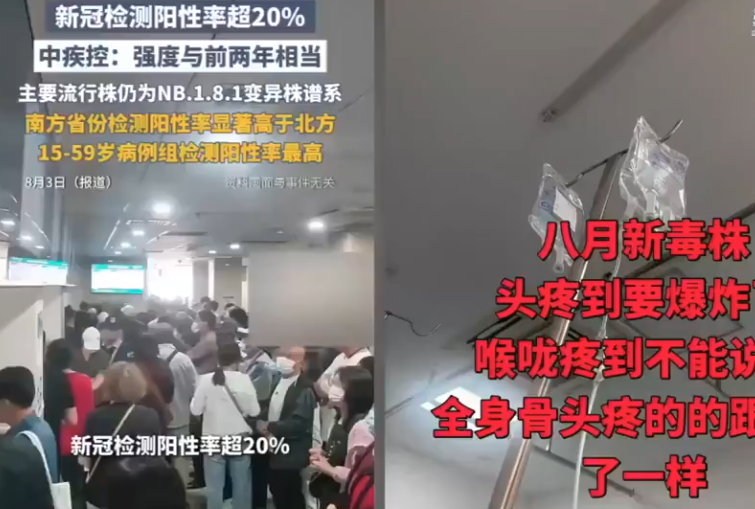
In the scorching summer of 2026, the resurgence of the mainland’s COVID-19 pandemic has once again attracted attention. According to the data released by the China Center for Disease Control and Prevention (China CDC) on July 30, the positivity rate of COVID-19 testing has exceeded 20% for the first time, climbing from 2.9% in the week of June 1 to 20.3% in the week of July 26. Officials have acknowledged the increased transmissibility of the virus, categorizing it as a “medium epidemic level,” while emphasizing that the virulence has not significantly increased. Doctors and the public interviewed have reported overcrowding in outpatient and emergency rooms.
Since 2023, information on COVID-19 infections in China has mainly come from monthly epidemic data, surveillance of sentinel hospitals, and the outpatient situation of medical institutions after the implementation of the “category management for class B infectious diseases.” However, clinical practices are facing administrative interventions such as “control of indicators and non-reporting of COVID-19,” discontinuation of effective medications in offline pharmacies, and immune system depletion due to recurrent infections. There are concerns from the public questioning whether this current upsurge is simply a seasonal “normal fluctuation” as officially claimed or if it is quietly surging and making a comeback at the grassroots level.
According to the China CDC, in the 30th week of 2026 (July 20-26), the positivity rate of COVID-19 among flu-like cases in sentinel hospitals nationwide had reached 20.3%, a 4-percentage point increase from the previous week’s 16.3%, surpassing the influenza virus (14.5%) and ranking first among respiratory pathogens. The positivity rate of COVID-19 among cases of severe acute respiratory infections requiring hospitalization also rose to 9.5%, an increase of 3.3 percentage points from the previous week.
Official data shows that from the 23rd week (June 1-7) starting at 2.9%, the positivity rate of COVID-19 has steadily increased for eight consecutive weeks: 2.9% → 4.1% → 5.3% → 6.4% → 9.6% → 12.0% → 16.3% → 20.3%. Lai Xiaorui, an expert from the China CDC, confirmed that the epidemic had seen a slight rebound since late May, entering a phase of low-level transmission in mid-June. He claimed that the predominant circulating strain in the country remains the NB.1.8.1 variant, and current surveillance has not detected any new variants posing additional public health risks.
Current data indicates that the clinical presentation of the NB.1.8.1 variant is similar to other Omicron subtypes, with most patients experiencing mild symptoms or being asymptomatic. Hu Biji, the director of the infectious diseases department at Fudan Zhongshan Hospital, pointed out that while the 20.3% positivity rate represents flu-like outpatient cases, the number of new COVID-19 patients in the hospital’s fever clinic has increased from a few cases per day to dozens, indicating that the current outbreak is still in its upward phase.
Lin Xiaoxu, a former microbiologist in the US Army and associate professor at Northern University’s Aerospace College, told reporters that the authorities raising the epidemic to a “moderate level” in the 29th week (July 13-19) has revealed the scale of pressure, suggesting that actual community transmission is apparently “more serious than sporadic outbreaks.”
This outbreak is showing distinct features of both “higher incidence in the south and lower in the north” and “higher incidence in young and middle-aged adults (aged 15-59)”. Zheng Yuanyu, an infectious disease specialist, explained in an interview with Dajiyuan that the high temperatures have driven people towards air-conditioned enclosed spaces, increasing the risk of indoor airborne transmission, aligning with the transmission patterns of young and middle-aged adults who spend more time in offices.
In contrast to the authorities’ moderate stance, frontline medical staff and patients have given much more severe feedback. Some doctors bluntly stated: “The hospital emergency rooms are packed, there’s no place left on the floor to lie down.” Interviewees from Guangdong, Shanghai, Hubei, Zhejiang, and other regions told reporters that there has been a significant increase in patients with high fever, cough, and fatigue recently, leading to a sharp rise in hospital visits.
A man from Yuhang, Zhejiang, went to the emergency room at Zhejiang Medical University Yuhang Hospital on July 26 for treatment. He described the situation to reporters as “way too crowded”: “The emergency room felt even longer than the outpatient waiting time, where I waited for 2 hours to see a doctor, 1.5 hours for test results, and another hour for a follow-up visit. I was so exhausted from waiting.” After being diagnosed, he took a domestic oral medication called “Xiannoxin,” which helped him recover, but he still feels out of breath when walking fast.
A 17-year-old high school senior from Nanjing, Jiangsu, tested positive for COVID-19 after returning home from a trip to Anhui. She recalled that the first sign of something abnormal was the loss of her sense of smell: “I noticed that I couldn’t smell anything, and even thought that the food I was eating that night was improperly prepared, only to later realize it was due to (contracting) COVID-19.”
When she visited the Pukou People’s Hospital, she was rejected by the pediatric department due to being over 17 years old and was unable to receive antiviral medication since it is only prescribed to those above 18. She could only get self-paid cough suppressants for 470 yuan.
She told Dajiyuan, “I don’t know how many days it will take to recover. Most likely I will have to tough it out on my own and treat it like a common cold. I can’t stop coughing, having dry heaves, and tears flowing, which is especially uncomfortable.”
Hospitalized patients are also facing challenges. A man in Hubei, hospitalized for surgery due to three broken ribs, tested positive for COVID-19 during a follow-up examination post-surgery. He expressed his agony, saying, “I coughed, but dared not to, my ribs are hurting terribly. How can I not cough when my ribs are broken?”
A woman from Shanghai, Ji Xin (pseudonym), reported that she developed a sore throat and fever on July 27. Initially, the doctor suggested she “take common cold medicine and bear with it” and said there was no need for special medication. However, by July 30, her temperature rapidly rose to 39.1°C, and she felt dizzy. Taking medication quickly alleviated her symptoms.
She specifically mentioned, “Many people being admitted to hospitals are testing positive.”
Feng, a resident of Guangzhou, revealed that many friends and their families had come down with a “cold,” but due to the lack of official warnings, most people treated it merely as a common cold: “I suspect specific death news will be blocked.”
A prominent medical and health influencer with over two million followers, “Medical Notes,” stated that many people cannot differentiate between a common cold, the flu, and COVID-19. They warned that COVID-19 will not go away and should not be underestimated.
Since categorizing COVID-19 as a Category B infectious disease, Chinese officials have only released monthly reports. According to the data from the China CDC, the number of patients attending fever clinics increased from 58,000 at the beginning of the month to 65,000 by the end of June, with a total of 79,000 confirmed cases and 130 severe cases, and one death reported in a single month.
Lin Na (pseudonym) from Baiyun District in Guangzhou told reporters that she tested positive on June 28 and by July 10, she was coughing so much that she felt like crying. She went to a secondary hospital seeking special medications but was heartlessly turned down by the doctor.
According to her account, the doctor explained helplessly, “The hospital has quotas, we can’t report COVID-19 cases.” The doctor frankly stated that the reporting cards (infectious disease reporting cards) were limited and full, continuing to report and prescribe medications would be unfavorable, suggesting that “superiors would blame us for not controlling the epidemic properly… they want promotions and wealth, they want good results. Data can be controlled, not reporting (based on official data) leads to nothing.”
Lin Na also mentioned that her family members also tested positive. “My mom got it, my dad too, they are both coughing.” With many people in the hospital, “it’s bursting at the seams, I couldn’t even get an appointment.”
Lin Xiaoxu believes that the official data released is just the “tip of the iceberg.” In the current situation where mild cases are not tested and self-reports are not submitted, the official figures are out of touch with reality. He emphasized that authorities have lacked transparency regarding critical factors such as deaths from severe COVID-19, hospitalizations, and ICU occupancy rates over the long term, stating that “without detailed denominators, the actual burden cannot be ruled out as deliberately downplayed and underreported.”
In contrast, Taiwan has demonstrated transparency in information. The Taiwan Centers for Disease Control reported on August 4 that the number of patient visits to emergency rooms and clinics in the 30th week had reached 18,990 (an increase of 74.8% from the previous week) and detailed 62 new cases of severe COVID-19 and 3 deaths from July 28 to August 3.
The worsening epidemic has also driven up the demand for medication. Data from the JD Buy Drugs platform shows that on July 13, the transaction volume of drugs for COVID-19 increased nearly 6 times compared to the previous month, with sales of self-test kits and reagents also doubling. Sales of oral antiviral drugs such as Xiannoxin, Taizhongding, Leruling, domestic oral medications, and the import “Paxlovid” saw significant growth on e-commerce platforms.
However, despite the online surge, physical retail pharmacies are struggling. A journalist from Time Weekly visited 12 retail pharmacies in various districts in Beijing, with only one store selling special COVID-19 medications. Most pharmacists were unaware and only recommended fever-reducing and flu medications.
Expert Liu Jian pointed out that special COVID-19 medications in China are prescription drugs, and retail channels are strictly limited to medical institutions and specific internet e-commerce platforms, excluding offline retail pharmacies.
This restriction directly cuts off access for vulnerable individuals during the critical “golden 48 hours” after symptoms appear. Under the current system, patients who test positive for COVID-19 and wish to obtain medication have to either endure long waits and the risk of cross-infection at overcrowded hospitals or wait until the next day for delivery when ordering online. Every delay in the process unknowingly increases the risk of high-risk patients developing severe outcomes.
With the ongoing resurgence of the summer epidemic, discussions on the long-term existence of COVID-19 and the damage recurrent infections pose to the immune system have once again garnered attention. Medical influencer “Medical Notes” with millions of followers issued a warning, emphasizing that the public cannot distinguish between a common cold and COVID-19, and the virus has not disappeared. Each encounter with the virus weakens the immune system.
A physician working within the Chinese CDC system, Zeng Ling (pseudonym), pointed out that the surge in COVID-19 cases in China is not as simple as weakened herd immunity. He bluntly stated that the Chinese population, having experienced multiple accumulated infections in recent years, has reached a critical “tipping point” in terms of physical resilience.
He warned that although the pathogenicity of the predominant Omicron variant is reduced, repeated infections still silently erode the immune system, especially posing risks of severe disease and death to individuals with weaker immunity or at higher risk.