
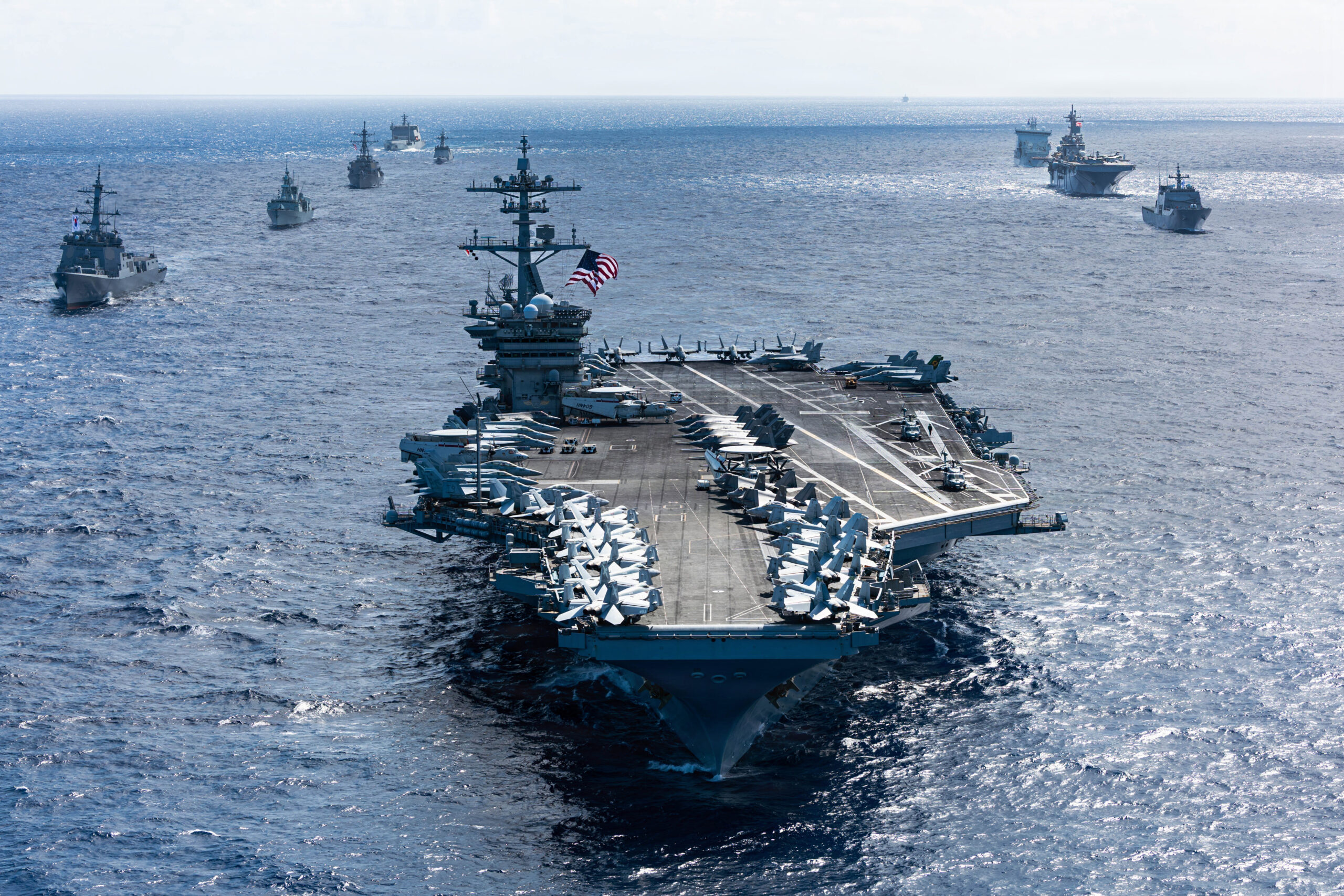
Recent diplomatic and military activities by the Chinese Communist Party (CCP) have shown that China is seeking to escalate nuclear threats in the Western Pacific, sparking a new round of nuclear arms race efforts. This has also compelled the United States to expedite the modernization of its triad nuclear forces to ensure strategic stability in the Pacific.
On July 6, 2026, in the South China Sea, a Type 094 nuclear submarine of the PLA Navy launched an intercontinental ballistic missile towards the Pacific Ocean. The missile, carrying a simulated warhead, flew approximately 7,300 kilometers, crossing multiple sovereign nations and regions before landing in the South Pacific Nuclear-Free Zone.
It is speculated that the missile launched was likely a modernized JL-3 intercontinental ballistic missile, showcasing China’s expanding sea-based nuclear strike capabilities. This marked the first time China had launched a submarine-launched ballistic missile into international waters. The timing of this test, just ahead of the joint China-Russia naval exercises and the NATO summit, carried clear provocative implications.
According to analysis by the International Institute for Strategic Studies (IISS), the range of the JL-3 missile enables Type 094 nuclear submarines to threaten the continental United States from their South China Sea area without needing to traverse the first island chain. This extension of sea-based delivery capabilities disrupts the relative nuclear posture balance maintained for decades and heightens US and allied concerns over strategic balance in the Western Pacific.
Additionally, during Chinese leader Xi Jinping’s visit to Pyongyang, both China and North Korea publicly omitted any mention of “denuclearization of the Korean Peninsula,” a sharp contrast to 2019. Xi Jinping’s focus during this visit was on strengthening strategic cooperation with North Korea and countering the United States, rather than promoting North Korea’s denuclearization.
On the day before Xi Jinping’s arrival in Pyongyang, Kim Yong-chol publicly stated that North Korea’s nuclear status was “irreversible” and rejected any demands for denuclearization. In this context, Xi Jinping’s visit to Pyongyang and the subsequent joint statements made by China and North Korea made no mention at all of denuclearization. This seemingly indicates that China has tacitly accepted North Korea’s nuclear status quo.
This significant policy shift by the CCP on the issue of denuclearization of the Korean Peninsula encourages North Korea to become a key strategic buffer against the United States. China’s deliberate silence and even tacit approval at the highest decision-making level regarding nuclear weapons expansion and regional nuclear proliferation issues are substantially escalating the nuclear threat posture across the entire Western Pacific region.
The Type 094 nuclear submarine is one of the PLA Navy’s missile submarines with high noise levels, distinct acoustic characteristics, and significant technological disadvantages in quiet cruising abilities. Such a submarine launching a ballistic missile with a range of up to 10,000 kilometers into the Pacific Nuclear-Free Zone, flying over northern Luzon, Japan, Palau, the Northern Mariana Islands, the Marshall Islands, and Micronesia, with the target near Fiji, has been described by Western powers as “alarming,” with the crisis being a cause for serious US and allied concerns.
Through this live missile launch, the Chinese authorities have demonstrated to the world that their sea-based nuclear power now possesses strategic projection capabilities. Analysis by the Center for Strategic and International Studies (CSIS) views this direct firing of strategic nuclear missiles into international waters as breaking established norms among major powers and long-standing international understandings. China’s move serves as a signal to the United States that China’s sea-based nuclear retaliatory capabilities are no longer confined to coastal defense but can now threaten the North American continent.
Of concern to the West is not only China’s efforts to perfect its nuclear triad but also its significant enhancement of its status as a nuclear power. In recent years, China has rapidly increased its arsenal to approximately 600 nuclear warheads, with projections to reach around 1000 warheads by 2030 and possibly further increase to 1500.
US commentators believe that China’s urgent expansion of its nuclear capabilities, despite the high noise levels and distinct acoustic characteristics of its nuclear submarines, as well as the significantly smaller size of its submarine fleet compared to the US, demonstrates China’s willingness to integrate these technically disadvantaged submarines into its nuclear triad and eager to showcase its ability to launch submarine-launched intercontinental ballistic missiles, all in pursuit of achieving what they call military dominance at all costs.
The US Department of Defense has repeatedly issued warnings in its recent China Military Reports highlighting the lack of transparency in China’s nuclear policies, strategies, and power development, making it increasingly challenging for outsiders to assess its capabilities and intentions. This significantly complicates strategic uncertainties.
In contrast, the United States is accelerating the construction of the more advanced Columbia-class nuclear-powered submarines to replace the Ohio-class submarines. As a representative of the upgrading sea-based nuclear power, the Columbia-class nuclear submarine will assume the US’s future sea-based nuclear deterrence mission for decades to come. It is the stealthiest and most difficult to track and destroy component of the nuclear triad. The submarine is expected to be formally commissioned for patrol duties between 2030 and 2031. The significance of this timeline lies in maintaining continual strategic deterrence against both China and Russia.
The Columbia-class submarine will be equipped with advanced technologies such as X-shaped rudders, all-electric propulsion systems, new nuclear reactors, and extremely low acoustic signatures to ensure its ability to deliver devastating strikes on enemy targets in any ocean, shattering any illusions hostile countries may have about launching nuclear attacks. Compared to China’s Type 094 submarines, the Columbia-class possesses an absolute advantage in silent technologies and underwater survival capabilities, ensuring US dominance in secondary nuclear retaliation. The prioritization of this project by the US Navy directly responds to the increasingly challenging security environment in the Western Pacific.
Additionally, the United States places great importance on another branch of its triad, the air-based nuclear strike force, represented by the B-21 bomber. The Pentagon is pushing to accelerate the B-21 bomber program, which features unprecedented stealth capabilities and advanced propulsion management systems, enabling it to survive in highly contested environments and carry advanced precision strike weapons outside enemy air defense zones.
The combination of aircraft penetrative capabilities and long-range precision strike capabilities makes this air force a key player in maintaining strategic balance. As of now, the B-21 program is progressing smoothly.
In the realm of land-based intercontinental ballistic missiles, the Pentagon is comprehensively advancing the Sentinel project, which aims to replace the aging Minuteman III system. The strategic importance of the Sentinel system is irreplaceable. The Pentagon is restructuring the Sentinel intercontinental ballistic missile program to ensure its progress and achieve rapid combat deployment. The Sentinel system utilizes modular design and advanced guidance technology, providing unmatched speed of response and precision strike capability.
This will ensure the US has the most reliable and robust land-based counterattack option in the event of a sudden nuclear crisis or preemptive enemy strikes.
One of the crucial reasons the US is hastening the comprehensive triad modernization is to establish new nuclear deterrence against both China and Russia. The fact that China test-launched an intercontinental ballistic missile from a submarine underscores the realistic necessity of the US government’s proactive measures.
China’s firing of an intercontinental missile carrying a simulated nuclear warhead into the South Pacific Nuclear-Free Zone also violates the basic spirit of the Non-Proliferation Treaty. Such unilateral actions lacking prior notification, transparency, and with clear military provocations damage strategic mutual trust among neighboring countries. This will lead to an even more fragile nuclear deterrence balance in the Pacific region.
The international community has long denied North Korea’s nuclear status, and China’s tacit acceptance of North Korea’s nuclear status at the diplomatic level further alters the security balance in Northeast Asia. For years, denuclearization of the Korean Peninsula has been an international consensus and a rare basis for cooperation between China and the US in regional security affairs. The intentional omission of this consensus in China-North Korea statements implies China is trying to portray North Korea with nuclear weapons as a force to counter the United States and its regional allies, making achieving denuclearization of the Korean Peninsula even more complex and objectively increasing the costs and risks of US involvement in Pacific affairs.
The CCP is attempting to change the existing international strategic framework and security order, viewing nuclear power as a tool to drive regional strategic realignment. China is disrupting the nuclear deterrence balance in the Pacific, making a new round of nuclear arms race seemingly inevitable. However, it is undeniable that the US has always maintained the upper hand.